Facts
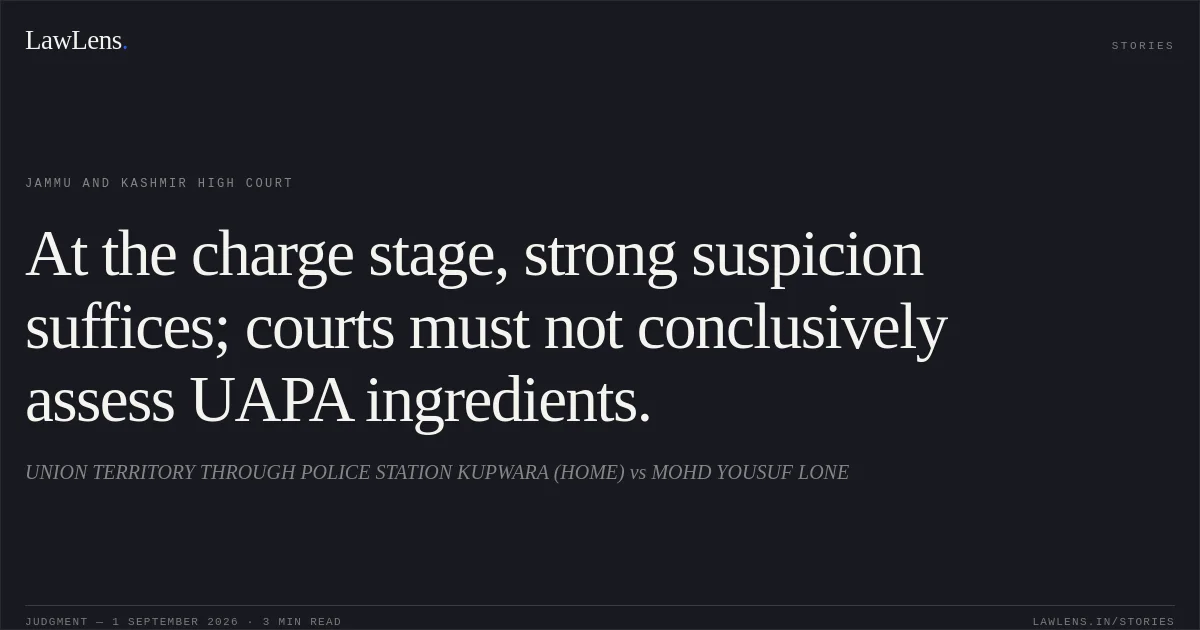
On 8 November 2013, police received information that a procession led by Syed Ali Shah Geelani and respondent Mohd Yousuf Lone had raised allegedly anti-national and secessionist slogans, incited the public, and pelted stones at security forces in Kupwara.
Source reference: p.3, para. 6FIR No. 279/2013 was registered under Sections 148, 336, 171-C and 171-F RPC and Section 13 of the UAPA.
Source reference: p.3, para. 6After investigation and sanction under the UAPA, a charge-sheet was filed.
Source reference: p.1, para. 1The Special Court discharged the respondent from the offences under Section 13 UAPA and Sections 171-C and 171-F RPC, while transferring the matter to the Sub-Judge for proceedings concerning Sections 147 and 336 RPC.
Source reference: p.1, para. 1; p.3, para. 6The State challenged the discharge order.
Source reference: no citationThe High Court first condoned a delay of 57 days in filing the appeal, after applying the limitation framework under Section 21(5) of the NIA Act.
Source reference: p.2, paras. 2–4Issues
Whether the delay in filing the appeal against the Special Court’s order was liable to be condoned under Section 21(5) of the NIA Act.
Source reference: p.2, paras. 2–4Whether the material in the charge-sheet disclosed a prima facie or grave suspicion of the respondent’s commission of an offence under Section 13 UAPA read with Section 2(o) UAPA, warranting framing of charge rather than discharge.
Source reference: pp.9–11, paras. 18–22Whether the Special Court erred by conclusively determining the absence of the ingredients of “unlawful activity” at the stage of discharge, without adequately examining the prosecution material.
Source reference: pp.9–11, paras. 18–22Law Applied
Section 21(5) of the NIA Act requires an appeal against a non-interlocutory order of a Special Court to be filed within 30 days, permits condonation for a further period of 30 days upon sufficient cause, and bars entertainment of an appeal after 90 days.
Source reference: p.2, para. 2Sections 227 and 228 CrPC distinguish between discharge and framing of charge: discharge is appropriate where there is insufficient ground to proceed, whereas charge is framed where there is ground for presuming that the accused committed the offence.
Source reference: pp.5–6, paras. 10–11At the charge stage, the court must not conduct a mini-trial or finally assess the truth and weight of the evidence; grave suspicion based on the prosecution material is sufficient to proceed, while discharge is justified where the material raises only a mere suspicion.
Source reference: pp.6–9, paras. 11–17These principles were drawn from State of Bihar v. Ramesh Singh, (1977) 4 SCC 39; Union of India v. Prafulla Kumar Samal, (1979) 3 SCC 4; Sajjan Kumar v. CBI, (2010) 9 SCC 368; Asim Shariff v. NIA, (2019) 7 SCC 148; M.E. Shivalingamurthy v. CBI, 2020 (2) SCC 768; State of Orissa v. Debendra Nath Padhi, (2005) 1 SCC 568; and Vijayan v. State of Kerala, (2010) 2 SCC 398.
Source reference: pp.6–9, paras. 11–17Section 2(o) UAPA defines “unlawful activity” to include acts, words, signs or representations intended to support the cession of Indian territory, incite such cession, or question or disrupt India’s sovereignty and territorial integrity; Section 13 penalises such unlawful activity.
Source reference: p.10, para. 20Reasoning
The High Court held that the Special Court correctly stated the applicable discharge principles but failed to apply them.
Source reference: p.10, para. 19The prosecution material alleged that the respondent led a mob with a separatist leader, raised slogans advocating secession, incited the public against India’s sovereignty and territorial integrity, and participated in conduct followed by violence against security forces.
Source reference: p.10, para. 19On a prima facie assessment, these allegations, together with the recorded slogans, witness statements, site plan and other charge-sheet material, were capable of satisfying the statutory concept of “unlawful activity” under Section 2(o) UAPA.
Source reference: pp.10–11, paras. 20–22By holding conclusively that the ingredients of Section 2(o) were not fulfilled, the Special Court effectively undertook an assessment appropriate to the trial stage rather than determining whether the material generated grave suspicion sufficient to frame a charge.
Source reference: pp.9–11, paras. 18, 21The High Court emphasised that it was not deciding the respondent’s guilt, but only whether the case should proceed to trial.
Source reference: p.11, para. 23Holding
The delay of 57 days was condoned under Section 21(5) of the NIA Act.
The appeal was allowed, and the Special Court’s order dated 3 January 2025 was set aside.
Source reference: p.12, paras. 24–26The charge-sheet was restored, and the Trial Court was directed to reconsider framing of charges against the respondent afresh, after examining the prosecution material, hearing both sides, and passing a reasoned order in accordance with law.
Source reference: p.12, paras. 24–26The High Court expressly left the respondent’s guilt or innocence and the ultimate merits of the prosecution case open for determination at trial.
Source reference: p.11, para. 23Acts & Sections Cited
7 provisions across 3 statutes referred to in this judgment. Each provision opens on LawLens.
National Investigation Agency Act, 20081
Unlawful Activities (Prevention) Act, 19673
Code of Criminal Procedure, 19733
Original Court PDF
UNION TERRITORY THROUGH POLICE STATION KUPWARA (HOME)vsMOHD YOUSUF LONE
Click to open original judgment
Original judgment, available to read, download and summarize on LawLens.in
![A finding of malingering requires clear, cogent, and unambiguous medical evidence.. Dharmatma Singh vs General Manager, N E Rly. CAT - ['Allahabad']. LawLens](/stories/thumbnails/a-finding-of-malingering-requires-clear-cogent-and-unambiguous-medical-evidence-cceb7a3c818d4b65bebebcb59b5f7b08.webp)