Facts
The petitioners agreed to purchase an apartment from the respondents under an Agreement to Sell dated 23 October 2013 for ₹1,81,32,000, of which they paid ₹1,76,07,633.
Source reference: paras. 2–3, pp. 4–6They alleged that the respondents failed to complete the project and deliver the property free from litigation; they also relied on a subsequent gift deed concerning the apartment.
Source reference: paras. 2–3, pp. 4–6The agreement contained an arbitration clause.
Source reference: paras. 2–3, pp. 4–6After disputes arose, the petitioners issued a notice invoking arbitration under Section 21 of the Arbitration and Conciliation Act, 1996, on 3 October 2024.
Source reference: paras. 3–4, pp. 5–6The respondents did not respond, and the petitioners applied under Section 11(6) for appointment of an arbitrator.
Source reference: paras. 3–4, pp. 5–6Certain respondents objected that the claims were time-barred; respondent No. 8 submitted that no dispute subsisted between it and the petitioners.
Source reference: paras. 5–6, p. 6Issues
1. Whether the Court should decide at the Section 11(6) stage the respondents’ objection that the underlying claims are barred by limitation.
Source reference: paras. 7–9, pp. 7–82. Whether the existence and invocation of the arbitration clause, followed by the respondents’ failure to act on the invocation, warranted appointment of a sole arbitrator.
Source reference: para. 10, p. 8Law Applied
Section 11(6) of the Arbitration and Conciliation Act, 1996 provides for the appointment of an arbitrator where the agreed appointment procedure has not been followed.
Source reference: p. 7Section 21 concerns commencement of arbitral proceedings upon receipt of a request to refer the dispute to arbitration.
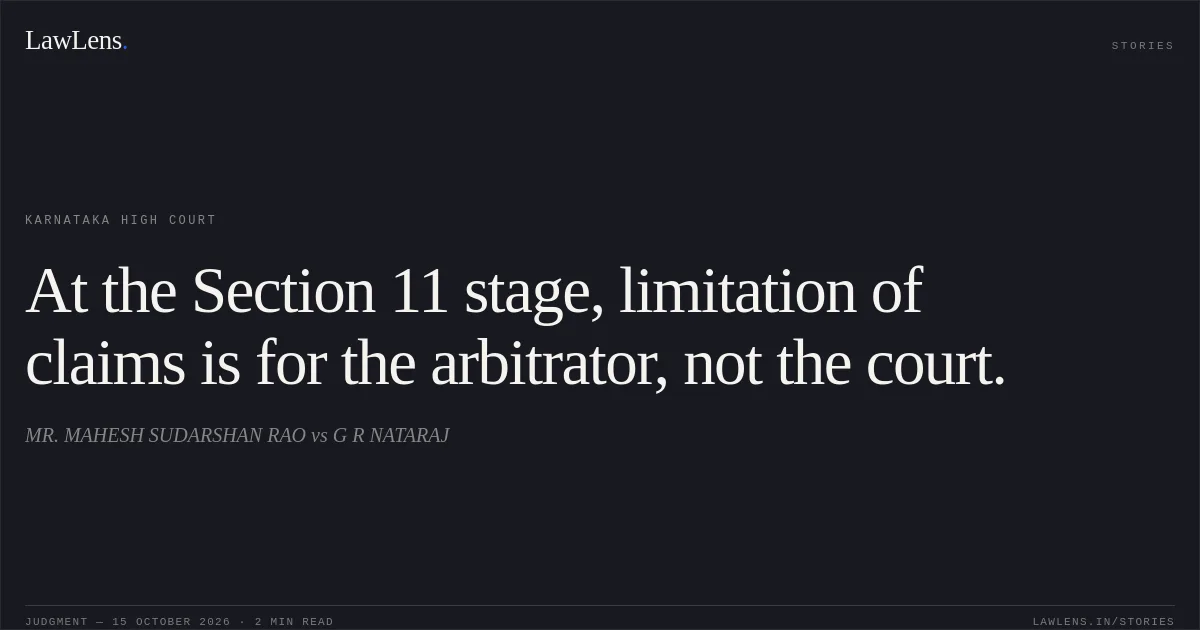
Source reference: paras. 3–4, pp. 5–6Relying on SBI General Insurance Company Limited v. Krish Spinning, (2024) 12 SCC 1, the Court stated that, at the Section 11 stage, it must consider whether the appointment petition was filed within three years; whether the substantive claims are time-barred is for the arbitrator to decide.
Source reference: para. 8, p. 7Reasoning
The Court found that the petitioners had invoked Clause 20 by notice dated 3 October 2024 and filed the Section 11 petition within three years of that invocation.
Source reference: para. 9, p. 8Accordingly, the objection that the underlying claims were time-barred was left open for the arbitrator rather than decided at the appointment stage.
Source reference: para. 9, p. 8The Court also found that an arbitration clause existed, had been invoked, and had not been acted upon by the respondents.
Source reference: para. 10, pp. 8–9It therefore referred the disputes to arbitration, leaving open respondent No. 8’s contention that no dispute subsisted, along with the parties’ other claims and contentions.
Source reference: para. 10, pp. 8–9Holding
The petition was allowed.
Hon’ble Mr. Justice C. R. Kumaraswamy, former Judge of the Karnataka High Court, was appointed as sole arbitrator, with the arbitration to be conducted at the Arbitration and Conciliation Centre (Domestic & International), Bengaluru, under its rules.
Source reference: para. 11, pp. 9–10All claims and contentions were left open, and the parties were directed to appear before the Centre’s Director on 11 November 2026 at 11:30 a.m.
Source reference: para. 11, pp. 9–10Acts & Sections Cited
2 provisions across 1 statute referred to in this judgment. Each provision opens on LawLens.
Arbitration and Conciliation Act, 19962
Original Court PDF
MR. MAHESH SUDARSHAN RAOvsG R NATARAJ
Click to open original judgment
Original judgment, available to read, download and summarize on LawLens.in


