01Facts
The dispute arose from the partition of ancestral agricultural land, which was already the subject of civil litigation.
¶ 2On 18.04.2026, the complainant Sanjeev Kumar and his brother Rajeev Kumar were allegedly assaulted near a dhaba at village Batta by several persons armed with lathis, gandasis and other weapons.
¶ 2A gandasi blow to Rajeev was attributed to petitioner No. 1, Salinder Kumar @ Sindi. The complainant also attributed an exhortation to kill to Narender and Surender.
¶ 2Both injured persons were medically examined on 18.04.2026. Radiological examination revealed fractures, and certain injuries were declared grievous.
¶ 3The medical record describes the injuries as caused by blunt force, and a later medical opinion (16.05.2026) stated they were not dangerous to life.
¶ 3 · ¶ 16Upon Crime Branch verification, Narender, Pankaj, Bahadur and Surender were excluded from the case.
¶ 4The police report was filed against eight accused, including the petitioners.
¶ 4The police added Sections 109(1), 117(2) and 61(2) BNS during investigation.
¶ 3The Additional Sessions Judge, Kaithal, framed charges by order dated 18.08.2026.
¶ 5The petitioners challenged the framing of charges under Sections 109(1), 117(2) and 61(2) BNS, corresponding to Sections 307, 325 and 120-B IPC, under Sections 438 and 442 BNSS.
¶ 1 · ¶ 502Issues
i.1. Whether the material collected during investigation, taken at face value, discloses the intention or knowledge required to frame a charge under Section 109(1) BNS (attempt to murder), or whether the acts fall only within voluntarily causing hurt or grievous hurt.
¶ 9 · ¶ 22ii.2. Whether the exclusion of the persons originally named for the exhortation to kill affects the prima facie foundation for the charge under Section 109(1) BNS.
¶ 19iii.3. Whether the charges under Sections 117(2) and 61(2) BNS, and the remaining charges, warrant interference in revision.
¶ 2303Law Applied
The court applied the principles on framing of charges from Union of India v. Prafulla Kumar Samal (1979) 3 SCC 4, as reiterated in Vishnu Kumar Shukla v. State of U.P. (Crl. A. No. 3618 of 2023), under which the court may sift material to determine a prima facie case.
¶ 10Charges must rest on grave suspicion, and a judge may not act as a post office for the prosecution or conduct a roving enquiry.
¶ 11The court applied Section 109(1) BNS (corresponding to Section 307 IPC), under which the intention or knowledge to commit murder is the sine qua non of the offence. The distinction from voluntarily causing grievous hurt lies in the mental element, not merely the degree of injury.
¶ 13 · ¶ 14Relying on Surender Kumar v. State of Haryana, 2026 SCC OnLine SC 191, the court held that the grievousness of an injury is not an indispensable ingredient of Section 307 IPC, and that the weapon, situs of injury, manner of assault and surrounding circumstances are relevant indicators of intention or knowledge.
¶ 15Section 239 BNSS empowers the trial court to alter or add charges at any stage based on evidence emerging during trial.
¶ 25Provisions in the judgment · 14 · Linked ones open on LawLens
Bharatiya Nagarik Suraksha Sanhita, 2023 Section 438Section 442Section 227Section 239
Bharatiya Nyaya Sanhita, 2023 Section 115Section 126Section 190Section 191Section 351Section 109Section 117Section 61
Indian Penal Code, 1860 Section 307Section 325
04Reasoning
The court held that the medical evidence, showing predominantly limb injuries, fractures from blunt force, and an opinion that injuries were not dangerous to life, is a relevant circumstance for assessing intention. It is not conclusive, however.
¶ 16 · ¶ 17The inquiry cannot rest on the anatomical location of injuries alone. It must examine whether the acts attributed to the accused, viewed with the whole occurrence, disclose intention to commit murder rather than a conjectural possibility of a more serious consequence.
¶ 18The exhortation to kill was attributed to Narender and Surender, who were excluded from the case. Their exclusion did not extinguish accusations against remaining accused or the doctrine of common object. However, the requisite intention still must find a prima facie basis in material concerning the persons actually sent up for trial.
¶ 19Although the land dispute, the armed group, and the investigation material (witness statements, recoveries, and electronic evidence) supported participation in an assault, participation alone does not equate to intention to murder.
¶ 20The impugned order recorded satisfaction without identifying the circumstances supporting the requisite intention. Brevity alone was not a ground for interference, but the satisfaction must rest on material disclosing the essential ingredients.
¶ 21Having regard to the nature and situs of the injuries, the acts attributed, and the exhortation, the court found that the intention or knowledge under Section 109(1) BNS was not prima facie discernible.
¶ 22As to Sections 117(2) and 61(2) BNS and the remaining charges, the court found no ground for interference and left the contentions open for the trial court.
¶ 2305Holding
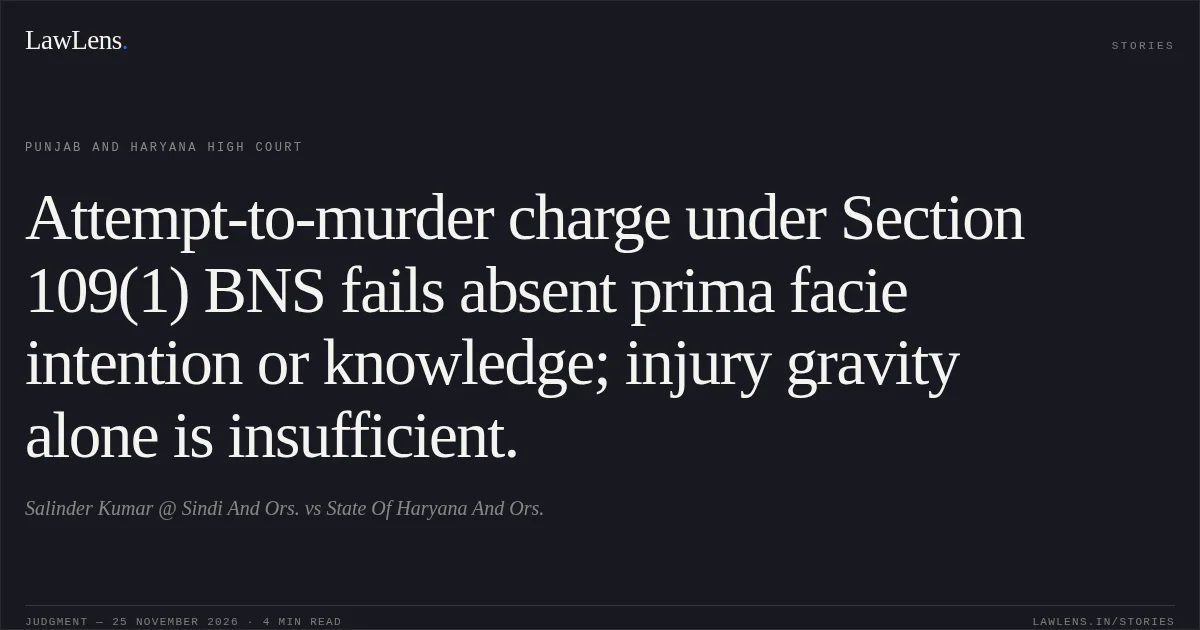
The requisite intention or knowledge under Section 109(1) BNS was not prima facie made out against the petitioners, and the acts fall within the scope of the material only insofar as participation in the assault is concerned.
¶ 22 · ¶ 24The court partly allowed the revision petition. The order dated 18.08.2026 was set aside as against the petitioners only to the extent of framing the charge under Section 109(1) BNS.
¶ 22 · ¶ 24The charges under Sections 117(2) and 61(2) BNS and the remaining charges stand undisturbed.
¶ 23 · ¶ 24The matter was remanded to the trial court for consequential orders. The order does not curtail the trial court's power under Section 239 BNSS to alter or add charges based on trial evidence, and it expresses no opinion on the merits.
¶ 24 · ¶ 25Pending applications, if any, were disposed of.
¶ 26Original Court PDF
Salinder Kumar @ Sindi And Ors.vsState Of Haryana And Ors.
Click to open original judgment
Original judgment, available to read, download and summarize on LawLens.in