Facts
The matter originated from Writ Petition No. 28456/2025 filed by Ashutosh Dixit alleging illegal mining by companies owned by the contemnor, Sanjay Satyendra Pathak.
Source reference: p. 1-2On 01.09.2025, the Single Judge recused himself, recording that Pathak had "made an attempt to call me to have discussion regarding this particular matter".
Source reference: p. 2Subsequently, in a separate writ seeking judicial cognizance of this interference, a Division Bench directed the Registry to register a suo motu criminal contempt petition on 02.04.2026.
Source reference: p. 3The contemnor filed an affidavit admitting to making the call and sending an introductory message but claimed the call was a "bonafide mistake," immediately disconnected, and was made without conversation.
Source reference: p. 3-4He tendered an unconditional apology, citing reverence for the judiciary.
Source reference: p. 4Issues
1. Whether the act of making a telephone call and sending a message to a presiding judge by a party interested in a pending litigation constitutes "criminal contempt" under Section 2(c) of the Contempt of Courts Act, 1971.
Source reference: p. 7-82. Whether the contemnor’s unconditional apology should be accepted in lieu of punishment under Sections 12 and 13 of the Act.
Source reference: p. 8-9Law Applied
The court primarily applied Section 2(c)(ii) and (iii) of the Contempt of Courts Act, 1971, which defines criminal contempt as acts that prejudice, interfere, or tend to interfere with the due course of judicial proceedings or the administration of justice.
Source reference: p. 7It utilized Section 12, which allows the court to discharge an accused or remit punishment upon an apology made to the "satisfaction of the court".
Source reference: p. 7-8Crucially, the court applied Section 13(a) (as amended in 2006), which mandates that no sentence shall be imposed unless the contempt "substantially interferes, or tends substantially to interfere with the due course of justice".
Source reference: p. 8Precedential secondary reliance was placed on O.P. Sharma v. High Court of Punjab and Haryana [p. 4-6] and In Re: N. Peddi Raju [p. 6], establishing that the majesty of law lies in forgiving those who acknowledge mistakes through bona fide apologies.
Source reference: p. 4-6, 6Reasoning
The court found that the fact of the contemnor making a call and sending a message to the Judge was established and admitted.
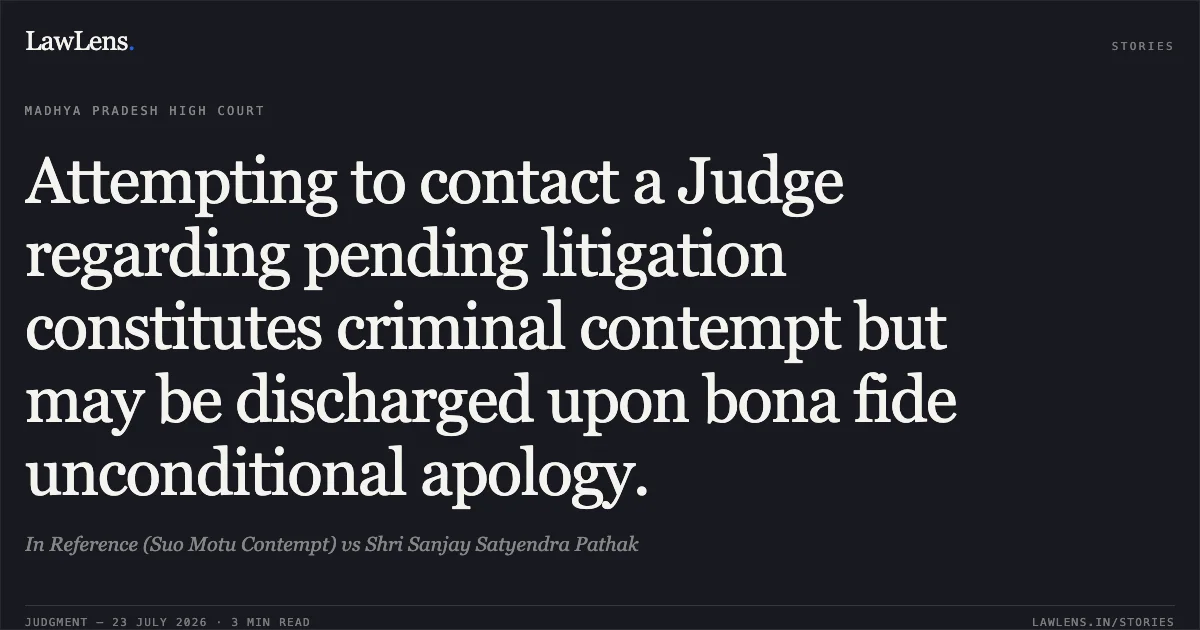
Source reference: p. 8-9The court reasoned that any attempt by a person connected to a case to contact the presiding judge—whether via call or message—falls squarely within the definition of criminal contempt as it tends to interfere with the administration of justice.
Source reference: p. 9However, in determining the sentence, the court evaluated the "nature" of the interference under Section 13. It noted that the call was disconnected and no actual conversation regarding the merits of the case took place.
Source reference: p. 8-9Applying the principle that the court should exercise restraint and show magnanimity where an acknowledgment of error is made, the court found that the act did not "substantially" interfere with the course of justice to a degree warranting imprisonment or fine.
Source reference: p. 9Holding
The court held that while the contemnor’s actions constituted criminal contempt, the gravity of the interference did not necessitate a custodial sentence or fine under Section 13 of the Act.
The court accepted Sanjay Satyendra Pathak’s unconditional apology; however, the court issued a stern "note of caution" and a formal warning to the contemnor—noting his status as a Member of the Legislature—to refrain from such conduct in the future and the contempt proceedings were accordingly closed.
Source reference: p. 9Acts & Sections Cited
3 provisions across 1 statute referred to in this judgment. Each provision opens on LawLens.
Contempt of Courts Act, 19713
Original Court PDF
In Reference (Suo Motu Contempt)vsShri Sanjay Satyendra Pathak
Click to open original judgment
Original judgment, available to read, download and summarize on LawLens.in


