Facts
The Respondent No. 1, a Police Sub-Inspector, seized the Complainant’s vehicle and phone on accusations of illegal rice transportation
Source reference: p. 2When the Complainant sought their return, a private person (Accused No. 3) allegedly demanded ₹50,000 on the Respondent’s behalf
Source reference: p. 3On 01.06.2023, the Respondent allegedly told the Complainant to "do something to these boys" (subordinates) while directing a Constable (Accused No. 2) to release the vehicle
Source reference: p. 4Accused No. 2 then demanded ₹5,000
Source reference: p. 4Following a trap where a bribe was recovered from Accused No. 4, an FIR was registered
Source reference: p. 5The High Court of Karnataka quashed the FIR on the grounds that there was no direct demand or acceptance by Respondent No. 1
Source reference: p. 6Issues
1. Whether the High Court exceeded its jurisdiction under Section 482 CrPC by conducting a "mini-trial" to quash an FIR at the investigation stage
Source reference: p. 13 / para 16-172. Whether an "attempt to obtain" undue advantage for "another person" through a third party constitutes an offence under Section 7(a) read with Explanation 2 of the Prevention of Corruption (PC) Act, 1988
Source reference: p. 15 / para 18-22Law Applied
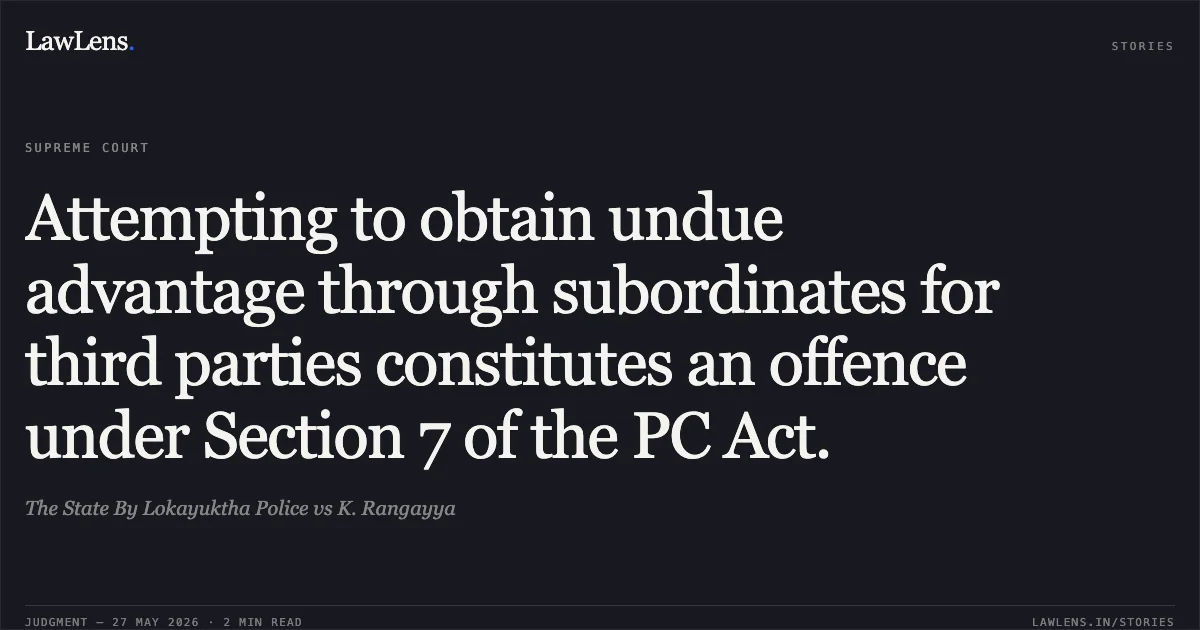
The Court applied Section 7(a) of the PC Act (as amended in 2018), which criminalizes a public servant who "obtains, accepts, or attempts to obtain" undue advantage with the intent to perform public duty improperly
Source reference: p. 15It emphasized Explanation 2 to Section 7, which clarifies that the advantage can be for "another person" and may be sought "directly or through a third party"
Source reference: p. 15Regarding quashing, the Court relied on the "face value" principle from State of Haryana v. Bhajan Lal and distinguished K. Shanthamma v. State of Telangana and Neeraj Dutta v. State (NCT of Delhi), noting they apply the "proof beyond reasonable doubt" standard post-trial, not at the FIR stage.
Source reference: p. 11, 13, 25, 28Reasoning
The Supreme Court observed that the High Court erred by sifting through evidence—such as the negative phenolphthalein test and departmental inquiry findings—matters strictly reserved for trial
Source reference: p. 14On merits, the Court interpreted Section 7(a) expansively, noting that the 2018 amendment and Explanation 2 cover scenarios where a senior official orchestrates bribery for subordinates
Source reference: p. 19-20The Respondent’s statement to "do something for those boys" followed by a subordinate’s specific monetary demand prima facie constituted an "attempt to obtain" an undue advantage for "another person"
Source reference: p. 20, 24The Court reasoned that requiring a direct, personal demand by the official would create a "perilous loophole" for senior officers to maintain deniability while directing corruption through intermediaries
Source reference: p. 21-22Holding
The Court allowed the appeal and set aside the High Court’s order, holding that the FIR prima facie disclosed a cognizable offence
The FIR and proceedings against Respondent No. 1 were revived and restored for trial
Source reference: p. 36The Court clarified that its observations are restricted to the prima facie stage and should not influence the final determination of guilt at trial
Source reference: p. 36Acts & Sections Cited
7 provisions across 3 statutes referred to in this judgment. Each provision opens on LawLens.
Prevention of Corruption Act, 19884
Code of Criminal Procedure, 19731
Indian Penal Code, 18602
Original Court PDF
The State By Lokayuktha PolicevsK. Rangayya
Click to open original judgment
Original judgment, available to read, download and summarize on LawLens.in