Facts
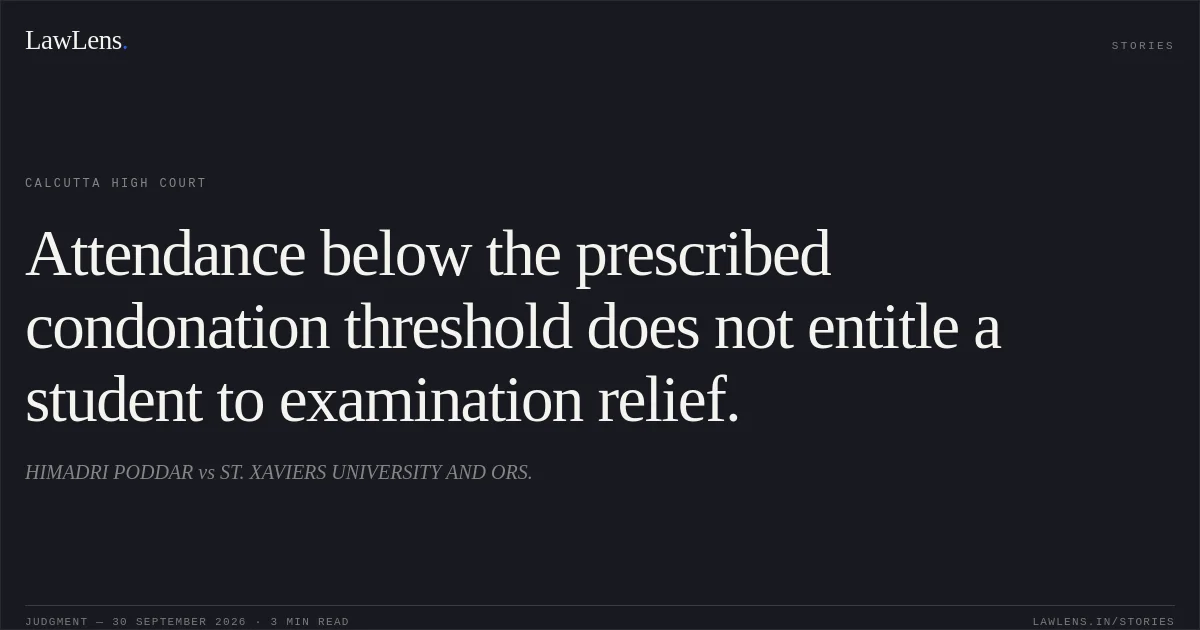
The petitioner, a B.Com. LL.B. student, was debarred from the sixth-semester examination because her recorded attendance was 61.57%, below the 65% minimum for consideration of condonation and the general 75% attendance requirement.
Source reference: para. 16–18, 23She sought condonation, relying on her brother’s serious illness, her own health issues, and an alleged error in recording attendance for a subject.
Source reference: para. 16–18, 23The University declined her request, citing the attendance rules and late submission of the medical application and certificates.
Source reference: para. 16–18, 23During the writ proceedings, the Court permitted her, on an interim basis and without creating equity, to enter later semesters and take examinations.
Source reference: para. 5; para. 3The petitioner sought, among other relief, permission to take the sixth-semester examination as arrear papers and publication of later-semester results.
Source reference: para. 2Issues
1. Whether the University’s refusal to condone the petitioner’s attendance shortage was arbitrary or contrary to its attendance regulations, including in light of its treatment of other students.
Source reference: para. 12–15, 17, 232. Whether the petitioner’s stated grounds—her brother’s illness, her own illness, and the alleged attendance-recording error—justified condonation or other relief.
Source reference: para. 16–223. Whether the petitioner was entitled to have her later-semester examination results published despite the sixth-semester attendance shortfall.
Source reference: para. 16; para. 24Law Applied
Under Regulations 3.4.1–3.4.3, a student must ordinarily maintain 75% aggregate attendance; for B.A.-LL.B. and B.Com.-LL.B. students, attendance between 65% and 74% may be considered for condonation on specified grounds, subject to the applicable conditions, while attendance below the prescribed lower limit does not qualify for condonation under Regulation 3.4.2.
Source reference: para. 13Regulation 3.4.2(a) requires a timely leave application and medical certificate for illness, while Regulation 3.4.2(b) provides for prior written confirmation and Dean-authorised condonation for extracurricular activities.
Source reference: para. 13The Court treated a delay in submitting a medical application or certificate as not necessarily fatal where illness is supported by a medical certificate, but distinguished illness from extracurricular participation, for which prior written approval is specifically required.
Source reference: para. 19It also relied on the principle, reflected in University of Calcutta v. Amit Jalan, that attendance requirements in legal education must be taken seriously and followed scrupulously.
Source reference: para. 7Reasoning
The Court found no sufficient basis to disturb the University’s decision.
Source reference: para. 24Although the University’s records were incomplete in some respects, the Court found substantial compliance in record-keeping and no specific, substantiated example of another student being improperly favoured that warranted further inquiry.
Source reference: para. 5The Court treated the single case of Bhavini Sinha, in which attendance had been calculated differently, as an exceptional instance that could not be used against the University.
Source reference: para. 14The Court considered that late medical documentation should not automatically defeat a genuine illness claim, but found that the petitioner’s account of missing classes because she was away for her brother’s treatment was undermined by attendance records showing that she was present at the University on the relevant days and attended some classes while missing others.
Source reference: para. 19–20It further held that a relative’s illness was not a sufficient ground for condonation in the circumstances, that the petitioner’s throat infection did not establish an exceptional basis for relief, and that she had not proved the alleged attendance-recording error.
Source reference: para. 20–22Her recorded attendance also remained below the 65% threshold for consideration of condonation.
Source reference: para. 23Holding
The Court declined to grant condonation or the requested relief concerning the sixth-semester examination.
However, because the petitioner had been permitted provisionally to attend later semesters and sit examinations during the proceedings, it directed her to repeat the semester for which her attendance was inadequate and fulfil the attendance requirement; thereafter, the University was to publish the results of that and/or subsequent semesters, evaluate any unevaluated examination papers in the meantime, and issue her certificates and mark sheets without stigma or further prejudice.
Source reference: para. 24(i)–(v)Acts & Sections Cited
1 provisions across 1 statute referred to in this judgment. Each provision opens on LawLens.
St. Xavier's University, Kolkata Act, 20161
Original Court PDF
HIMADRI PODDARvsST. XAVIERS UNIVERSITY AND ORS.
Click to open original judgment
Original judgment, available to read, download and summarize on LawLens.in