01Facts
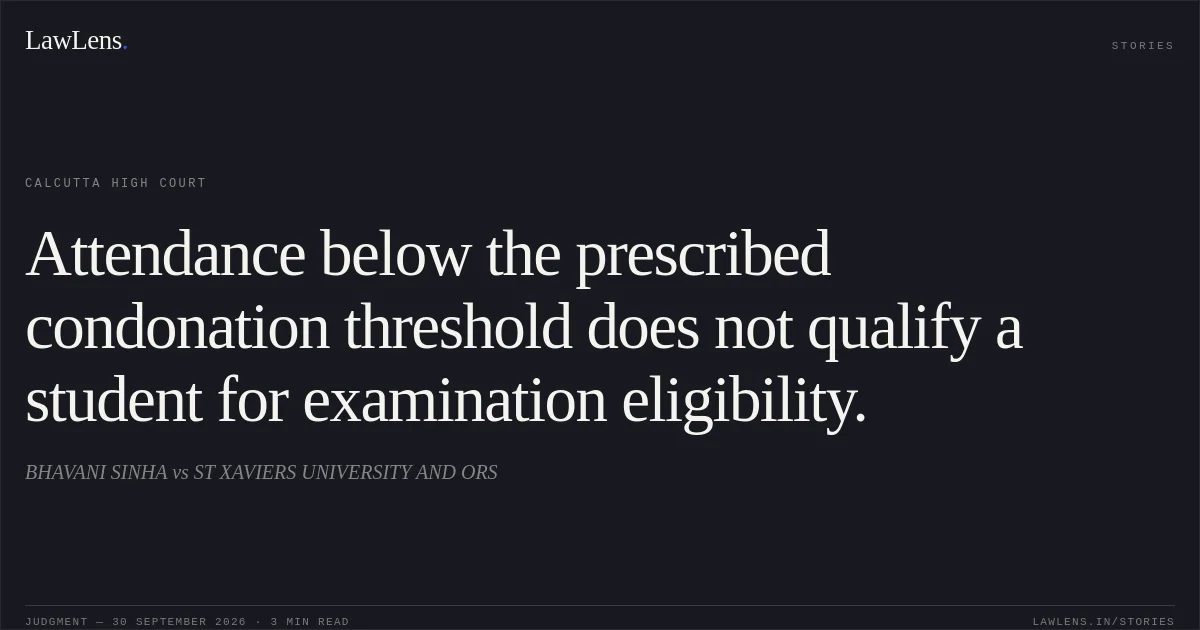
The petitioner, a B.A. LL.B. (Hons.) student, had 55.76% attendance in her sixth semester, below the University’s 75% requirement and the 65% threshold for consideration of condonation under its regulations.
¶ 16–17, 19–20, 24She sought condonation for absences attributed to illness and participation in University cultural events.
¶ 16–17, 19–20, 24The University declined to condone her attendance shortage, noting, among other things, that her medical documents were submitted late and that 15 classes had already been adjusted for her participation in Xavkala.
¶ 16–17, 19–20, 24Following an earlier order directing the University to consider her representation, the Vice-Chancellor rejected it by a reasoned order.
¶ 16–17, 19–20, 24During the present writ proceedings, the petitioner was permitted, without prejudice, to attend subsequent classes and sit examinations; the results were kept unpublished pending the outcome of the case.
¶ 16–17, 19–20, 2402Issues
i.1. Whether the University acted unlawfully or arbitrarily in refusing to condone the petitioner’s attendance shortage for illness and participation in extracurricular activities.
¶ 16–20ii.2. Whether the University’s attendance rules permitted condonation below the 65% threshold applicable to the petitioner’s course, or required a different calculation of her aggregate attendance.
¶ 12–15, 22–23iii.3. Whether the petitioner was entitled to retain the benefit of attending subsequent semesters and taking examinations while her sixth-semester attendance remained deficient.
¶ 2403Law Applied
The University’s regulations, framed under Section 31(XVI) of the St. Xavier’s University, Kolkata Act, 2016, required 75% aggregate attendance; Regulation 3.4.2 allowed consideration of condonation for specified grounds only within the prescribed attendance range, with a 65% lower limit for B.A. LL.B. students, while Regulation 3.4.2(b) required prior written confirmation for extracurricular participation and Regulation 3.4.3 provided for debarment where attendance remained below the required level without condonation.
¶ 13, 15The Court applied the principle that a university must comply with its governing regulations and that courts should not direct an institution to act contrary to them; it also recognised that Article 226 review remains available where a student’s rights are prejudiced by erroneous or procedurally unfair treatment.
¶ 6–7, 11, 14The Court referred to University of Calcutta v. Amit Jalan on the importance of enforcing attendance requirements in legal education.
¶ 7Provisions in the judgment · 1 · Linked ones open on LawLens
St. Xavier's University, Kolkata Act, 2016 Section 31
04Reasoning
The Court found that the petitioner had not shown prior permission for all the extracurricular activities for which she claimed attendance credit; the University had adjusted 15 classes on the basis of a form signed by the relevant Professor-in-Charge and countersigned by the Dean.
¶ 20Although the Court considered a late medical application or certificate not necessarily fatal, the medical prescription did not state a diagnosis and did not justify intervention on the facts.
¶ 19, 21The Court also held that the apparent discrepancy between the student portal’s attendance view and the final attendance calculation did not outweigh the University’s final calculation under its rules.
¶ 22With attendance of 55.76%, the petitioner fell below the 65% threshold for consideration of condonation; the Court therefore found no basis to disturb the University’s decision.
¶ 2305Holding
The Court declined to grant the petitioner’s application to excuse her sixth-semester attendance shortage.
¶ 24However, because she had attended subsequent semesters and taken examinations under interim orders, it directed her to repeat the semester for which her attendance was inadequate and fulfil the attendance requirement.
¶ 24Thereafter, the University was to publish the results of that and/or subsequent semesters, evaluate any unevaluated examination papers in the meantime, attach no stigma or further prejudice to her for repeating the semester, and issue her certificates and other academic documents upon completion of the course.
¶ 24Original Court PDF
BHAVANI SINHAvsST XAVIERS UNIVERSITY AND ORS
Click to open original judgment
Original judgment, available to read, download and summarize on LawLens.in