Facts
Late T. Pullana Gupta died on 25 February 2005. The plaintiffs sought Letters of Administration with his Will dated 27 December 2004 annexed; the Will named V. Sethuraman as executor, but he died before giving evidence.
Source reference: pp. 3–6The plaintiffs examined both attesting witnesses. The defendants disputed the Will’s execution, the testator’s testamentary capacity, and its genuineness, relying on circumstances including the testator’s age and health, earlier Wills, the signatures, the date following the tsunami, and the Will’s dispositions. The suit was tried on the evidence of the plaintiffs’ witnesses and the defendants’ evidence.
Source reference: pp. 3–6; pp. 4, 11Issues
Whether the testator executed the Will dated 27 December 2004 voluntarily and while of sound disposing mind.
Source reference: p. 6, para. 7Whether the Will was duly attested and proved under Section 63 of the Indian Succession Act, 1925, and Section 68 of the Indian Evidence Act.
Source reference: p. 6, para. 7Whether the circumstances raised by the defendants were suspicious and, if so, whether the plaintiffs satisfactorily removed those suspicions.
Source reference: p. 7, para. 7Whether the plaintiffs were entitled to Letters of Administration with the Will annexed.
Source reference: p. 7, para. 7Law Applied
Under Section 63(c) of the Indian Succession Act, 1925, a Will must be attested by at least two witnesses in the manner prescribed; Section 68 of the Indian Evidence Act requires at least one attesting witness to be examined to prove a document required by law to be attested.
Source reference: p. 7, para. 8The propounder must establish due execution and attestation, the testator’s sound disposing state of mind, and understanding of the nature and effect of the disposition. Where genuine suspicious circumstances arise, the propounder bears the heavier burden of removing them and satisfying the Court’s conscience; conjectural suspicions need not be answered.
Source reference: p. 8, para. 8Registration of a Will is not compulsory, and non-registration alone does not invalidate it.
Source reference: p. 8, para. 9Reasoning
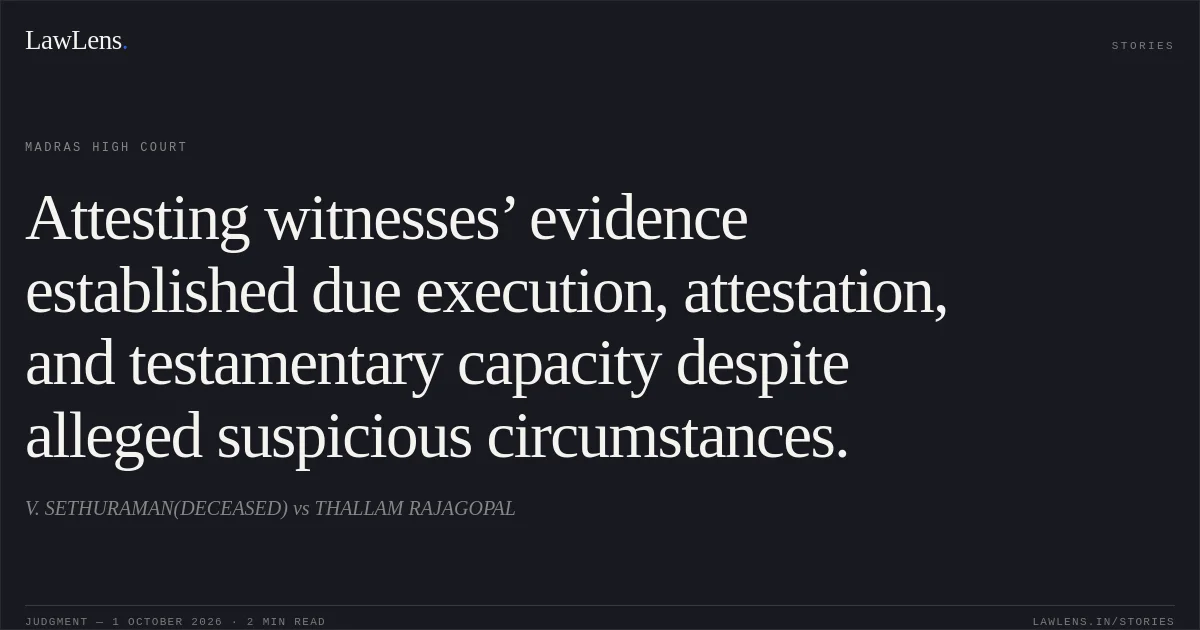
The Court considered the alleged suspicious circumstances cumulatively, but found that they did not outweigh the attesting witnesses’ evidence. Both witnesses spoke to the testator’s execution and their attestation; discrepancies concerned peripheral matters and did not undermine their participation in the execution.
Source reference: pp. 13–14, para. 18The testator’s age, questioned signatures, later use of a thumb impression, absence of medical evidence, non-examination of the scribe, unequal bequests, and the tsunami the day before the Will’s date were not, individually or cumulatively, sufficient to displace that evidence or establish incapacity or fabrication. The Court was satisfied that the testator acted voluntarily and had a sound disposing state of mind.
Source reference: pp. 10–17, paras. 12–23; p. 17, para. 23Holding
The Court held that the Will dated 27 December 2004 was duly executed and attested, and that the plaintiffs had proved their entitlement to Letters of Administration with the Will annexed.
The suit was decreed, subject to an administrative bond of Rs. 25,000 and compliance with statutory and procedural requirements. The plaintiffs were directed to file an inventory of the estate and a statement of accounts within six weeks of receiving the order; there was no order as to costs.
Source reference: p. 18, paras. 24–25Acts & Sections Cited
4 provisions across 1 statute referred to in this judgment. Each provision opens on LawLens.
Indian Succession Act, 19254
Original Court PDF
V. SETHURAMAN(DECEASED)vsTHALLAM RAJAGOPAL
Click to open original judgment
Original judgment, available to read, download and summarize on LawLens.in