Facts
The petitioners challenged aspects of the recruitment process for Van Rakshak, Kshetra Rakshak, Jail Prahri and other posts under the Combined Recruitment Test–2023.
Source reference: para. 1In W.P. Nos. 20051/2025 and 19946/2025, they sought production of the complete recruitment record, disclosure of their marks and merit position, and appointment against available posts.
Source reference: para. 1They also questioned the notification dated 7 March 2024, allegedly issued pursuant to an interim order in W.P. No. 18105/2021, contending that it was unconstitutional and inconsistent with the subsequent proceedings before the Supreme Court.
Source reference: para. 1In W.P. No. 44358/2025, the petitioner challenged the extent of 27% reservation for the Other Backward Classes category, sought its reduction to 14%, preparation of a fresh select list, and restraint against appointments under the impugned selection lists.
Source reference: para. 1The petitioners further asserted that their claims should be considered against the 87% posts filled on merit, based on their marks, and stated that their representations had not been decided.
Source reference: para. 2The State relied upon the decision in Youth for Quality v. State of Madhya Pradesh and Others, W.P. No. 18105/2021, and informed the Court that the connected Special Leave Petition (Civil) No. 8274/2025 had been dismissed by the Supreme Court.
Source reference: para. 3Issues
Whether the petitioners’ claims for selection or appointment against the 87% merit-based posts could be considered on the basis of their examination marks, notwithstanding the decision in Youth for Quality.
Source reference: paras. 2–4Whether the petitioners’ existing representations were sufficiently detailed and required consideration by the State authorities.
Source reference: para. 4Whether the Court should directly adjudicate the challenges to the recruitment notification, reservation percentage, and select lists at that stage.
Source reference: para. 1; para. 6Law Applied
The petitions were considered under Article 226 of the Constitution, which empowers the High Court to issue appropriate writs and directions for enforcement of legal rights.
Source reference: no citationThe Court applied the principle that a representation concerning a claim for selection or appointment must be considered by the competent authority in accordance with law, particularly where the claim is sought to be distinguished from an earlier binding or otherwise relevant decision.
Source reference: no citationThe Court also relied upon the earlier decision in Youth for Quality v. State of Madhya Pradesh and Others, W.P. No. 18105/2021, and noted the dismissal of SLP (Civil) No. 8274/2025 by the Supreme Court.
Source reference: para. 3However, the Court expressly refrained from deciding the merits of the petitioners’ claims or the validity of the reservation and recruitment arrangements.
Source reference: para. 6Reasoning
The Court noted that the petitioners’ principal surviving grievance concerned their possible consideration against the 87% merit-based vacancies on the basis of marks obtained in the examination.
Source reference: paras. 2–3Although the State relied on Youth for Quality and the dismissal of the related SLP, the Court held that the petitioners’ representations could still be examined to determine whether their individual cases were distinguishable from that precedent.
Source reference: para. 3Since the representations already submitted were not sufficiently descriptive, the Court granted liberty to the petitioners to file detailed representations explaining the distinguishing features of their claims.
Source reference: para. 4The Court did not undertake a substantive examination of the constitutional challenge to the 7 March 2024 notification, the 27% OBC reservation, or the select lists, and left those matters for consideration by the competent authority in accordance with law.
Source reference: paras. 1, 4–6Holding
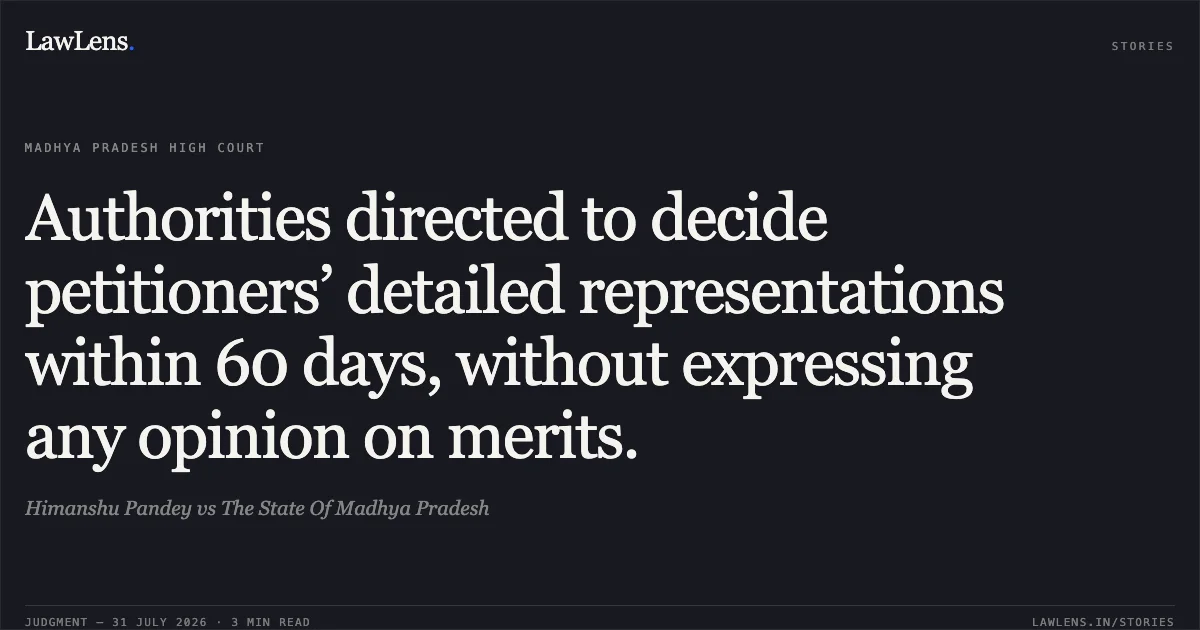
The Court disposed of all three writ petitions without expressing any opinion on their merits.
The petitioners were granted liberty to submit detailed representations concerning their claims, particularly their eligibility for selection or appointment against the 87% merit-based posts and the manner in which their cases differed from Youth for Quality.
Source reference: para. 4The competent authority was directed to consider such representations within 60 days in accordance with law.
Source reference: para. 5No direct direction for appointment, preparation of a fresh select list, invalidation of the notification, or alteration of the reservation percentage was issued.
Source reference: paras. 5–7Original Court PDF
Himanshu PandeyvsThe State Of Madhya Pradesh
Click to open original judgment
Original judgment, available to read, download and summarize on LawLens.in