01Facts
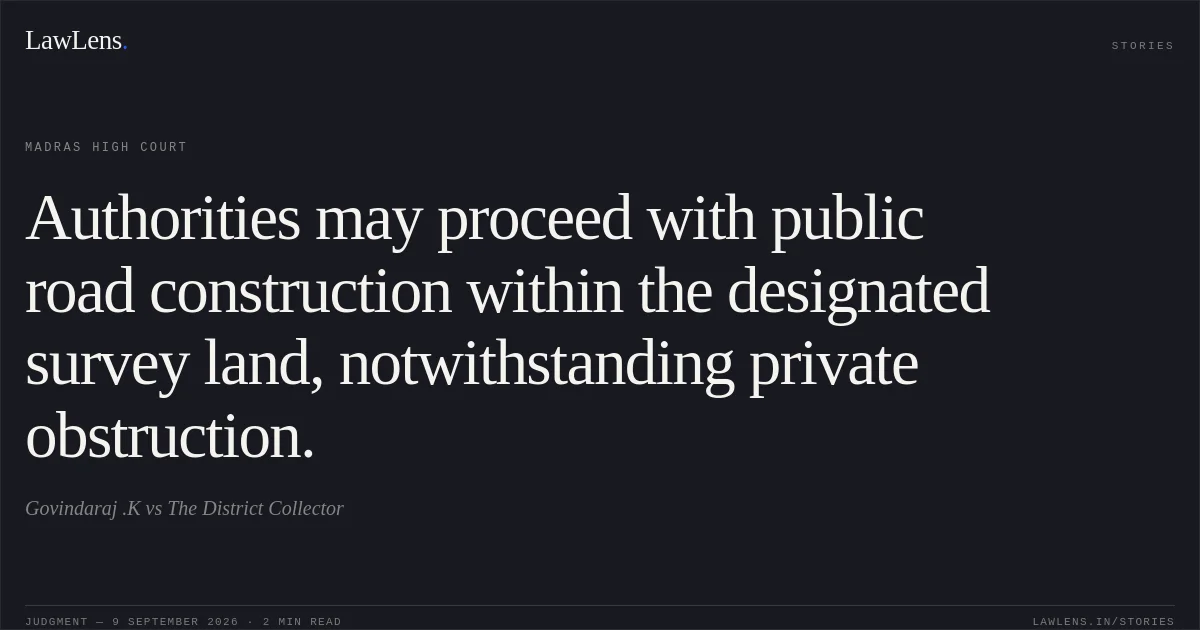
The petitioner filed a writ petition under Article 226 of the Constitution seeking a mandamus directing respondents 1 to 4—the District Collector, Tahsildar, Block Development Officer, and Village Panchayat President—to complete the laying of a road in a public pathway situated in Survey No.63/3, Arasathoor Village, Ramanathapuram District, pursuant to his representation dated 10.10.2023.
p. 2 · ¶ 1The petitioner asserted that the road was required by him and the village residents, but that the fifth respondent, who occupied land in Survey No.63/4, was obstructing the work.
p. 2 · ¶ 2The fifth respondent had instituted O.S.No.71 of 2023 before the District Munsif Court, Thiruvadanai; that suit was dismissed for default on 14.11.2024.
p. 2 · ¶ 2The Government clarified that the proposed road would be laid only in Survey No.63/3 and not in Survey No.63/4.
p. 3 · ¶ 302Issues
i.Whether the High Court should issue a mandamus directing the competent authorities to complete the road work in the public pathway situated in Survey No.63/3 pursuant to the petitioner’s representation?
p. 2 · ¶ 1 · p. 3 · ¶ 3ii.Whether the fifth respondent could obstruct the road work on the basis of his alleged occupation of or interest in Survey No.63/4, when the proposed road was confined to Survey No.63/3?
p. 2 · ¶ 2 · p. 3 · ¶ 303Law Applied
The Court exercised its writ jurisdiction under Article 226 of the Constitution of India to consider the petitioner’s claim for a writ of mandamus.
p. 2 · ¶ 1The governing principle is that mandamus may be issued to compel public authorities to perform a public or statutory duty where the entitlement to such performance is established.
p. 2 · ¶ 1The Court also applied the principle that a person claiming rights in one parcel of land cannot obstruct public work lawfully confined to a distinct survey number.
p. 3 · ¶ 3No specific statutory provision or judicial precedent was cited in the judgment; the decision turned on the authorities’ clarification regarding the precise survey number in which the road would be laid.
p. 2 · ¶ 1 · p. 3 · ¶ 304Reasoning
The Court noted that the petition concerned the completion of a public road in Survey No.63/3 and that the alleged obstruction arose from the fifth respondent’s occupation of Survey No.63/4.
p. 2 · ¶ 1–2Since the Government clarified that the road would be laid exclusively in Survey No.63/3, the Court found that the fifth respondent had no basis to obstruct the work on the ground that it affected Survey No.63/4.
p. 3 · ¶ 3The dismissal for default of O.S.No.71 of 2023 was also recorded as part of the procedural background.
p. 2 · ¶ 2On that basis, the Court directed the public authorities to proceed with the road work and treated the petitioner’s request as warranting appropriate mandamus relief.
p. 3 · ¶ 305Holding
The Court held that the fifth respondent should not obstruct the laying of the road because the work was confined to Survey No.63/3 and did not involve Survey No.63/4.
p. 3 · ¶ 3Respondents 1 to 4 were directed to proceed with and complete the road work in Survey No.63/3 within two months from the date of receipt of a copy of the order.
p. 3 · ¶ 3The writ petition was accordingly disposed of, with no order as to costs.
p. 3 · ¶ 3Original Court PDF
Govindaraj .KvsThe District Collector
Click to open original judgment
Original judgment, available to read, download and summarize on LawLens.in