Facts
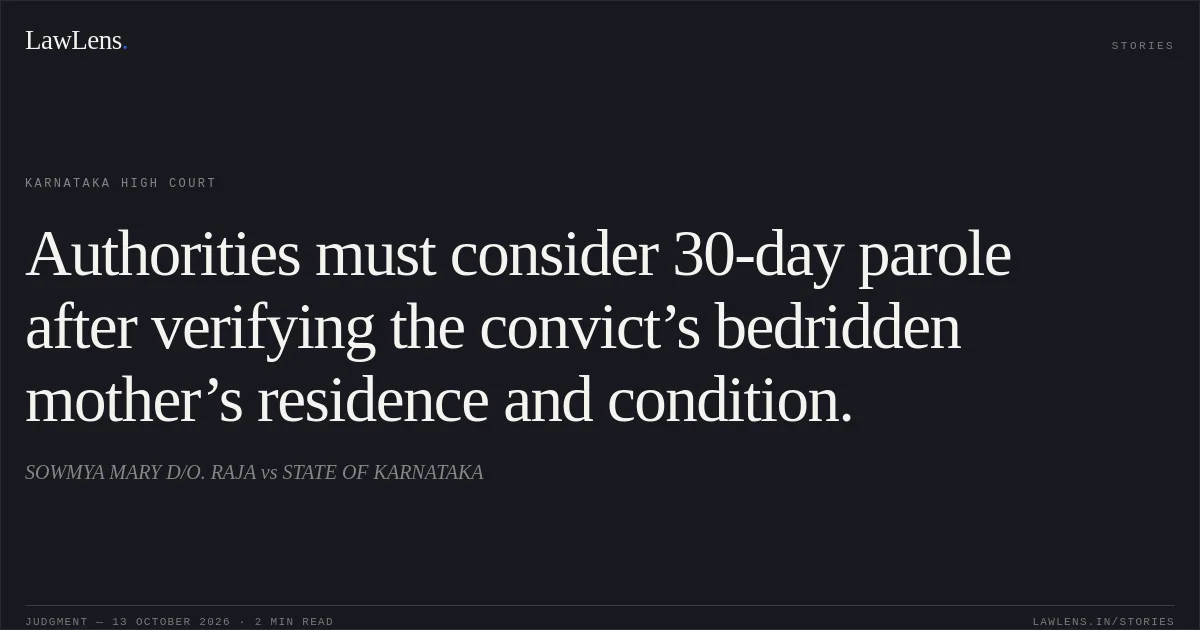
The petitioner, wife of convict Madhu @ Madhurnath, sought a direction for his release on general parole for 90 days so that he could attend to his 75-year-old, bedridden mother.
Source reference: p.2, paras. 1–2The convict had been sentenced to 30 years’ imprisonment for offences under Sections 302, 364 and 201 read with Section 34 of the IPC, had served 20 years, 2 months and 13 days, and had previously been granted 90 days’ parole, which he completed by surrendering on time
Source reference: p.2, paras. 1–2, 8The prison authority had indicated that he was eligible for general parole, with no adverse custody remarks.
Source reference: p.3, para. 3; p.5, para. 8The State opposed the request, including on the grounds that other family members existed and that the mother did not reside at the stated address. The petitioner provided an alternative address for verification.
Source reference: pp.3–5, paras. 4–6, 10–11Issues
Whether the petitioner was entitled to a direction requiring the prison authority to consider the convict’s request for parole to attend to his bedridden mother
Source reference: pp.2, 5, paras. 1–2, 8–9Whether the mother’s residence and medical condition should be verified before the parole request was decided, and what conditions should govern any parole granted
Source reference: pp.5–6, paras. 9–14Law Applied
The Court exercised its jurisdiction under Articles 226 and 227 of the Constitution, under which it may issue appropriate writs, orders or directions
Source reference: p.1In considering the request, the Court treated the convict’s parole eligibility, prior compliance, absence of adverse custody remarks, and the stated humanitarian ground as relevant factors
Source reference: pp.3, 5, paras. 3, 8–9It directed verification of the mother’s residence and condition and prescribed supervision and return-to-prison conditions for any parole granted
Source reference: pp.6–7, paras. 14(i)–(v)Reasoning
The Court considered the request reasonable in light of the mother’s alleged bedridden condition and the convict’s wish to be with her, together with his prior timely surrender and the absence of adverse custody remarks
Source reference: p.5, paras. 8–9The State’s concerns about the family’s residence were addressed by the petitioner’s provision of an alternative address. Rather than itself ordering the convict’s release, the Court required the prison authority to verify that address and the mother’s illness and then decide the application, subject to specified safeguards
Source reference: pp.5–7, paras. 10–15Holding
The petition was allowed.
The second respondent was directed to consider the petitioner’s application dated 24 March 2026 for 30 days’ parole, after verifying the mother’s residence and whether she was sick and bedridden.
Source reference: p.6, paras. 12–14Any parole granted was to be for 30 days from release, with weekly reporting to the jurisdictional police, no involvement in illegal or criminal activity, and return to prison by expiry; the authorities were to secure the convict’s return if conditions were breached and ensure his return when the period ended.
Source reference: pp.6–7, para. 14(i)–(v)The authority was directed to pass orders within 15 days of receiving the certified order.
Source reference: p.7, para. 15Acts & Sections Cited
4 provisions across 1 statute referred to in this judgment. Each provision opens on LawLens.
Indian Penal Code, 18604
Original Court PDF
SOWMYA MARY D/O. RAJAvsSTATE OF KARNATAKA
Click to open original judgment
Original judgment, available to read, download and summarize on LawLens.in