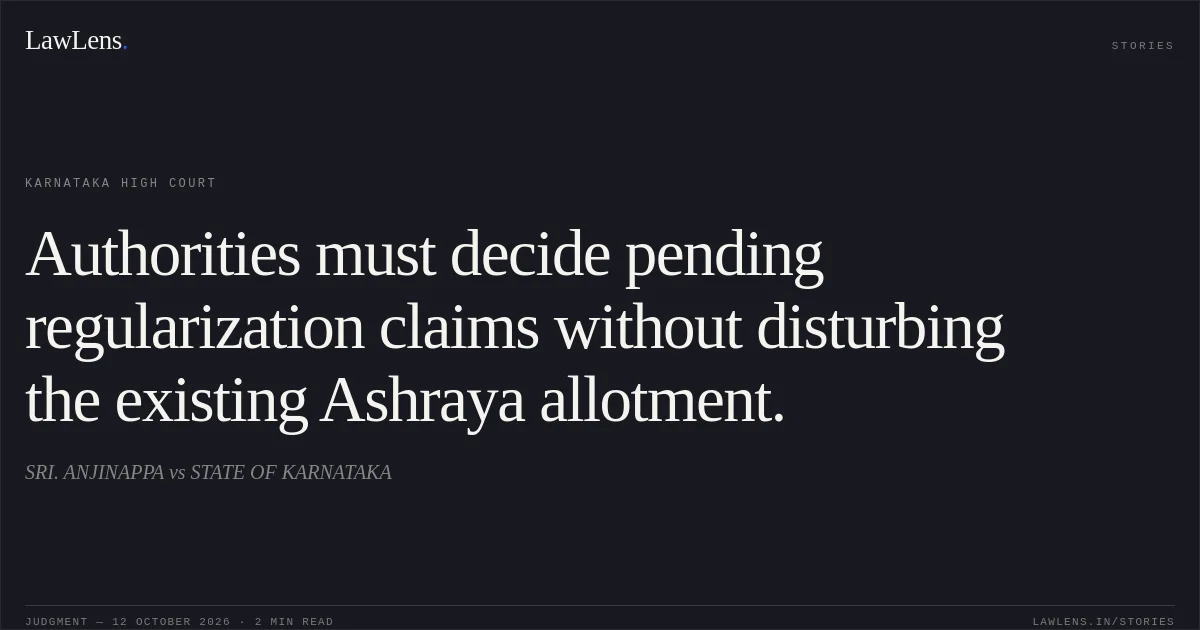
Facts
The petitioners sought regularization of their occupation of land in Sy. No. 198, Mahadeva Kodigehalli Village.
Source reference: no citationThey had earlier approached the High Court, which directed the authorities to place their applications before the competent committee for consideration within four months of its constitution and directed that possession be maintained status quo until the applications were decided
Source reference: para. 7Although the petitioners’ applications remained undecided, the Deputy Commissioner allotted the subject land to the Rajiv Gandhi Housing Board for construction under the Ashraya Scheme
Source reference: paras. 1, 4The petitioners challenged the 1999 order and subsequent 2023 orders.
Source reference: no citationThe State submitted that the petitioners had no right to claim the land, but that their claims could be considered in accordance with law
Source reference: paras. 1, 6The Housing Board stated that Sy. No. 198 comprised 404 acres 12 guntas, including 137 acres 06 guntas of Government land, and that land remained available for grant.
Source reference: para. 5Issues
1. Whether the Committee should be directed to decide the petitioners’ pending claims for regularization in accordance with the earlier court order
Source reference: paras. 7, 9–112. Whether the Court should interfere with the allotment of the subject land to the Housing Board under the Ashraya Scheme
Source reference: paras. 4–5, 13Law Applied
Articles 226 and 227 of the Constitution provide the basis for the writ petitions
Source reference: p. 3; p. 5The earlier order in W.P. Nos. 33219 and 33220 of 2009 required the competent committee to consider the petitioners’ applications within four months of its constitution and directed maintenance of status quo as to possession until disposal
Source reference: para. 7In W.P. No. 31099 of 2010, the Court held that reserving Government land for a public purpose, including the Ashraya Scheme, was not per se unlawful, and declined to grant mandamus or certiorari in that case
Source reference: para. 8Reasoning
The earlier direction required a decision on the petitioners’ applications, but the Committee had not acted despite the passage of considerable time
Source reference: paras. 9–10The Court therefore directed the Committee to decide the claims in accordance with law.
Source reference: no citationHowever, given the prior decision in W.P. No. 31099 of 2010 and the fact that the land had already been allotted to the Housing Board, the Court found no basis to interfere with that allotment
Source reference: para. 13The Housing Board’s statement that other land might be available justified directing the authorities to ascertain whether suitable vacant Government land could be considered for the petitioners
Source reference: para. 12Holding
The petitions were disposed of with a direction to the Committee to consider and decide the petitioners’ claims within two months of receiving a certified copy of the order
The Court declined to interfere with the allotment to the Housing Board, but left it open to the authorities to identify and consider available Government land, including land in Sy. No. 198, for the petitioners in accordance with law
Source reference: paras. 12–14Original Court PDF
SRI. ANJINAPPAvsSTATE OF KARNATAKA
Click to open original judgment
Original judgment, available to read, download and summarize on LawLens.in
![Excess-pay recovery from retired Group C employees is impermissible absent fraud or misrepresentation.. SATYA NAND YADAV vs NORTH EASTERN RAILWAY. CAT - ['Allahabad']. LawLens](/stories/thumbnails/excess-pay-recovery-from-retired-group-c-employees-is-impermissible-absent-fraud-or-misrep-c357cbdd195c44d68331385eea2a3c9a.webp)
![A different Tribunal Bench cannot adjudicate claims seeking implementation of another Bench’s order.. KAMLA DEVI vs NORTH CENTRAL RAILWAY. CAT - ['Allahabad']. LawLens](/stories/thumbnails/a-different-tribunal-bench-cannot-adjudicate-claims-seeking-implementation-of-another-benc-cca646896f904d429d1270d122130c8b.webp)