Facts
The petitioner filed a writ petition in the nature of public interest litigation under Article 226 of the Constitution, seeking prevention of alleged illegal sand/silt mining in Naalairamudiyarkulam, Survey No. 853/1, and Nathakulam ponds situated in Kandasamypuram Village, Thiruchendur Taluk, Thoothukudi District.
Source reference: p.2The petitioner alleged that private individuals were digging the ponds, thereby affecting their water-retention capacity and the local ecosystem.
Source reference: p.3Pursuant to the Court’s direction, the Tahsildar, Tiruchendur, submitted a report.
Source reference: p.3The report stated that permissions for removal of silt from water bodies were issued pursuant to the District Collector’s proceedings dated 15 July 2024, based on patta and adangal particulars and the dimensions of the agriculturists’ lands.
Source reference: pp.3–4The report recorded permissions concerning Nalayeramudayar Kulam and Nathakulam, totalling 115 applications and 13,169 cubic metres of permitted silt.
Source reference: p.3It further stated that transit passes were issued by the Water Resources Department, while agricultural officials monitored whether the removed material was transported to the permitted agricultural lands.
Source reference: p.4The authorities maintained that the removal of silt and clay did not damage the tank bunds, facilitated water storage for agricultural purposes, and was not being diverted to brick kilns, as there were no registered or unregistered brick manufacturing units in the taluk.
Source reference: p.4They also reported that, having regard to waterlogging, storage requirements, ecological considerations, and the pendency of the writ petition, no permission had been granted for quarrying or removing silt/clay from the two tanks in question thereafter.
Source reference: p.5Issues
1. Whether the respondents were required to prevent alleged illegal sand/silt mining and removal from Naalairamudiyarkulam and Nathakulam ponds in accordance with the Tamil Nadu Minor Mineral Concession Rules, 1959 and G.O.Ms.No.50 dated 27 April 2017.
Source reference: p.22. Whether the removal of silt/clay from the ponds, as monitored and regulated by the authorities, adversely affected the tanks’ water-storage capacity, bunds, or ecological balance.
Source reference: pp.3–53. Whether further directions were necessary to ensure the proper maintenance of the tanks and preservation of their ecological function.
Source reference: p.5Law Applied
The Court considered the Tamil Nadu Minor Mineral Concession Rules, 1959 and G.O.Ms.No.50 dated 27 April 2017, relied upon by the petitioner in challenging the alleged illegal extraction of sand/silt.
Source reference: p.2The Court also proceeded on the administrative framework described in the Tahsildar’s report, under which removal of silt was permitted on the basis of land records and the extent of agricultural land, with transit passes, measurement by Water Resources Department officials, and verification by agricultural officials.
Source reference: pp.3–4The governing principle applied was that removal of silt from public tanks must remain regulated and must not impair the tanks’ water-storage capacity, structural integrity, or ecological balance.
Source reference: p.5Reasoning
The Court examined the Tahsildar’s report rather than treating the petitioner’s allegation of illegal mining as established.
Source reference: pp.3–4The report indicated that any authorised removal was subject to permissions, quantity limits, transit passes, and monitoring by officials.
Source reference: pp.3–4It also stated that the activity did not damage the tank bunds and that removal of silt facilitated the storage of water for agricultural use.
Source reference: p.4The authorities further reported that no silt or clay was being diverted to brick kilns and that no permission had been granted for further removal from the two tanks in view of waterlogging, ecological considerations, and the pending litigation.
Source reference: p.5On that material, the Court did not find it necessary to issue a coercive direction to prohibit the activity altogether.
Source reference: p.5However, recognising the continuing public and ecological importance of the tanks, it directed that their maintenance and water-storage capacity be ensured in the future while maintaining ecological balance.
Source reference: p.5Holding
The Court held that the material placed before it showed regulated removal and monitoring of silt/clay, with no established illegality requiring the blanket relief sought by the petitioner.
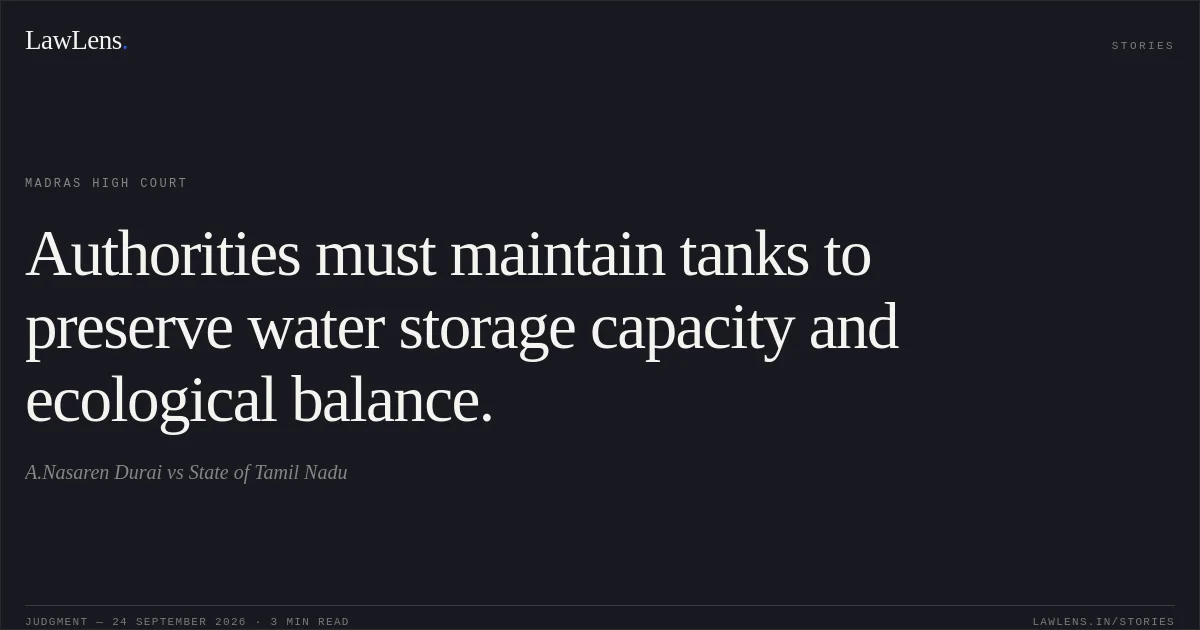
Nevertheless, it directed the authorities to ensure that Naalairamudiyarkulam and Nathakulam tanks were properly maintained in the future, that water-storage capacity was preserved, and that ecological balance was protected for the benefit of the public.
Source reference: p.5The writ petition was accordingly disposed of, the connected miscellaneous petition was closed, and there was no order as to costs.
Source reference: p.5Original Court PDF
A.Nasaren DuraivsState of Tamil Nadu
Click to open original judgment
Original judgment, available to read, download and summarize on LawLens.in