Facts
The petitioners in four connected writ petitions claimed leave encashment under the Chhattisgarh Work-Charged/Contingency Paid Employees Leave Rules, 1977.
Source reference: no citationThey approached the High Court seeking directions to the Public Works Department authorities to consider and process their claims.
Source reference: no citationThe petitioners relied upon the High Court’s decision in W.P.(S) No. 3870/2021, Faguvaram Patel & Others v. State of Chhattisgarh & Others, decided on 30 September 2022, where a similar claim was allowed.
Source reference: para. 3That decision was affirmed by the Division Bench in W.A. No. 119/2023, decided on 20 June 2023.
Source reference: para. 3Since the petitions involved identical issues, they were heard and disposed of by a common order.
Source reference: para. 1Issues
Whether the petitioners’ claims for leave encashment under the Chhattisgarh Work-Charged/Contingency Paid Employees Leave Rules, 1977 should be considered by the respondent authorities in light of the decision in Faguvaram Patel?
Source reference: para. 2–3Whether the High Court should direct the respondent authorities to process the claims of the petitioners and similarly placed persons within a prescribed time?
Source reference: para. 4Law Applied
The Court applied the Chhattisgarh Work-Charged/Contingency Paid Employees Leave Rules, 1977, which govern leave-related benefits, including leave encashment, for covered work-charged and contingency-paid employees.
Source reference: para. 2It relied upon the precedent in Faguvaram Patel & Others v. State of Chhattisgarh & Others, W.P.(S) No. 3870/2021, decided on 30 September 2022, concerning a similar claim for leave encashment; that decision had been affirmed in W.A. No. 119/2023 on 20 June 2023.
Source reference: para. 3The governing principle was that claims of similarly situated employees should be considered consistently in accordance with the applicable Rules and the binding precedent.
Source reference: no citationReasoning
The Court noted that the petitioners had raised claims identical to those considered in Faguvaram Patel, and that the earlier decision had attained greater precedential force after being affirmed by the Division Bench.
Source reference: para. 3Rather than adjudicating the individual entitlement to leave encashment at the writ stage, the Court directed the competent authorities to examine and process the claims of the petitioners and similarly placed persons in accordance with the applicable Rules and the earlier decisions.
Source reference: para. 4The Court accordingly considered a time-bound administrative determination appropriate.
Source reference: para. 4Holding
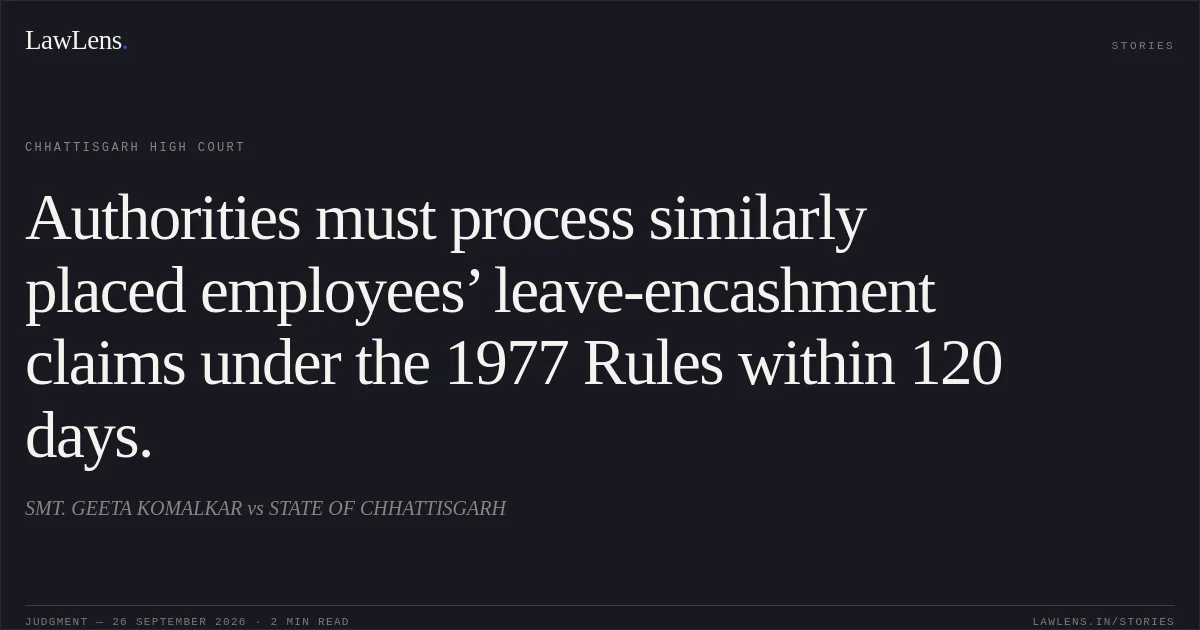
The writ petitions were disposed of with a direction to the respondent authorities to immediately process the petitioners’ claims, as well as the claims of similarly placed persons, in light of the decision in Faguvaram Patel and the applicable 1977 Rules.
The authorities were required to complete the process within an outer limit of 120 days from the date of receipt of a copy of the order.
Source reference: paras. 4–5The Court did not itself grant or quantify leave encashment, but directed consideration and processing of the claims in accordance with law.
Source reference: no citationOriginal Court PDF
SMT. GEETA KOMALKARvsSTATE OF CHHATTISGARH
Click to open original judgment
Original judgment, available to read, download and summarize on LawLens.in