Facts
The petitioner claimed to be a street vendor operating for several years from a footpath on Netaji Subhash Marg, near Link Road, City-SP Zone, Ward 84-N, New Delhi.
Source reference: p.1He possessed a provisional Certificate of Vending (CoV), URI No. 6576651, authorising vending under the category “Food/Snack with gas cylinder/fire” in City-SP Zone, Ward 84-N.
Source reference: p.1The petitioner alleged that officials of the Municipal Corporation of Delhi (MCD) and Delhi Police were harassing him and preventing him from vending peacefully.
Source reference: p.2The MCD informed the Court that Netaji Subhash Marg was a “No-vending zone”.
Source reference: p.2Relying on Malkit Singh v. State of U.T. Chandigarh, the petitioner sought protection of his livelihood and directions permitting him to vend from the site or providing a workable alternative vending location.
Source reference: pp.2–4Issues
Whether the petitioner, holding a provisional CoV, could be permitted to continue vending from the disputed site despite the site being situated in a “No-vending zone”.
Source reference: pp.2, 4–5Whether the MCD was required to assist the petitioner by identifying an appropriate alternative vending location within the permitted vending areas of the same zone.
Source reference: pp.3–4, 7What safeguards and conditions should govern the petitioner’s vending activity so as to protect public hygiene, pedestrian movement and traffic regulation.
Source reference: pp.5–7Law Applied
The Court exercised jurisdiction under Article 226 of the Constitution to protect the petitioner’s livelihood while regulating his vending activity.
Source reference: p.1It relied on the Supreme Court’s decision in Malkit Singh v. State of U.T. Chandigarh, SLP (C) No. 21349/2025, decided on 9 April 2026, which held that when vendors are displaced from existing locations, authorities must act with fairness and responsibility and, where designated vending zones exist, provide a lawful and workable alternative and assist in the transition.
Source reference: pp.2–4The Court also applied the Street Vendors (Protection of Livelihood and Regulation of Street Vending) Act, 2014, particularly the planning framework under Section 21, under which the directions remained subject to any plan formulated by the Town Vending Committee.
Source reference: p.7The petitioner was required to comply with the terms of his provisional CoV, including requirements relating to hygiene, non-obstruction, public health, prohibition on permanent or temporary structures, non-transferability and compliance with the Delhi Street Vendors Scheme, 2019.
Source reference: pp.5–6Reasoning
The Court accepted that the petitioner held a provisional CoV and was engaged in food vending, but also noted that the existing site was a “No-vending zone”.
Source reference: pp.1–2, 7Applying Malkit Singh, the Court held that displacement from such a location could not be undertaken without providing a practical alternative that enabled the vendor to continue earning a livelihood.
Source reference: pp.3–4At the same time, the petitioner’s right to vend was subject to regulatory conditions protecting pedestrian and vehicular movement, cleanliness, hygiene and public safety.
Source reference: pp.5–6Accordingly, the Court permitted the petitioner to operate with only a small gas cylinder, within a restricted space, without causing obstruction or traffic congestion, and with a dustbin maintained near the vending site.
Source reference: pp.5–6Condition No. 11 of the CoV, concerning the time limit applicable to mobile vendors, was expressly made inapplicable, while all other CoV conditions remained binding.
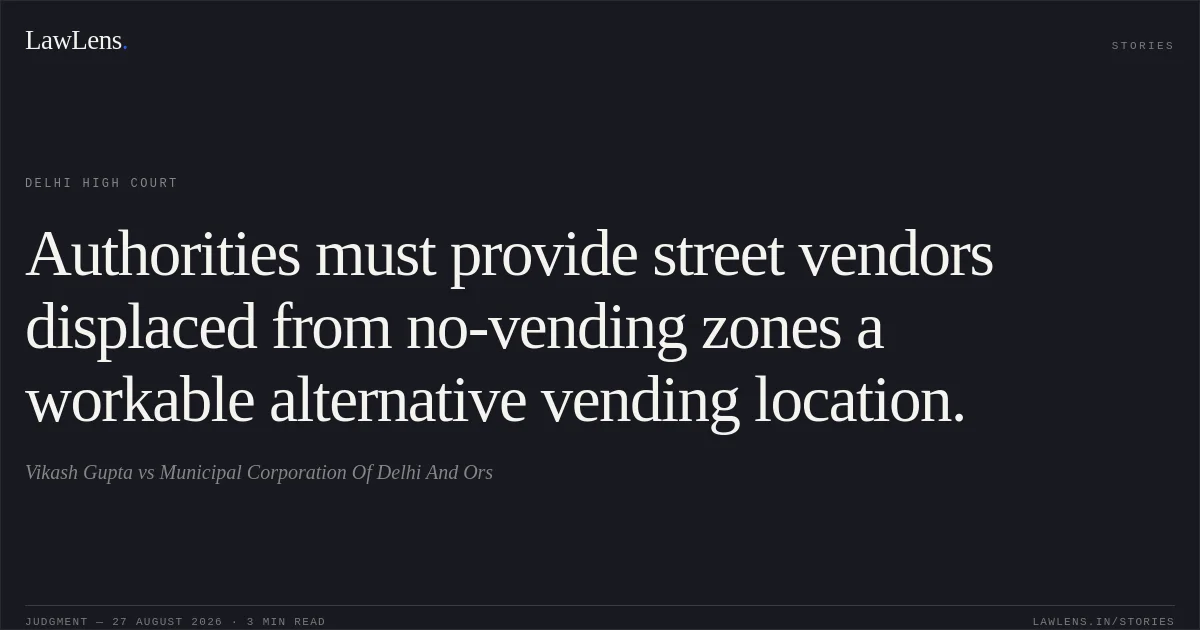
Source reference: p.6Since the site was a no-vending zone, the Assistant Commissioner, MCD was directed to identify an appropriate alternative location within the permitted vending areas of the same zone.
Source reference: p.7Holding
The petition was disposed of with directions protecting the petitioner’s ability to vend, subject to strict compliance with the provisional CoV and the additional safeguards imposed by the Court.
The petitioner was permitted to use only a small gas cylinder, vend from a limited space without obstructing pedestrians or traffic, maintain hygiene and provide a dustbin, and refrain from creating any third-party interest or erecting any permanent or temporary structure.
Source reference: pp.5–7Condition No. 11 of the CoV was excluded, but all other conditions remained applicable.
Source reference: p.6The Assistant Commissioner, MCD was directed to identify an alternative vending location for the petitioner within the permitted vending areas of the same zone within ten days.
Source reference: p.7These directions were made subject to any future plan of the Town Vending Committee under Section 21 of the 2014 Act, and no vested right was created in favour of the petitioner.
Source reference: p.7Acts & Sections Cited
1 provisions across 1 statute referred to in this judgment. Each provision opens on LawLens.
Street Vendors (Protection of Livelihood and Regulation of Street Vending) Act, 20141
Original Court PDF
Vikash GuptavsMunicipal Corporation Of Delhi And Ors
Click to open original judgment
Original judgment, available to read, download and summarize on LawLens.in
![Courts will not interfere with transfers absent mala fides or violation of statutory rules.. M Ramya vs EMPLOYEES STATE INSURANCE CORPORATION (ESIC). CAT - ['Chennai']. LawLens](/stories/thumbnails/courts-will-not-interfere-with-transfers-absent-mala-fides-or-violation-of-statutory-rules-a6845e9ca6f548fca284c51c8351957f.webp)
![Courts cannot direct one-time recruitment age relaxation absent authority in the governing rules or advertisement.. UT OF PUDUCHERRY vs M ANDAL. CAT - ['Chennai']. LawLens](/stories/thumbnails/courts-cannot-direct-one-time-recruitment-age-relaxation-absent-authority-in-the-governing-895d78fde47143e2a8ed0207c4b6a44f.webp)
![A review cannot correct an allegedly erroneous decision absent an error apparent on the record.. Ajit Kumar Jha vs RAILWAY BOARD. CAT - ['Delhi']. LawLens](/stories/thumbnails/a-review-cannot-correct-an-allegedly-erroneous-decision-absent-an-error-apparent-on-the-re-8ac952fd4eba470c92f7da20af72a220.webp)