Facts
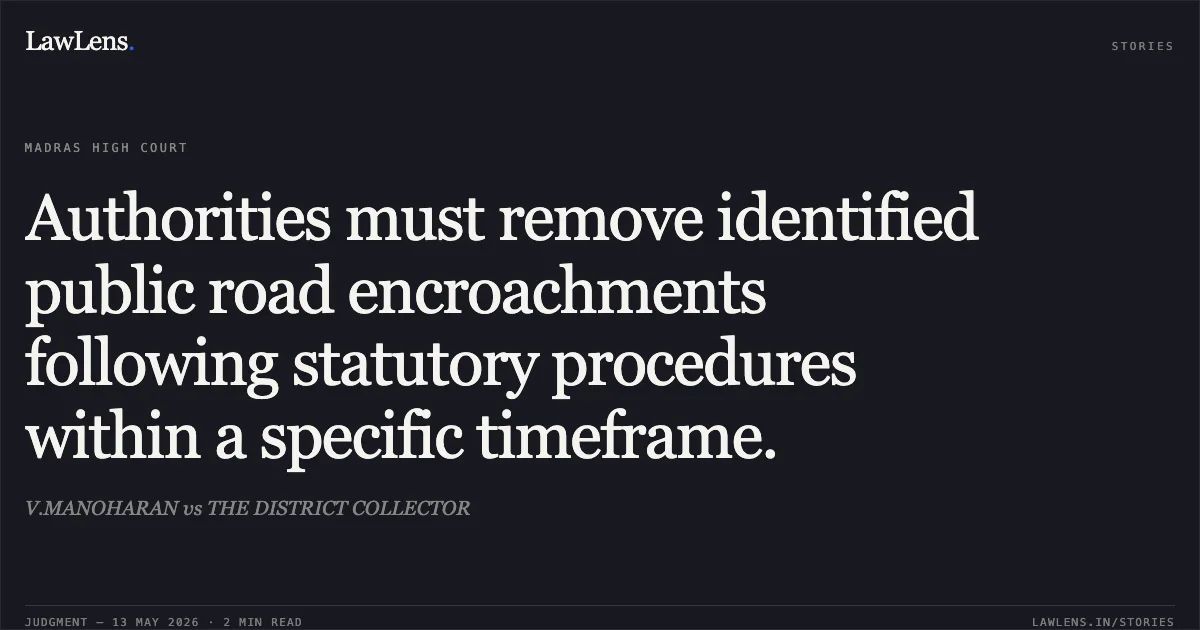
The petitioner filed a Writ Petition under Article 226 of the Constitution of India seeking a Writ of Mandamus to compel respondents 1 to 4 (Revenue Authorities) to remove encroachments made by private respondents (respondents 5 to 8) on a public road.
Source reference: p.1The road is situated in S.No.118/7, Alankanatham Privu, Senthamangalam Taluk, Namakkal District.
Source reference: p.1Despite five representations sent by the petitioner between December 2022 and August 2025, no final action had been taken.
Source reference: p.1During the proceedings, the Tahsildar submitted a written instruction stating that a survey had been conducted and encroachments were successfully identified.
Source reference: p.2Issues
1. Whether the court should direct the Revenue Authorities to remove identified encroachments on public land based on the petitioner's representations.
Source reference: p.2Law Applied
The court applied the statutory obligations of Revenue Authorities to protect public pathways and government lands.
Source reference: p.2The core principle involves the enforcement of removal of encroachments under the relevant State Statutes and Rules (such as the Tamil Nadu Land Encroachment Act, 1905), which mandate that once an encroachment on public property is identified through a proper survey, the authorities must initiate formal enforcement action following the principles of natural justice and due process.
Source reference: p.2Reasoning
The court's reasoning was predicated on the admission made by the State. The Additional Government Pleader, acting on instructions from the Tahsildar of Senthamangalam, confirmed to the Court that the revenue authorities had already conducted a survey and verified the existence of the encroachments complained of by the petitioner.
Source reference: p.2Since the factual dispute regarding the existence of the encroachment was resolved by the state's own survey, the court determined that the legal obligation to clear the public road must follow.
Source reference: p.2The court emphasized that the removal must not be arbitrary but must be executed by "following procedures as contemplated under the relevant Statute and Rules in force," ensuring that the private respondents are afforded due process before eviction.
Source reference: p.2Holding
The court disposed of the writ petition by directing the Revenue Divisional Officer (R3) and the Tahsildar (R4) to initiate enforcement actions to remove the identified encroachments.
The court ordered that this exercise be completed within twelve weeks from the date of receipt of the order copy.
Source reference: p.2No costs were awarded.
Source reference: p.3Original Court PDF
V.MANOHARANvsTHE DISTRICT COLLECTOR
Click to open original judgment
Original judgment, available to read, download and summarize on LawLens.in