Facts
The petitioner, while serving as an Accountant in the office of the Assistant Director, Horticulture, Gwalior, was served a charge sheet on 22/04/2017 by the Collector, Gwalior, alleging five counts of misconduct.
Source reference: para. 2Following a departmental enquiry where four charges were proved, the Collector issued an order on 28/02/2022 (Annexure P/1) imposing a major penalty—bringing the petitioner down to the basic of the pay scale—under Rule 10(v) of the M.P. Civil Services (Classification, Control and Appeal) Rules, 1966 ("CCA Rules").
Source reference: para. 2The petitioner's appeal was subsequently dismissed by the Commissioner, Gwalior Division, on 02/05/2023 (Annexure P/2).
Source reference: para. 1, 2The petitioner challenged these orders on the ground that the Collector lacked the jurisdiction to initiate major penalty proceedings or impose major punishments.
Source reference: para. 3During the pendency of the matter, the petitioner retired from service on 30/09/2022.
Source reference: para. 14Issues
1. Whether the Collector, Gwalior, was competent to initiate disciplinary proceedings for a major penalty against a Class-III employee despite being authorized only to impose minor penalties.
Source reference: para. 7, 92. Whether the imposition of a major penalty by the Collector, an authority only empowered to impose minor penalties, was legally sustainable under the CCA Rules.
Source reference: para. 12Law Applied
The court applied the M.P. Civil Services (Classification, Control and Appeal) Rules, 1966.
Source reference: no citationRule 2(d) defines the "disciplinary authority".
Source reference: para. 8Rule 12 outlines the power of the Governor to empower authorities to impose penalties.
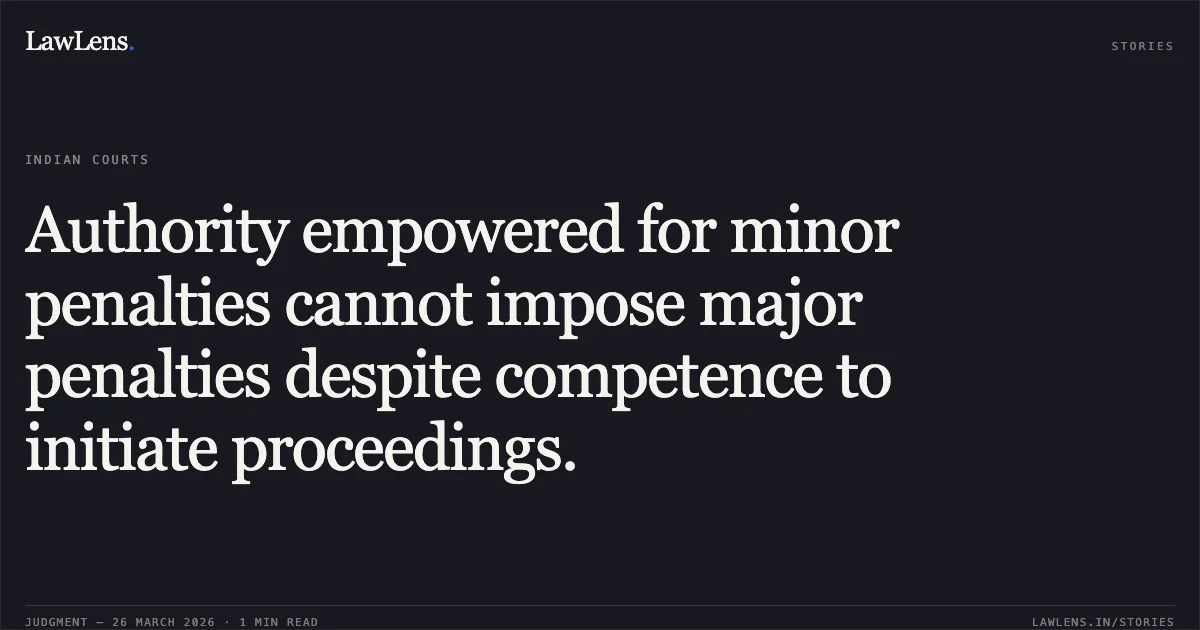
Source reference: para. 6Rule 13(2) stipulates that a disciplinary authority competent to impose only minor penalties (clauses i to iv of Rule 10) is nonetheless competent to institute disciplinary proceedings for major penalties (clauses v to ix).
Source reference: para. 9, 10Rule 14(21)(a) mandates that if such an authority, after enquiry, determines that a major penalty is warranted, it must forward the records to the authority competent to impose major penalties.
Source reference: para. 11The court also referenced a notification dated 23/05/1996, which limits the Collector’s power to the imposition of minor penalties on Class-III and IV employees.
Source reference: para. 3, 7Reasoning
The Court performed a conjoint reading of Rules 2(d), 12, 13, and 14(21) of the CCA Rules to delineate the boundaries of the Collector's jurisdiction.
Source reference: para. 12It held that by virtue of Rule 13(2), the Collector was legally competent to initiate the major penalty proceedings via the 2017 charge sheet, even though his power to punish was limited to minor penalties.
Source reference: para. 10, 12The court found a procedural and jurisdictional failure at the conclusion of the enquiry. Under Rule 14(21), once the Collector concluded that a major penalty (reduction to basic pay scale) was necessary, he was legally required to remit the enquiry records to the specific departmental authority competent to impose major penalties.
Source reference: para. 11, 12By imposing the major penalty himself, the Collector acted without jurisdiction, rendering the punishment order (Annexure P/1) and the subsequent appellate order (Annexure P/2) void.
Source reference: para. 12, 13Holding
The Court allowed the petition in part, setting aside the punishment order dated 28/02/2022 and the appellate order dated 02/05/2023.
It held that while the initiation of proceedings was valid, the imposition of the major penalty was without jurisdiction.
Source reference: para. 12The Collector was directed to remit the enquiry records to the competent authority of the department.
Source reference: para. 13Since the petitioner has retired, the competent authority was directed to pass a final order in accordance with the rules applicable to retired employees within 90 days of receiving the court's order.
Source reference: para. 14, 15Original Court PDF
Mata Prasad ShakyavsThe State Of Madhya Pradesh
Click to open original judgment
Original judgment, available to read, download and summarize on LawLens.in


![Subsequent exoneration does not retrospectively invalidate a finalized promotion select list.. UNNIKRISHNAN M vs M/o Environment And Forests. CAT - ['Ernakulam']. LawLens](/stories/thumbnails/subsequent-exoneration-does-not-retrospectively-invalidate-a-finalized-promotion-select-li-ce80a0e84f2f4887857271e8b4341c42.webp)