Facts
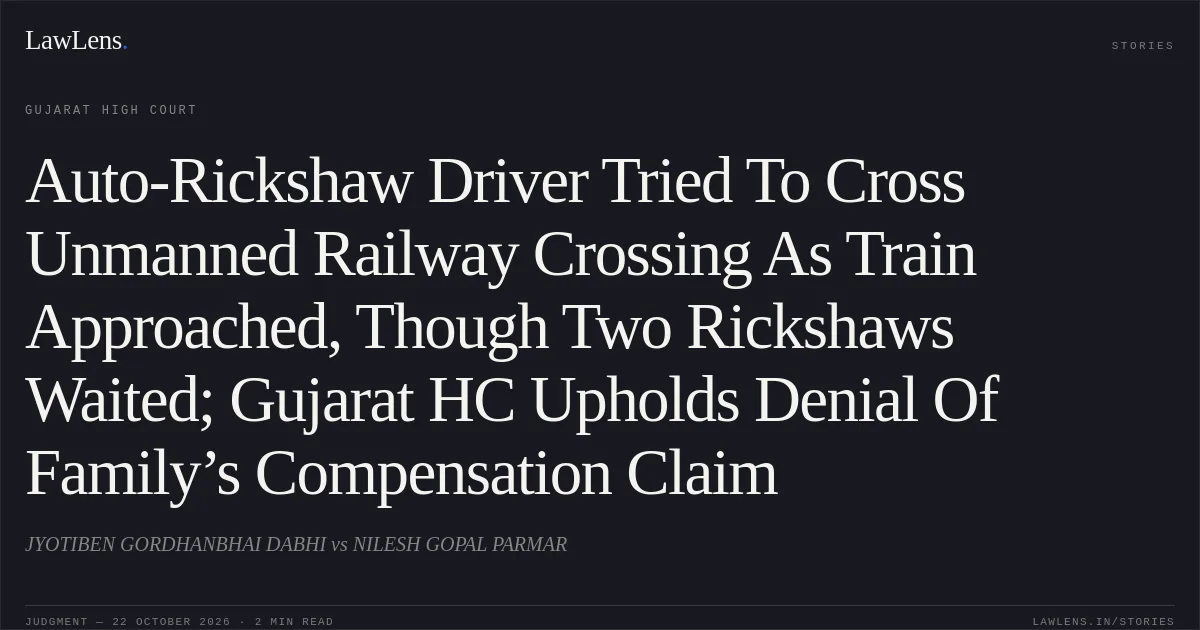
On 27 August 2003, Bachubhai Dabhi was driving an auto-rickshaw across an unmanned railway level crossing when he saw an approaching train.
Source reference: paras. 2, 7The rickshaw stopped on the tracks and was struck by the train, killing him.
Source reference: paras. 2, 7His widow and children filed a claim under Section 166 of the Motor Vehicles Act, 1988, against the vehicle’s owner and the Union of India.
Source reference: paras. 2.2–2.4The Motor Accident Claims Tribunal dismissed the claim, finding the deceased solely negligent; it also found that the claimants had not proved the alleged owner’s ownership of the vehicle.
Source reference: paras. 2.2–2.4The claimants appealed.
Source reference: para. 2.4Issues
1. Whether the deceased’s conduct at the unmanned level crossing amounted to negligence that was the sole cause of the accident, relieving the Railways of liability.
Source reference: paras. 13–212. Whether the Railways could be held liable for breach of statutory or common-law duties at the crossing on the evidence presented.
Source reference: paras. 17–213. Whether the Motor Accident Claims Tribunal had jurisdiction to determine the claim arising from the collision between a motor vehicle and a train.
Source reference: paras. 4.7, 5.5, 23Law Applied
Section 161 of the Railways Act, 1989 treats a person driving or leading a vehicle as negligent when crossing an unmanned level crossing without stopping or caring to stop to check for approaching rolling stock, or when crossing while rolling stock is in sight.
Source reference: para. 13Section 131 of the Motor Vehicles Act, 1988 requires a driver approaching an unguarded railway crossing to stop and ensure that no train or trolley is approaching before crossing.
Source reference: para. 15Relying on Union of India v. United India Insurance Co. Ltd., (1997) 8 SCC 683, the Court recognised that the Railways may owe common-law duties of care at level crossings, enforceable alongside or independently of statutory duties; liability depends on proof of a breach of the applicable duty.
Source reference: paras. 17–18The Court also proceeded on the basis that the Tribunal had jurisdiction to hear the matter, without treating jurisdiction as determinative of liability.
Source reference: para. 23Reasoning
The Court found that the deceased attempted to cross while two other rickshaws were stopped, and that he was frightened by the approaching train, causing his rickshaw to stop on the tracks.
Source reference: paras. 12, 19, 21The claimant’s witness acknowledged that a signboard was present, that a train could be heard, and that taking precautions could have avoided the accident.
Source reference: paras. 10.1–10.7The train’s loco pilot and co-loco pilot testified that they had continuously sounded the horn; the evidence did not establish a relevant omission by the Railways.
Source reference: paras. 12.1–12.2, 20–21Applying Sections 161 and 131, the Court concluded that the deceased had failed to take the required precautions and was solely negligent.
Source reference: paras. 16, 18–21It found no evidentiary basis to impose statutory or common-law liability on the Railways.
Source reference: paras. 16, 18–21Holding
The Court held that, even assuming the Claims Tribunal had jurisdiction, the claim failed because the accident resulted from the deceased’s own negligence and no actionable breach by the Railways was proved.
The appeal was dismissed, and the record and proceedings were directed to be returned to the Tribunal.
Source reference: paras. 25–26Acts & Sections Cited
6 provisions across 2 statutes referred to in this judgment. Each provision opens on LawLens.
Motor Vehicles Act, 19884
Railways Act, 19892
Original Court PDF
JYOTIBEN GORDHANBHAI DABHIvsNILESH GOPAL PARMAR
Click to open original judgment
Original judgment, available to read, download and summarize on LawLens.in