Facts
The appellant, a retired Senior Office Assistant of the Bihar Council on Science and Technology (BCST), challenged the judgment of a learned Single Judge dated March 27, 2025.
Source reference: para. 2The appellant sought the implementation of the 7th Pay Commission recommendations from April 1, 2017 (the date applicable to State Government employees) instead of October 1, 2020, as decided by the BCST Executive Committee.
Source reference: paras. 5-7The appellant argued that since BCST employees receive dearness allowances and follow specific State service rules, BCST should be treated as a Government Department.
Source reference: paras. 6, 11The BCST, an autonomous body, had resolved to implement the pay revision from its own internal resources from October 1, 2020, provided the State Government bore no financial burden.
Source reference: para. 15Issues
1. Whether the Bihar Council on Science and Technology (BCST) is a Government Department or an autonomous entity for the purpose of pay revision implementation.
Source reference: paras. 9, 112. Whether internal file notings of an organization create a legally enforceable right for employees to claim specific pay benefits.
Source reference: paras. 10, 133. Whether the Court can interfere with an autonomous body's decision to fix a specific effective date for pay revision based on its financial capacity.
Source reference: paras. 4, 15Law Applied
The court relied on the principle that autonomous bodies are free to decide the date of implementation for pay revisions based on financial stability and internal resources.
Source reference: para. 4Regarding administrative law, it applied the doctrine from Bachhittar Singh v. State of Punjab [AIR 1963 SC 395], which establishes that file notings do not have the sanction of law as an effective order.
Source reference: para. 10, 13This was further reinforced by Union of India v. Kartick Chandra Mondal [(2010) 2 SCC 422], holding that internal communications are not government orders until officially issued and publicized.
Source reference: paras. 10, 13Reasoning
The Court rejected the appellant's contention that BCST is a Government Department, clarifying that the mere adoption of State-like allowances and service rules for administrative ease does not change the Council's autonomous character.
Source reference: paras. 11-12The Court observed that the BCST Executive Committee took a conscious financial decision to implement the 7th Pay Commission from October 1, 2020, using internal funds without State assistance.
Source reference: para. 15It held that the file notings relied upon by the appellant lacked legal force as they were merely internal processing steps and not final publicized orders.
Source reference: paras. 13-14Furthermore, the appellant failed to legally challenge the specific resolution of the Executive Committee that fixed the effective date of the pay scale.
Source reference: para. 15Holding
The High Court dismissed the Letters Patent Appeal and upheld the Single Judge's decision.
It held that the BCST is an autonomous entity, and its determination of the effective date for pay revision—based on financial burden and internal resources—suffers from no perversity.
Source reference: paras. 15-16The prayer for arrears from April 1, 2017, was denied.
Source reference: no citationOriginal Court PDF
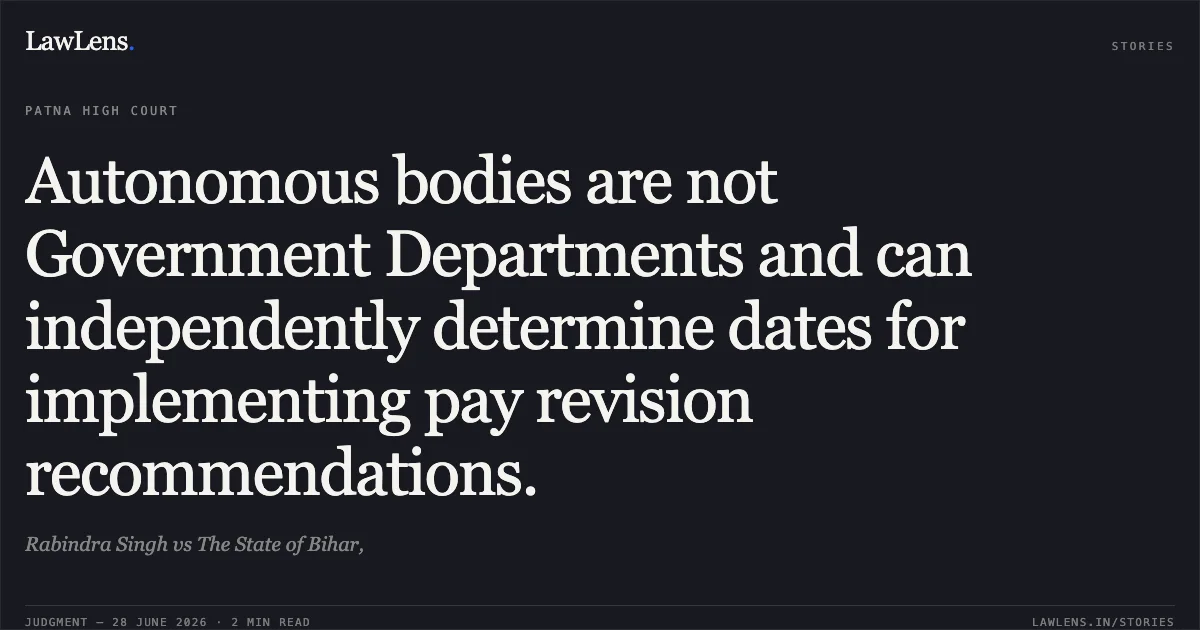
Rabindra SinghvsThe State of Bihar,
Click to open original judgment
Original judgment, available to read, download and summarize on LawLens.in


