Facts
The Petitioner was appointed as a Single Window Operator at the Vjaypur Branch of the State Bank of Indore.
Source reference: para. 2Following complaints of illegal withdrawals in 2006-07, the Petitioner was suspended and issued a charge-sheet.
Source reference: para. 2After an inquiry, the Disciplinary Authority issued a removal order dated 31.12.2008.
Source reference: para. 2An appeal against this order was rejected by the Appellate Authority on 06.04.2009 via a non-speaking order.
Source reference: para. 2The Petitioner filed the present writ petition in 2016 seeking to quash the removal and appellate orders and for reinstatement with consequential benefits.
Source reference: para. 1The Respondents raised a preliminary objection regarding the maintainability of the petition, arguing the availability of an alternative statutory remedy under the Industrial Disputes Act, 1947.
Source reference: para. 3Issues
1. Whether the High Court can dismiss a writ petition on the ground of the availability of an alternative remedy after the petition has been pending for several years
Source reference: para. 5 & 92. Whether the Petitioner, as a bank employee in a clerical cadre, must exhaust the remedy under the Industrial Disputes Act, 1947, before approaching the High Court under Article 226
Source reference: para. 8 & 10Law Applied
The Court applied the principle of "self-imposed limitation" under Article 226 of the Constitution of India, which dictates that writ jurisdiction should not typically be exercised when an efficacious alternative statutory remedy exists.
Source reference: para. 7State of Uttar Pradesh v. Uttar Pradesh Rajya Khanij Vikas Nigam Sangharsh Samiti (2008) 12 SCC 675, which held that the mere admission of a petition or passing of interim orders does not bar its dismissal on the ground of alternative remedy.
Source reference: para. 6Genpact India Private Limited v. Deputy Commissioner of Income Tax (2019) SCC Online SC 1500 and Commissioner of Income Tax v. Chhabil Dass Agarwal (2014) 1 SCC 603 to establish that discretionary jurisdiction should be refused unless there is a violation of natural justice, lack of jurisdiction, or a challenge to the constitutionality of a statute.
Source reference: para. 7Division Bench ruling in State Bank of India v. Vikram Sharma (W.A. No. 36/12) and Jitendra Kumar v. State of M.P. (W.P. No. 3479/2005), which clarified that clerical bank employees are amenable to the jurisdiction of the Industrial Disputes Act.
Source reference: para. 8Reasoning
The Court noted that the Petitioner’s grievance involved "multiple disputed questions of facts" regarding the alleged illegal withdrawals and subsequent disciplinary proceedings.
Source reference: para. 10Referring to the Supreme Court's precedents, the Court reasoned that the existence of a statutory forum (the Central Government Industrial Tribunal or CGIT) is a relevant consideration even in long-pending matters.
Source reference: para. 6-7The Court distinguished the Petitioner’s reliance on Hindustan Petroleum Corp Ltd. v. Kailash Chandra (W.A. No. 240/2018), noting that in that case, there were no disputed questions of fact.
Source reference: para. 10Since the Petitioner is a clerical cadre employee, the Court determined that the Industrial Disputes Act provides a more suitable and efficacious forum for fact-finding than the writ court under Article 226.
Source reference: para. 8, 10Holding
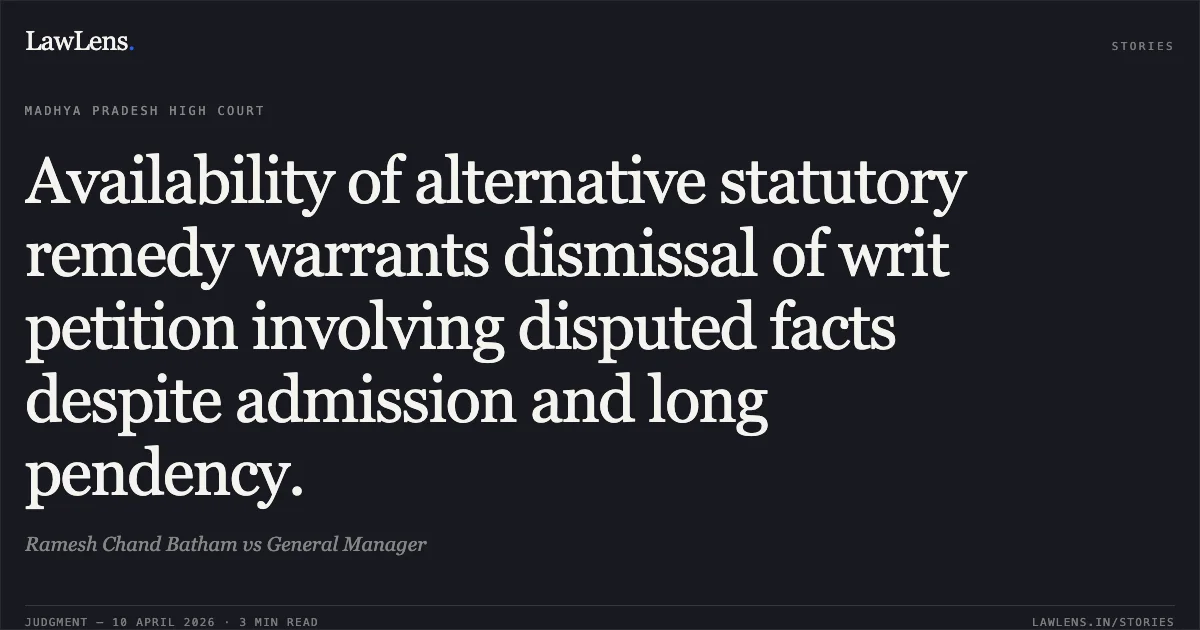
The Court declined to entertain the writ petition due to the availability of an alternative remedy.
It disposed of the petition with liberty to the Petitioner to approach the CGIT within one month from the date of the order. The CGIT was directed to decide the dispute within three months on its merits, passing a reasoned and speaking order, while ignoring any delay caused by the pendency of the writ petition.
Source reference: para. 11Acts & Sections Cited
5 provisions across 4 statutes referred to in this judgment. Linked provisions open on LawLens.
Industrial Disputes Act, 19472
U.P. Industrial Disputes Act, 19471
Payment Of Wages Act, 19361
Companies Act, 19561
Original Court PDF
Ramesh Chand BathamvsGeneral Manager
Click to open original judgment
Original judgment, available to read, download and summarize on LawLens.in


![Subsequent exoneration does not retrospectively invalidate a finalized promotion select list.. UNNIKRISHNAN M vs M/o Environment And Forests. CAT - ['Ernakulam']. LawLens](/stories/thumbnails/subsequent-exoneration-does-not-retrospectively-invalidate-a-finalized-promotion-select-li-ce80a0e84f2f4887857271e8b4341c42.webp)