Facts
On October 2, 2025, the petitioner and his nephew, Naresh Rathiya, witnessed a road accident involving a truck and two bikers
Source reference: para. 4Police arrived at the scene and placed the deceased bikers and Naresh Rathiya—who was allegedly alive and healthy at the time—into an ambulance
Source reference: paras. 4–5The following day, the petitioner was informed that Naresh had died; his body was found at Civil Hospital, Dharamjaigarh
Source reference: para. 5While a post-mortem report attributed the death to "blunt trauma to the head" consistent with an accident, the petitioner alleged that Naresh was assaulted by police personnel in the ambulance
Source reference: paras. 6–7Despite registering a 'Merg' (accidental death report) under Section 194 of the Bharatiya Nagarik Suraksha Sanhita (BNSS), 2023, the petitioner contended that no fair investigation was conducted and no FIR was lodged
Source reference: paras. 6, 9The petitioner approached the High Court seeking an independent investigation and compensation
Source reference: para. 2Issues
1. Whether the High Court should direct an independent investigation into the death of Naresh Rathiya under its writ jurisdiction despite the availability of alternative statutory remedies
Source reference: paras. 10–11Law Applied
The court primarily applied the principle of "efficacious alternative remedy" regarding criminal investigation procedures
Source reference: para. 11Section 194 of the Bharatiya Nagarik Suraksha Sanhita (BNSS), 2023, regarding death inquiries
Source reference: para. 6Sections 175(3) and 223 of the BNSS (the current counterparts to Sections 156(3) and 200 of the CrPC), which empower a Magistrate to order an investigation or take cognizance of a complaint
Source reference: para. 10The precedents of Waseem Haider v. State of U.P. (Misc. Bench No. 24492 of 2020) and Akhilesh Agrawal v. State of Chhattisgarh (WPCR No. 333 of 2020), which established that writ petitions for investigation are not maintainable when statutory remedies before a Magistrate remain unexhausted
Source reference: para. 10Reasoning
The Court evaluated the petitioner’s grievance regarding the suspicious nature of the death and the alleged police misconduct
Source reference: paras. 6–8The Court observed that the petitioner had not yet exhausted the procedural remedies available under the BNSS, specifically the option to approach a competent Magistrate to seek an order for an FIR or to file a private complaint
Source reference: paras. 10–11By citing established case law from the Allahabad High Court and its own previous divisions, the Court determined that the controversy regarding the bypass of statutory remedies was well-settled
Source reference: para. 10The Court reasoned that the petitioner’s concerns could be adequately addressed by the lower judiciary, making the exercise of extraordinary writ jurisdiction under Article 226 unnecessary at this stage
Source reference: para. 11Holding
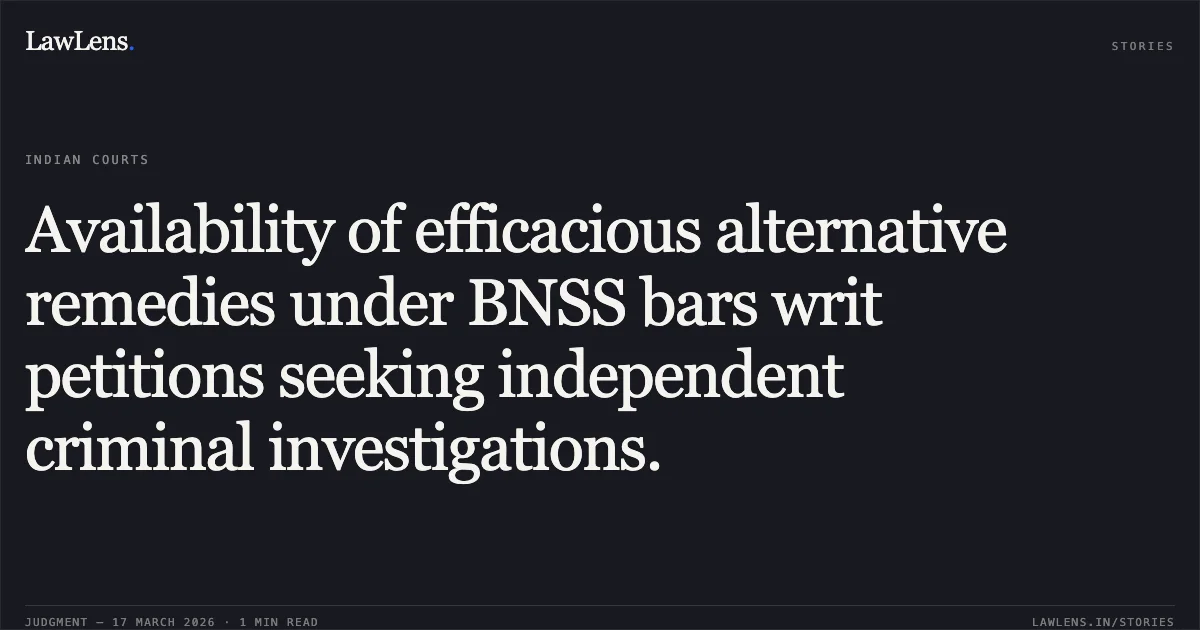
The Court held that the petitioner possesses an efficacious alternative remedy under the Bharatiya Nagarik Suraksha Sanhita, 2023
The High Court dismissed the writ petition and granted liberty to the petitioner to pursue appropriate legal remedies before the competent Court or forum in accordance with the law
Source reference: paras. 11-12Acts & Sections Cited
5 provisions across 2 statutes referred to in this judgment. Each provision opens on LawLens.
Bharatiya Nagarik Suraksha Sanhita, 20233
Code of Criminal Procedure, 19732
Original Court PDF
MOHIT RAM RATHIYAvsSTATE OF CHHATTISGARH
Click to open original judgment
Original judgment, available to read, download and summarize on LawLens.in