Facts
The petitioners and respondent no. 2 filed cross-FIRs arising from the same incident: Case Crime No. 252/2023 (under IPC and SC/ST Act) and Case Crime No. 253/2023 (under IPC).
Source reference: para. 3Due to the nature of the offenses, the SC/ST case was pending before the Special Judge, SC/ST Act, while the counter-case was before the Chief Judicial Magistrate.
Source reference: para. 4Relying on the principle that cross-cases should be tried by the same court to avoid conflicting judgments, the petitioners moved an application under Section 408 of the Code of Criminal Procedure (Cr.P.C.) before the Sessions Judge, Mirzapur, to transfer the Magistrate-level case to the Special Court.
Source reference: para. 5On 23.05.2025, the Sessions Judge rejected the application, holding that the petitioners should have instead approached the Magistrate under Section 323 Cr.P.C. for committal.
Source reference: para. 6Issues
1. Whether the Sessions Judge was justified in rejecting a transfer application under Section 408 Cr.P.C. solely on the ground that an alternative remedy under Section 323 Cr.P.C. was available before the Magistrate.
Source reference: para. 10Law Applied
The Court relied on the Supreme Court precedents in Nathi Lal v. State of U.P. (1990) and Sudhir v. State of Madhya Pradesh (2001), which established that cross-cases arising from the same incident must be tried by the same Judge to prevent inconsistent findings.
Source reference: para. 12-13Section 323 Cr.P.C. empowers a Magistrate to commit a case to the Sessions Court during inquiry or trial.
Source reference: para. 14-15Section 408 Cr.P.C. grants the Sessions Judge wide discretionary power to transfer cases between courts within a division to subserve the "ends of justice".
Source reference: para. 16-17Reasoning
The Court reasoned that Section 323 and Section 408 Cr.P.C. operate in "distinct spheres". While Section 323 is a power of committal exercised by a Magistrate, Section 408 is a power of transfer exercised by a Sessions Judge.
Source reference: para. 18The Court observed that the Sessions Judge failed to recognize that once their jurisdiction under Section 408 was invoked, they were duty-bound to examine the merits of the transfer—specifically whether the cases were indeed cross-cases and if a common trial was expedient.
Source reference: para. 19, 23Rebuffing the application solely on the basis of procedural availability under Section 323 was deemed a failure to exercise vested jurisdiction.
Source reference: para. 24The Court emphasized that when one case involves the SC/ST Act (Special Court) and the other is before a Magistrate, a holistic examination by the Sessions Judge is essential to ensure a fair adjudication of rival versions.
Source reference: para. 20Holding
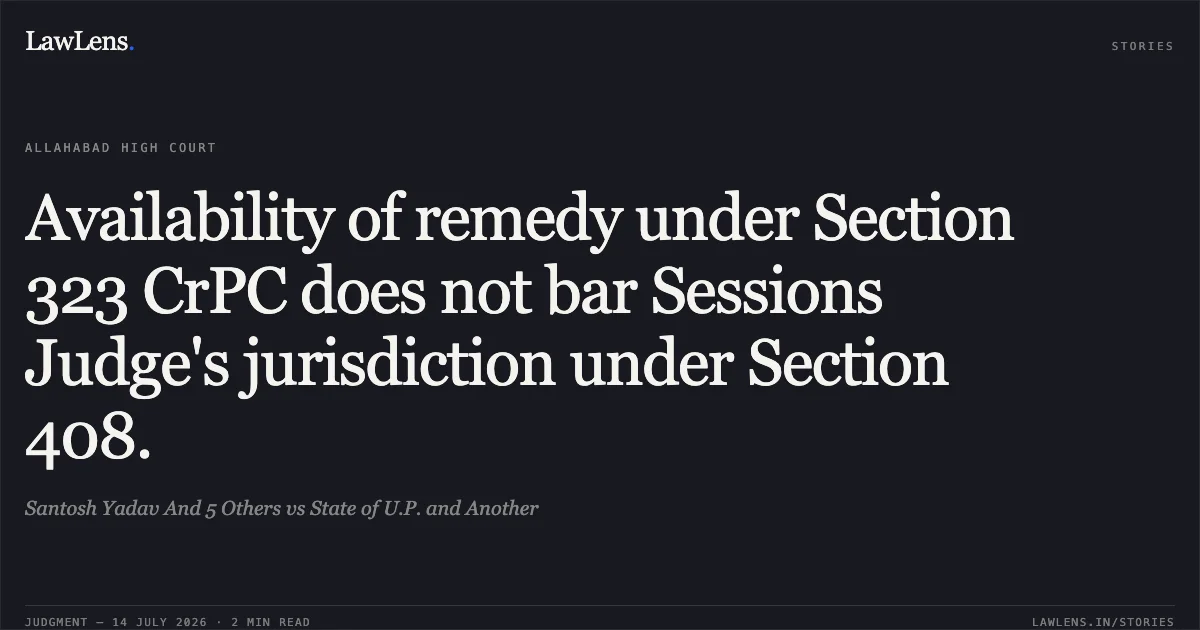
The Court answered the issue in the negative, holding that the availability of Section 323 Cr.P.C. does not exclude the jurisdiction of the Sessions Judge under Section 408 Cr.P.C.
The High Court set aside the order dated 23.05.2025 and remitted the matter to the Sessions Judge, Mirzapur, for a fresh determination on the merits. The Sessions Judge is directed to record a reasoned finding on whether the prosecutions constitute cross-cases and whether transfer is required for the ends of justice. The writ petition was allowed.
Source reference: para. 25, 26Acts & Sections Cited
9 provisions across 3 statutes referred to in this judgment. Each provision opens on LawLens.
Indian Penal Code, 18606
Scheduled Castes and the Scheduled Tribes (Prevention of Atrocities) Act, 19891
Code of Criminal Procedure, 19732
Original Court PDF
Santosh Yadav And 5 OthersvsState of U.P. and Another
Click to open original judgment
Original judgment, available to read, download and summarize on LawLens.in