Facts
The Appellant challenged a Provisional Attachment Order (PAO) issued under Section 5 of the Prevention of Money Laundering Act, 2002 (PMLA) via a writ petition
Source reference: p. 2The Appellant argued that the property in question was mortgaged to them and subject to proceedings under the SARFAESI Act, 2002, thereby rendering the PAO without jurisdiction
Source reference: p. 4-5On 01.09.2025, a learned Single Judge passed an interim order stating that any subsequent order by the Adjudicating Authority would be subject to the writ petition's outcome
Source reference: p. 2However, on 17.03.2026, the Single Judge disposed of the writ petition, relegating the Appellant to the statutory remedy of appeal under Section 26 of the PMLA based on the "nature of adjudication" conducted by the Authority
Source reference: p. 1-2, 4The Appellant filed this Intra-Court Appeal against that disposal
Source reference: p. 1Issues
1. Whether a Writ Court is legally compelled to decide a matter on merits, rather than relegating a party to a statutory remedy, solely because an interim order was previously passed making the lower authority's action subject to the writ outcome.
Source reference: para. 4-5, 112. Whether the learned Single Judge erred in relegating the Appellant to a statutory appeal without providing an explicit finding or reasoned justification regarding why discretionary jurisdiction under Article 226 was declined.
Source reference: para. 15-16Law Applied
The Court applied the principles of judicial review under Article 226 of the Constitution of India, noting that while legislative fetters cannot limit this power, the Court must observe self-imposed restrictions regarding the availability of an "equally efficacious statutory remedy"
Source reference: para. 10The Court referred to Section 26 of the Prevention of Money Laundering Act, 2002 (PMLA), which provides a statutory appellate mechanism against orders passed by the Adjudicating Authority under Section 8
Source reference: para. 2, 6The Court balanced the principle of discretionary jurisdiction with the "settled legal principles" of maintainability, bona fides, and public interest
Source reference: para. 10Reasoning
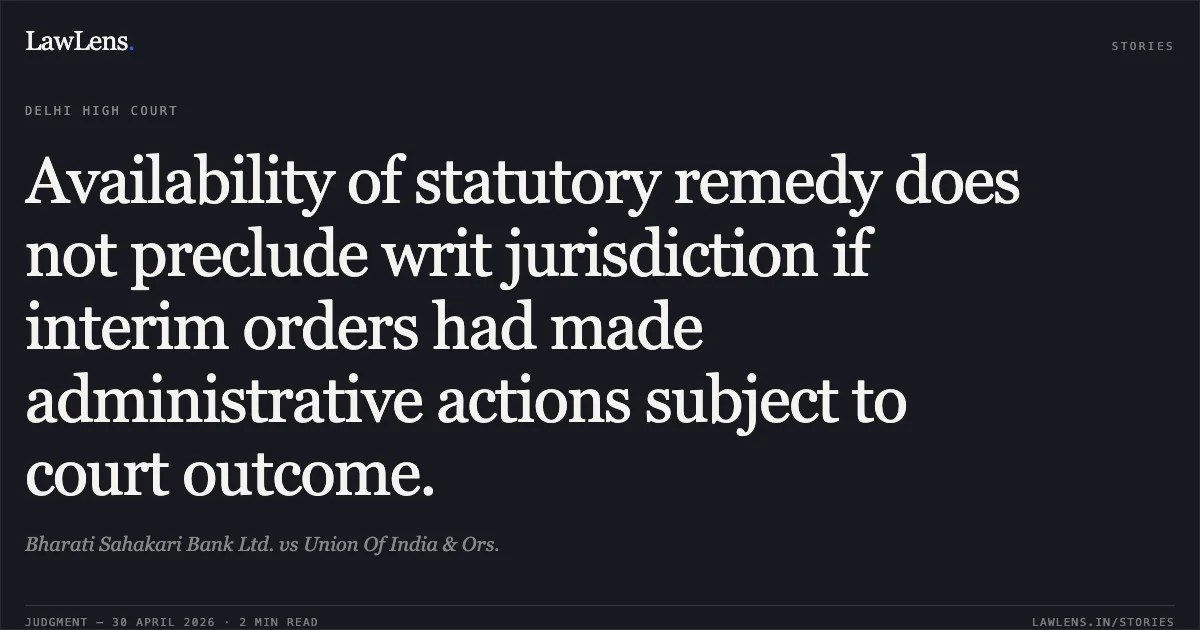
The Division Bench reasoned that there is no absolute legal compulsion for a Writ Court to decide a case finally just because an interim order was granted
Source reference: para. 11It acknowledged that while a Writ Court can relegate a petitioner to a statutory remedy even after passing interim orders, such a decision must be justified
Source reference: para. 12In this case, the Single Judge used the phrase "nature of the adjudication which has taken place" to justify the relegation but failed to elaborate on what that nature was or why it precluded the exercise of writ jurisdiction
Source reference: para. 13-15The Bench noted that the challenge involved a jurisdictional question—whether property under SARFAESI could be attached under PMLA—which required a more reasoned consideration of whether the alternative remedy was appropriate in place of judicial review
Source reference: para. 14-15Holding
The High Court held that while the availability of a statutory remedy is a valid consideration, the lack of explicit reasoning in the Impugned Order necessitated a fresh determination
The Court allowed the appeal and set aside the Impugned Order dated 17.03.2026. The Writ Petition (W.P.(C) 12692/2025) was restored to its original number, and the learned Single Judge was requested to decide the matter afresh, including the plea of maintainability
Source reference: para. 16, 18Acts & Sections Cited
3 provisions across 1 statute referred to in this judgment. Each provision opens on LawLens.
Prevention of Money-Laundering Act, 20023
Original Court PDF
Bharati Sahakari Bank Ltd.vsUnion Of India & Ors.
Click to open original judgment
Original judgment, available to read, download and summarize on LawLens.in


