Facts
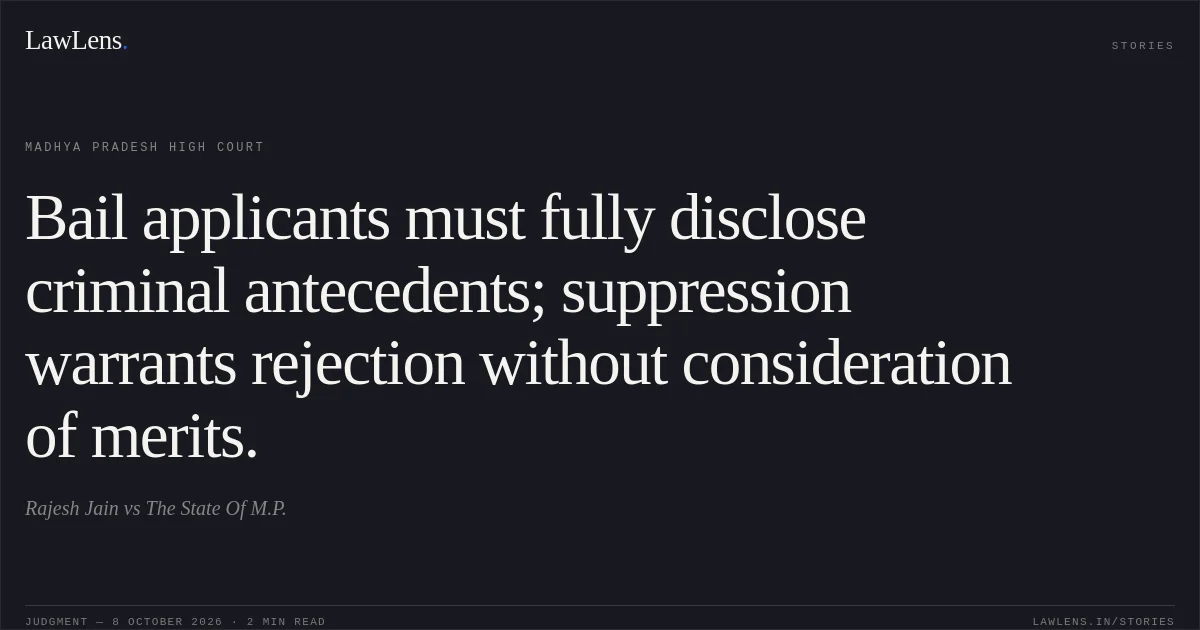
Rajesh Jain filed his first application under Section 483 of the Bharatiya Nagarik Suraksha Sanhita, 2023, seeking bail in Crime No. 04/2025, registered for offences under Sections 406, 409 and 420 of the IPC.
Source reference: para. 1He disclosed certain criminal cases and submitted that only three cases were pending, with closure reports filed in the others; the Trial Court had referred to 38 cases without, he contended, providing details.
Source reference: para. 2After the complainant supplied further information about his antecedents, Jain filed a response concerning some of the cases. The complainant nevertheless alleged incomplete disclosure, including in relation to Crime No. 46/2026.
Source reference: paras. 4, 8Jain’s counsel argued that antecedents should matter only where the allegations had substance.
Source reference: para. 5Issues
1. Whether the applicant’s alleged incomplete disclosure of criminal antecedents justified rejecting his bail application without consideration of its merits.
Source reference: paras. 4, 82. Whether the relevance of criminal antecedents depended on the substance of the allegations in those cases.
Source reference: paras. 5–8Law Applied
Section 483 of the BNSS, 2023, governed the bail application.
Source reference: para. 1Relying on Zeba Khan v. State of U.P. & Others, 2026 INSC 144, and Munnesh v. State of Uttar Pradesh, 2025 LiveLaw (SC) 389, the Court stated that a bail applicant must make a full and candid disclosure of criminal antecedents; suppression or selective disclosure of material facts may affect the exercise of judicial discretion.
Source reference: para. 8The Court also referred to the principles against misleading the court discussed in Kusha Duruka v. State of Odisha and Saumya Chaurasia v. Enforcement Directorate.
Source reference: paras. 6–7Reasoning
The Court treated the completeness of the applicant’s disclosure as material to the exercise of bail discretion. In light of the further antecedent information supplied by the complainant and the dispute over whether all relevant cases had been disclosed, the Court concluded that the application could not proceed on the disclosures then before it.
Source reference: paras. 4, 8It rejected counsel’s submission as inconsistent with the disclosure obligation described in the cited authorities; it did not decide whether the allegations in the antecedent cases had substance or assess the merits of the bail application.
Source reference: paras. 5–8Holding
The Court rejected the application without considering its merits and granted liberty to renew the bail prayer upon complete disclosure of the applicant’s criminal antecedents.
It directed the office to return the documents and vakalatnama, retaining photocopies to facilitate a fresh application.
Source reference: para. 9Acts & Sections Cited
7 provisions across 3 statutes referred to in this judgment. Each provision opens on LawLens.
Bharatiya Nagarik Suraksha Sanhita, 20231
Indian Penal Code, 18603
Original Court PDF
Rajesh JainvsThe State Of M.P.
Click to open original judgment
Original judgment, available to read, download and summarize on LawLens.in