Facts
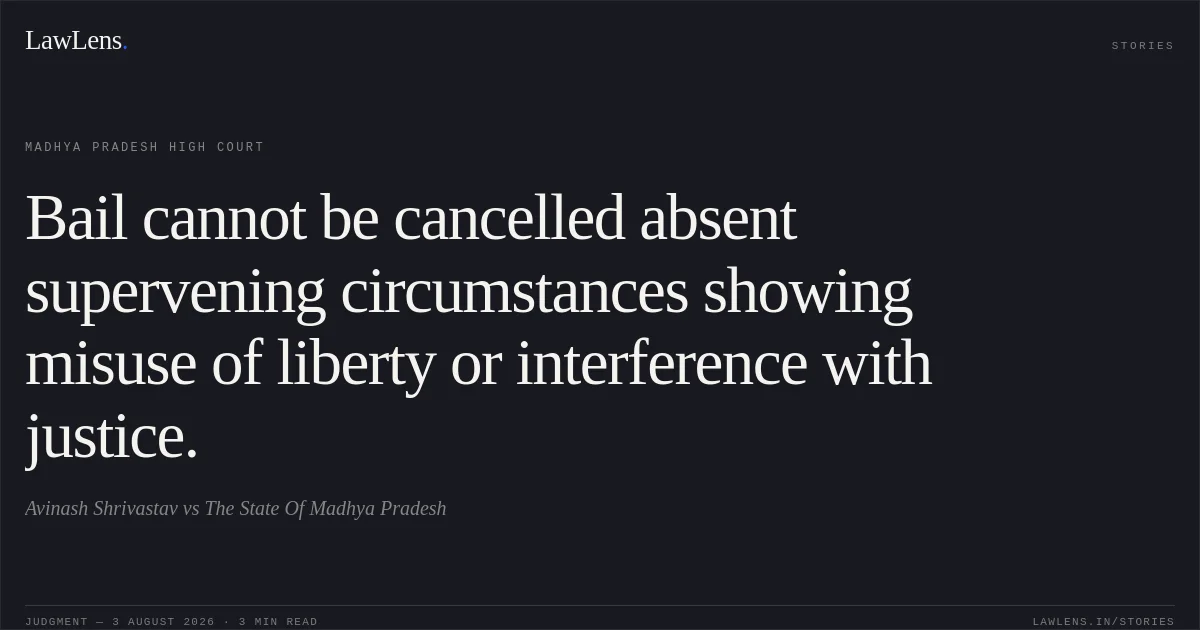
The petitioner sought cancellation of the anticipatory bail granted to respondent No. 2, Deepti Shrivastava, by the High Court on 28 October 2025 in connection with Crime No. 319/2025 registered at Police Station Madan Mahal, Jabalpur, for offences under Sections 340(2), 61(2) and 3(5) of the Bharatiya Nyaya Sanhita, 2023.
Source reference: para. 1The prosecution allegations were that respondent No. 2 and her husband, Abhilash Shrivastava, forged the partnership deed of M/s Reliable Movers Infinity, operated a bank account in the firm’s name, and withdrew approximately Rs. 19 lakh, besides committing other alleged acts of forgery.
Source reference: para. 2The petitioner further alleged that the respondents misused the firm’s funds, obtained contracts through forged documents, made false complaints to various government departments, and thereby caused cancellation of his railway contract.
Source reference: paras. 2–3Respondent No. 2 denied the allegations, asserting that the firm’s affairs and partnership changes arose from a family arrangement and that the complaints and departmental proceedings relied upon by the petitioner were unrelated to her or were otherwise baseless.
Source reference: para. 5The Court considered the pleadings, additional documents, and the record of the earlier bail proceedings.
Source reference: paras. 4–6Issues
Whether the anticipatory bail granted to respondent No. 2 ought to be cancelled on the grounds of alleged suppression of material facts, misuse of the firm’s bank account, filing of false complaints, and interference with the petitioner’s business interests.
Source reference: paras. 2–4, 9Whether the petitioner established any supervening or exceptional circumstance—such as misuse of liberty, interference with the administration of justice, evasion of the process of law, or likelihood of absconding—warranting cancellation of bail already granted.
Source reference: para. 7Whether the allegations that respondent No. 2 was not cooperating with the investigation or was not appearing before the Court constituted sufficient grounds for cancellation of bail.
Source reference: para. 9Law Applied
The Court exercised jurisdiction under Section 483(3) of the Bharatiya Nagarik Suraksha Sanhita, 2023 concerning cancellation of bail.
Source reference: para. 1It noted that the conditions imposed under Section 482(2) of the BNSS required the accused not to repeat the offence, threaten or contact prosecution witnesses, or leave India without the Court’s permission.
Source reference: para. 9The Court applied the principle in Dolatram v. State of Haryana, (1995) 1 SCC 349, that rejection of bail at the initial stage and cancellation of bail already granted operate on different standards; cancellation requires “very cogent and overwhelming circumstances,” such as interference with or evasion of the administration of justice, abuse of the concession of bail, or a real possibility of absconding.
Source reference: para. 7It further relied on Ms. X v. State of Telangana, 2018 Cri LJ 3070, which reiterated that bail should not be cancelled mechanically without supervening circumstances rendering continued liberty inconsistent with a fair trial.
Source reference: para. 8Reasoning
The Court distinguished between the merits of the original allegations and conduct occurring after the grant of bail.
Source reference: no citationAlthough the allegations concerned the alleged forgery of the partnership deed and misuse of the firm’s bank account, the Court observed that the earlier bail order had been passed after the issue of the allegedly forged signatures on the retirement deed had been considered.
Source reference: para. 7The petitioner did not identify any specific post-bail act by respondent No. 2 personally or through an agent showing misuse of liberty, misappropriation of additional funds, intimidation of witnesses, interference with the investigation or trial, or likelihood of absconding.
Source reference: para. 7The allegations concerning false departmental complaints, contracts, and cancellation of the petitioner’s contract were treated as matters that could be pursued before the appropriate authorities, rather than as grounds for cancellation of bail.
Source reference: para. 9Similarly, the assertions regarding non-cooperation with investigation or non-appearance were not found sufficient, on the material before the Court, to satisfy the stringent standard applicable to cancellation of an already granted bail.
Source reference: para. 9Holding
The Court held that no cogent, overwhelming, or supervening circumstance had been established to justify cancellation of respondent No. 2’s anticipatory bail.
The allegations raised by the petitioner did not demonstrate misuse of the liberty granted, interference with the administration of justice, evasion of the legal process, or any other circumstance making continued bail inconsistent with a fair trial.
Source reference: paras. 7–9Accordingly, the application for cancellation of bail was dismissed, and no direction was issued for respondent No. 2’s arrest.
Source reference: para. 10Acts & Sections Cited
6 provisions across 3 statutes referred to in this judgment. Each provision opens on LawLens.
Bharatiya Nagarik Suraksha Sanhita, 20232
Bharatiya Nyaya Sanhita, 20233
Central Goods and Services Tax Act, 20171
Original Court PDF
Avinash ShrivastavvsThe State Of Madhya Pradesh
Click to open original judgment
Original judgment, available to read, download and summarize on LawLens.in