Facts
On 27 August 2024, the Narcotics Control Bureau received secret information that Ramakant Das and Sanjeev Sahu were transporting methamphetamine from Dibrugarh to Muzaffarpur. The information was recorded and a raiding team intercepted both persons near Dharamsala Chowk, Muzaffarpur. A total of 1 kg of methamphetamine was allegedly recovered from three packets concealed in a specially created cavity in an electric pressure cooker carried with their luggage.
Source reference: pp. 2–3The apprehended persons allegedly disclosed that the consignment was to be delivered to Lallan Das. A search of Lallan Das’s rented house resulted in the seizure of 13 packets of black substance, seven packets of brown substance and two packets of deep-brown substance, all suspected to be heroin.
Source reference: pp. 3–4All three persons were arrested and booked under Sections 8(c), 22(c) and 29 of the Narcotic Drugs and Psychotropic Substances Act, 1985 (“NDPS Act”).
Source reference: pp. 4–6The Special Judge granted regular bail to Sanjeev Sahu and Lallan Das on 11 November 2024, principally observing that they had not been arrested at the spot, no contraband had been recovered from their possession, and their names had been disclosed by a co-accused.
Source reference: pp. 4–6Issues
1. Whether the bail order dated 11 November 2024 was illegal or perverse because it proceeded on findings contrary to the FIR, seizure materials and arrest records?
Source reference: pp. 11–12, 21–242. Whether bail could have been granted in a case involving commercial quantity of methamphetamine without recording the twin satisfactions mandated by Section 37(1)(b)(ii) of the NDPS Act?
Source reference: pp. 11–19, 24–253. Whether the bail order could be annulled under Section 439(2) CrPC in the absence of any alleged post-release misuse of liberty, where the order itself was illegal or perverse?
Source reference: pp. 11–14, 25–27Law Applied
The Court applied Section 439(2) CrPC, which permits cancellation or annulment of bail, and Section 37(1)(b) of the NDPS Act, which requires the Public Prosecutor to be heard and, where bail is opposed, mandates reasonable grounds for believing both that the accused is not guilty and that he is unlikely to commit any offence while on bail.
Source reference: pp. 15–16The Court distinguished ordinary cancellation of bail for supervening misconduct—which requires cogent and overwhelming circumstances under Dolat Ram v. State of Haryana, (1995) 1 SCC 349—from annulment of an inherently illegal, perverse or legally unsustainable bail order under Puran v. Rambilas, (2001) 6 SCC 338; Neeru Yadav v. State of U.P., (2014) 16 SCC 508; Vipan Kumar Dhir v. State of Punjab, (2021) 15 SCC 518; Deepak Yadav v. State of U.P., (2022) 8 SCC 559; and State of Karnataka v. Sri Darshan, 2025 SCC OnLine SC 1702.
Source reference: pp. 11–14It further relied on Union of India v. Rattan Mallik, (2009) 2 SCC 624, State of Kerala v. Rajesh, 2020 INSC 88, Union of India v. Prateek Shukla, (2021) 5 SCC 430, and Union of India v. Md. Nawaz Khan, (2021) 10 SCC 100, for the proposition that absence of physical possession alone does not satisfy Section 37 in a commercial-quantity case.
Source reference: pp. 17–23The Court also noted Tofan Singh v. State of Tamil Nadu, (2021) 4 SCC 1, under which a statement under Section 67 of the NDPS Act cannot by itself constitute substantive evidence against a co-accused.
Source reference: p. 24Reasoning
The Court held that the Special Judge’s factual premises were directly contradicted by the record. Sanjeev Sahu was named in the original secret information, intercepted along with Ramakant Das while carrying the common luggage, and associated with the recovery of 1 kg of methamphetamine concealed in the pressure cooker; therefore, the finding that there was no recovery connected with him was unsustainable.
Source reference: pp. 21–23The fact that the cooker may have been physically carried by the co-accused did not exclude joint conscious possession at the bail stage.
Source reference: pp. 21–23As to Lallan Das, the Court found that the Special Judge had ignored the seizure of suspected narcotic substances from his rented house and his alleged role as the intended recipient of the methamphetamine consignment.
Source reference: pp. 23–24Even if his implication initially arose from the disclosure of co-accused persons, the recovery from his premises constituted independent incriminating material; the prosecution case therefore did not rest solely on inadmissible Section 67 statements.
Source reference: p. 24Most importantly, the Special Judge had not referred to Section 37 of the NDPS Act or recorded either of its mandatory twin satisfactions, despite the alleged recovery being commercial quantity and the charge under Section 29 also relating to that transaction.
Source reference: pp. 24–25The bail order was consequently not merely an exercise of discretion with which the High Court disagreed; it was founded on erroneous factual findings and passed in disregard of a statutory limitation on the power to grant bail.
Source reference: pp. 24–25The absence of post-release misconduct was therefore immaterial because the case concerned annulment of an illegal bail order, rather than ordinary cancellation for misuse of liberty.
Source reference: pp. 26–27Holding
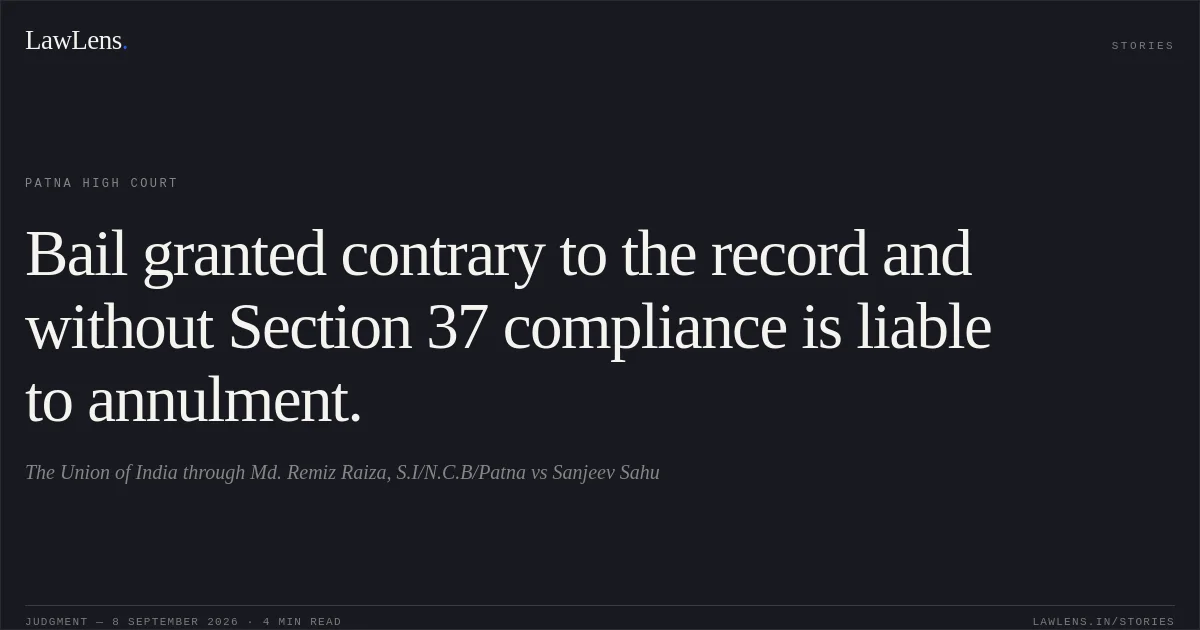
The High Court allowed the Union of India’s application under Section 439(2) CrPC and set aside the order dated 11 November 2024 granting bail to Sanjeev Sahu and Lallan Das.
It held that the order was perverse and unsustainable because it misstated the recovery and arrest record and ignored the mandatory requirements of Section 37 of the NDPS Act.
Source reference: pp. 26–27The bail bonds were cancelled, and both accused were directed to surrender before the trial court within two weeks, failing which the Senior Superintendent of Police, Muzaffarpur, was directed to secure their arrest.
Source reference: p. 27The trial court was directed to conclude the trial expeditiously and uninfluenced by the High Court’s observations on the merits.
Source reference: p. 28Acts & Sections Cited
9 provisions across 2 statutes referred to in this judgment. Each provision opens on LawLens.
Code of Criminal Procedure, 19732
Narcotic Drugs and Psychotropic Substances Act, 19857
Original Court PDF
The Union of India through Md. Remiz Raiza, S.I/N.C.B/PatnavsSanjeev Sahu
Click to open original judgment
Original judgment, available to read, download and summarize on LawLens.in