Facts
The appellants challenged the VI Additional District and Special Judge, Mysuru’s order dated 22 September 2026 rejecting their bail application in Crime No. 22/2026.
Source reference: p. 3–7The case arose from a complaint alleging that the appellants assaulted the complainant and Chandan, including with an iron rod, and abused Chandan by caste.
Source reference: p. 3–7The offences invoked included provisions of the Bharatiya Nyaya Sanhita, 2023 (BNS) and Sections 3(1)(r), 3(1)(s) and 3(2)(v) of the Scheduled Castes and the Scheduled Tribes (Prevention of Atrocities) Act, 1989.
Source reference: p. 3–7The appellants had been in judicial custody since 11 August 2026.
Source reference: p. 3–7They contended, among other things, that the victim had been discharged, their custodial presence was no longer required, and appellant No. 2 belonged to a Scheduled Tribe.
Source reference: p. 3–7The complainant, though served, did not appear.
Source reference: p. 6Issues
1. Whether the appellants should be released on bail pending trial, having regard to the nature of the injuries, their custody, and the investigation.
Source reference: p. 6–72. Whether the asserted Scheduled Tribe status of appellant No. 2 affected the applicability of the SC/ST (Prevention of Atrocities) Act.
Source reference: p. 7Law Applied
The appeal was brought under Section 14A(2) of the SC/ST (Prevention of Atrocities) Act, 1989, challenging the rejection of a bail application made under Section 483 of the Bharatiya Nagarik Suraksha Sanhita, 2023 (BNSS).
Source reference: p. 2, 6The prosecution had invoked Sections 109(1), 351 and 352, read with Section 3(5), of the BNS, and Sections 3(1)(r), 3(1)(s) and 3(2)(v) of the SC/ST Act.
Source reference: p. 2, 6The judgment cites no precedent and does not set out a detailed statutory test for bail; it states that bail was appropriate after considering the grounds raised, the nature of the injuries, and the appellants’ prior antecedents.
Source reference: p. 7Reasoning
The Court considered that the victim had been discharged, the appellants were not required for further investigation, and the nature of the injuries and the appellants’ prior antecedents supported release on conditions.
Source reference: p. 7It also noted counsel’s submission that appellant No. 2 belonged to a Scheduled Tribe, but did not separately determine the applicability of the SC/ST Act or analyse the ingredients of the alleged offences.
Source reference: p. 7The Court therefore allowed the appeal subject to safeguards intended to secure the appellants’ attendance and protect the investigation and witnesses.
Source reference: p. 7–8Holding
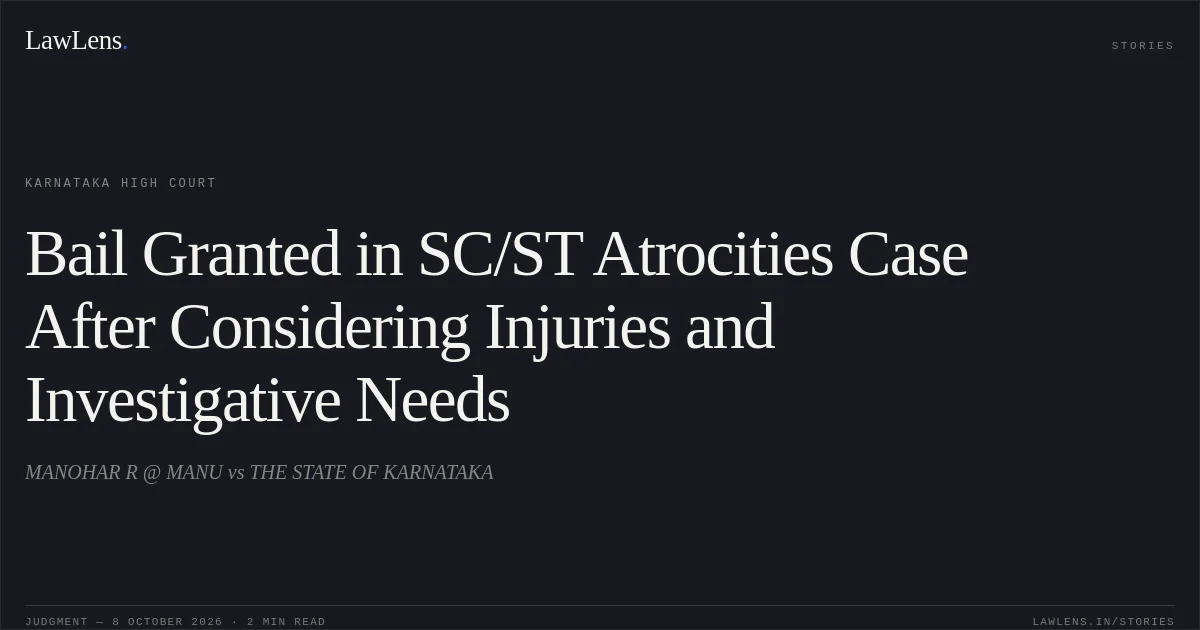
The Court allowed the appeal, set aside the order rejecting bail, and allowed the appellants’ application under Section 483 of the BNSS.
It directed that each appellant be released on executing a self-bond of ₹1,00,000 with one surety for the like amount, subject to conditions that they not tamper with or threaten witnesses, assist the investigating officer if required, and not commit a similar offence.
Source reference: p. 8Acts & Sections Cited
7 provisions across 3 statutes referred to in this judgment. Each provision opens on LawLens.
Scheduled Castes and the Scheduled Tribes (Prevention of Atrocities) Act, 19891
Bharatiya Nyaya Sanhita, 20235
Bharatiya Nagarik Suraksha Sanhita, 20231
Original Court PDF
MANOHAR R @ MANUvsTHE STATE OF KARNATAKA
Click to open original judgment
Original judgment, available to read, download and summarize on LawLens.in