01Facts
The appellants preferred a criminal appeal under Section 14-A(2) of the Scheduled Castes and Scheduled Tribes (Prevention of Atrocities) Act, 1989, challenging the order dated 14 November 2025 by which the Special Court, Koraput, refused them bail in Nandapur P.S. Case No.99 of 2025 and T.R. Case No.133 of 2025.
p. 2 / para.4The prosecution alleged that the deceased, Somnath Jani, belonging to an SC category, was abducted, murdered, and that his dead body was disposed of pursuant to a conspiracy involving the accused, attracting Sections 140(1), 103(1), 238(b), 61(2)(a) and 3(5) of the Bharatiya Nyaya Sanhita, read with Section 3(2)(va) of the SC/ST Act.
p. 2 / para.4The appellants had been in custody since 6 August 2025. The record indicated that appellant No.2, Jitru @ Jitu Gouda, was alleged to have participated in the abduction, murder, and disposal of the body, while appellant No.1, Rukmani Pani, was primarily alleged to have entered into the conspiracy by calling the deceased to a particular place.
pp. 3–4 / para.6Some witnesses had already been examined. Appellant No.1 was a woman.
p. 4 / para.6The appeal was accompanied by an application seeking condonation of a 129-day delay, which the Court allowed under Section 5 of the Limitation Act.
pp. 1–2 / paras.1–302Issues
i.Whether the 129-day delay in filing the appeal should be condoned under Section 5 of the Limitation Act?
pp. 1–2 / paras.1–3ii.Whether appellant No.1 was entitled to bail under Section 14-A(2) of the SC/ST Act, considering the nature of the allegations, her status as a woman, the period of custody, and the progress of the trial?
pp. 2–4 / paras.4–6iii.Whether appellant No.2, against whom allegations of abduction, murder, and disposal of the deceased’s body were made, should be granted bail?
pp. 3–4 / para.603Law Applied
The Court exercised appellate jurisdiction under Section 14-A(2) of the Scheduled Castes and Scheduled Tribes (Prevention of Atrocities) Act, 1989, in relation to a bail order.
p. 2 / para.4Section 5 of the Limitation Act permits condonation of delay where sufficient cause is shown, and the Court applied that provision to condone the 129-day delay.
pp. 1–2 / paras.1–3The bail determination was made on the basis of the specific allegations against each accused, the period of custody, the stage of trial, and the statutory consideration applicable to a woman accused under the proviso to Section 480 of the Bharatiya Nagarik Suraksha Sanhita, 2023.
p. 4 / para.6The alleged offences included Sections 140(1), 103(1), 238(b), 61(2)(a) and 3(5) of the Bharatiya Nyaya Sanhita, read with Section 3(2)(va) of the SC/ST Act.
p. 2 / para.4Provisions in the judgment · 8 · Linked ones open on LawLens
Scheduled Castes and the Scheduled Tribes (Prevention of Atrocities) Act, 1989 Section 3
Limitation Act, 1963 Section 5
Bharatiya Nyaya Sanhita, 2023 Section 140Section 103Section 238Section 61Section 3
Bharatiya Nagarik Suraksha Sanhita, 2023 Section 480
04Reasoning
The Court first accepted the reasons stated in the limitation application and condoned the 129-day delay.
pp. 1–2 / para.3On the merits of bail, it differentiated the appellants’ alleged roles.
p. 4 / para.6Appellant No.2 was directly implicated in the alleged abduction, murder, and disposal of the deceased’s body; accordingly, the Court was not inclined to grant him bail at that stage.
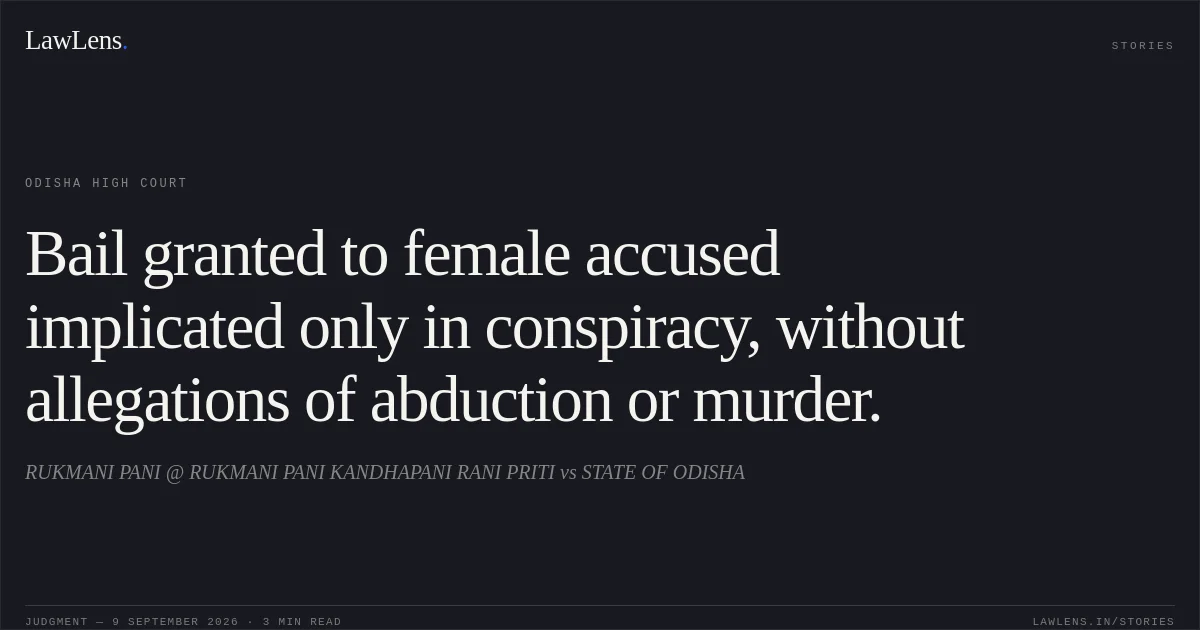
p. 4 / para.6In contrast, the allegation against appellant No.1 was principally that she participated in the conspiracy by calling the deceased to a particular place, with no specific allegation that she personally participated in the abduction or killing.
p. 3 / para.6Her custody since 6 August 2025, the examination of some witnesses, and her status as a woman, attracting consideration under the proviso to Section 480 of the BNSS, weighed in favour of granting her bail.
p. 4 / para.605Holding
The application for condonation of delay was allowed, and the 129-day delay in filing the appeal was condoned.
p. 2 / para.3The appeal was allowed in part.
p. 4 / para.7The order refusing bail was set aside only insofar as it concerned appellant No.1, Rukmani Pani, who was directed to be released on bail upon furnishing a bond of ₹25,000 with one solvent surety for the like amount, subject to the terms imposed by the trial court and excluding cash surety.
p. 4 / para.7Bail was refused to appellant No.2, Jitru @ Jitu Gouda; however, he was granted liberty to renew his bail application before the trial court if circumstances changed, including after further examination of witnesses.
p. 4 / para.7Original Court PDF
RUKMANI PANI @ RUKMANI PANI KANDHAPANI RANI PRITIvsSTATE OF ODISHA
Click to open original judgment
Original judgment, available to read, download and summarize on LawLens.in