Facts
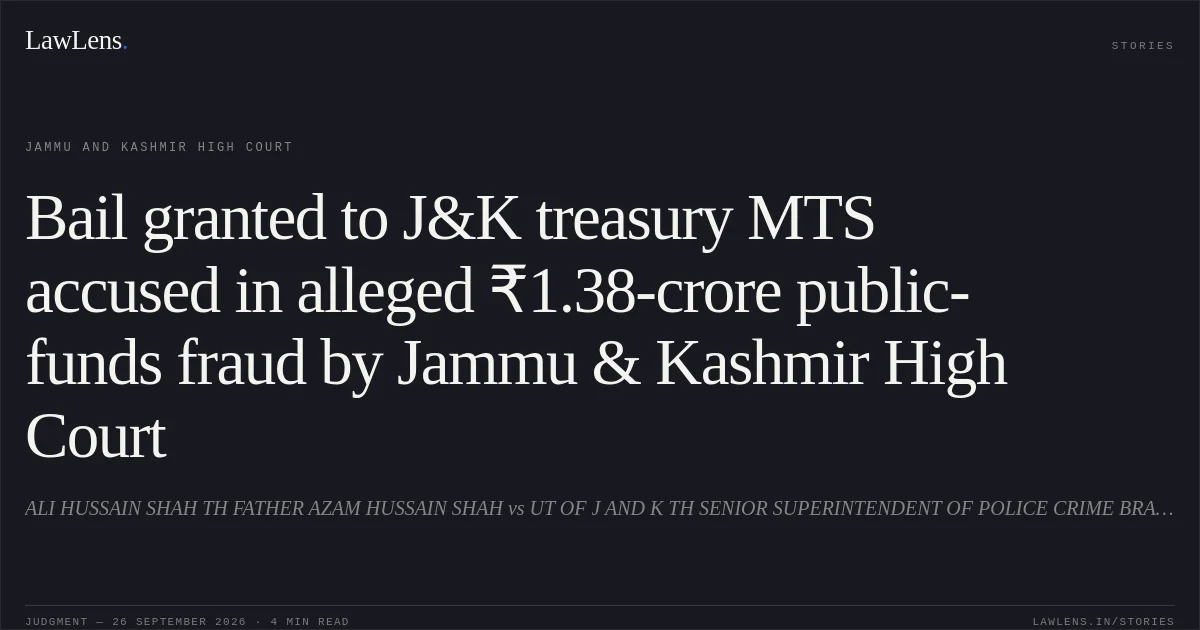
The petitioner, a Class-IV employee/MTS posted at Sub-Treasury, Dharmari, Reasi, sought regular bail under Section 483 of the Bharatiya Nagarik Suraksha Sanhita, 2023 (“BNSS”) in FIR No. 19/2024 registered at Police Station Arnas, Reasi, under Sections 409, 420, 467, 468, 471, 477-A and 120-B IPC.
Source reference: paras. 1–2; pp. 1–4The FIR arose from alleged fraudulent payments and misappropriation of approximately Rs. 1,38,17,971 from the Government treasury between 4 May 2023 and 1 March 2024.
Source reference: paras. 4, 11, 15; pp. 5–6, 10–11, 13–18The prosecution alleged that the petitioner, in conspiracy with the Assistant Treasury Officer and Accounts Assistant, misused treasury credential codes, prepared or uploaded forged bills and vouchers, and caused the misappropriated funds to be credited to his bank accounts and subsequently transferred to other accounts.
Source reference: paras. 4, 11, 15; pp. 5–6, 10–11, 13–18The petitioner was arrested in March 2024 and remained in custody thereafter.
Source reference: paras. 2, 7–10; pp. 2–5, 7–10He contended that, as an MTS/Class-IV employee, he lacked authority to process or transfer the payments, that the investigation had substantially concluded, that the charge-sheet had been filed, and that a co-accused, including the then Assistant Treasury Officer, had been granted bail.
Source reference: paras. 2, 7–10; pp. 2–5, 7–10The prosecution opposed bail on the grounds of the seriousness of the economic offences, the large loss to the public exchequer, the petitioner’s alleged role as the principal conspirator, the possibility of influencing witnesses, and the fact that further investigation remained open.
Source reference: paras. 4, 11–13; pp. 5–6, 10–13Issues
1. Whether the petitioner should be granted regular bail under Section 483 BNSS in view of the nature of the allegations, the applicable statutory bar, the status of the investigation, and the period of custody.
Source reference: paras. 17–19, 27–30; pp. 18–242. Whether the seriousness of the alleged economic offences and the possibility of witness tampering or interference with further investigation justified continued detention despite the filing of the charge-sheet and the grant of bail to a co-accused.
Source reference: paras. 29–37; pp. 24–293. Whether the restrictions under Section 480 BNSS applied to the offences alleged against the petitioner, some of which carried life imprisonment as a maximum or alternate punishment.
Source reference: paras. 21, 27; pp. 19, 23–24Law Applied
The Court applied Section 483 BNSS, corresponding to Section 439 of the Code of Criminal Procedure, 1973, concerning the High Court’s power to grant regular bail, read with the restrictions under Section 480 BNSS, corresponding to Section 437 CrPC.
Source reference: para. 1; p. 1It held that bail is generally the rule and detention is an exception where custodial interrogation is not necessary and there is no material showing a likelihood of absconding, tampering with evidence, non-cooperation, or obstruction of the trial.
Source reference: paras. 18–22; pp. 18–20The Court further held that the Section 480 BNSS bar is confined to offences punishable with death or imprisonment for life as an alternative to death, and does not apply in the same manner where life imprisonment is prescribed only as a maximum or disjunctive punishment.
Source reference: paras. 21, 27; pp. 19, 23–24Relying on State of Rajasthan v. Balchand , Gurbaksh Singh Sibbia v. State of Punjab , Sanjay Chandra v. CBI , Dataram Singh v. State of Uttar Pradesh , Prahlad Singh Bhati v. NCT of Delhi and State of U.P. v. Amarmani Tripathi , the Court emphasized that the object of bail is to secure the accused’s appearance, not to punish before conviction; seriousness of the charge is relevant but not determinative; and the Court must balance individual liberty with the interests of a fair trial and society.
Source reference: paras. 20, 23–26, 31–36; pp. 20–29Reasoning
The Court acknowledged that the allegations involved a serious financial fraud committed through an alleged conspiracy by officials entrusted with treasury functions and that the petitioner was alleged to have played a central role in routing the misappropriated funds.
Source reference: paras. 28–29; pp. 23–24However, it held that gravity or economic character of the offence could not, by itself, justify indefinite pre-trial detention.
Source reference: paras. 16–19, 29–35; pp. 17–19, 24–28The investigation had led to the filing of the charge-sheet, the petitioner had already undergone prolonged custody, and the prosecution’s concerns regarding witness influence and further investigation could be addressed through stringent conditions.
Source reference: paras. 16–19, 29–35; pp. 17–19, 24–28The Court also considered that the principal co-accused, the then Assistant Treasury Officer, had been granted bail and that the prosecution had not demonstrated circumstances requiring the petitioner’s continued custodial detention.
Source reference: paras. 29–35; pp. 24–28The decision relied on Sanjay Chandra to hold that seriousness of an economic offence is only one factor and must be balanced against the likely sentence, the presumption of innocence, and the constitutional guarantee of personal liberty under Article 21.
Source reference: paras. 30–35; pp. 24–28The prosecution’s reliance on Mohd. Ishaq Bhat v. CBI was distinguished because that case concerned an accused allegedly caught red-handed accepting a bribe, whereas the present case involved different factual circumstances.
Source reference: para. 37; p. 29Holding
The Court allowed the bail petition and admitted Ali Hussain Shah to regular bail in FIR No. 19/2024.
The petitioner was directed not to threaten, induce or promise prosecution witnesses; to appear before the Investigating Officer if required during further investigation; to remain punctual at trial; and not to leave the Union Territory of Jammu and Kashmir without prior permission of the trial court.
Source reference: para. 40; pp. 30–31The petitioner was admitted to regular bail subject to furnishing personal and surety bonds of Rs. 1 lakh each to the satisfaction of the Registrar Judicial and the Superintendent of the concerned jail.
Source reference: para. 40; p. 30Two relatives were required to furnish the surety amount in equal shares.
Source reference: para. 40; pp. 30–31The Court clarified that its observations were confined to the bail application and would not prejudice the merits of the criminal case.
Source reference: paras. 41–42; p. 31Acts & Sections Cited
11 provisions across 3 statutes referred to in this judgment. Each provision opens on LawLens.
Bharatiya Nagarik Suraksha Sanhita, 20232
Code of Criminal Procedure, 19734
Indian Penal Code, 18605
Original Court PDF
ALI HUSSAIN SHAH TH FATHER AZAM HUSSAIN SHAHvsUT OF J AND K TH SENIOR SUPERINTENDENT OF POLICE CRIME BRANCH JAMMU
Click to open original judgment
Original judgment, available to read, download and summarize on LawLens.in