Facts
The appellant was arrested on 4 May 2026 in Crime No. 06/2026 registered at Police Station Chilwani, District Sheopur, for offences under Sections 132, 121(1), 118(1), 296(A), 351(3), 121(2) and 3(5) of the Bharatiya Nyaya Sanhita, 2023, and Sections 3(1)(r), 3(1)(s), 3(2)(va) and 3(2)(v) of the Scheduled Castes and Scheduled Tribes (Prevention of Atrocities) Act, 1989 (“SC/ST Act”)
Source reference: para. 3His earlier criminal appeal was withdrawn with liberty to renew the bail prayer after filing of the charge-sheet.
Source reference: para. 1After the charge-sheet was filed, the appellant challenged the Special Judge’s order dated 16 July 2026 rejecting his application under Section 483 of the Bharatiya Nagarik Suraksha Sanhita, 2023 (“BNSS”).
Source reference: para. 1The appellant argued that the allegations arose from personal enmity, that the alleged obstruction was not connected with official duty, that the injured person suffered only a tibia fracture, and that no caste-based remarks were attributed to him.
Source reference: para. 4The State and the complainant opposed bail.
Source reference: para. 5The Court recorded that the victim had been informed of the appeal in compliance with Section 15-A of the SC/ST Act.
Source reference: para. 2Issues
Whether the appellant’s second criminal appeal under Section 14-A(2) of the SC/ST Act against rejection of bail under Section 483 of the BNSS was maintainable after the earlier appeal had been withdrawn with liberty to renew the request after filing of the charge-sheet.
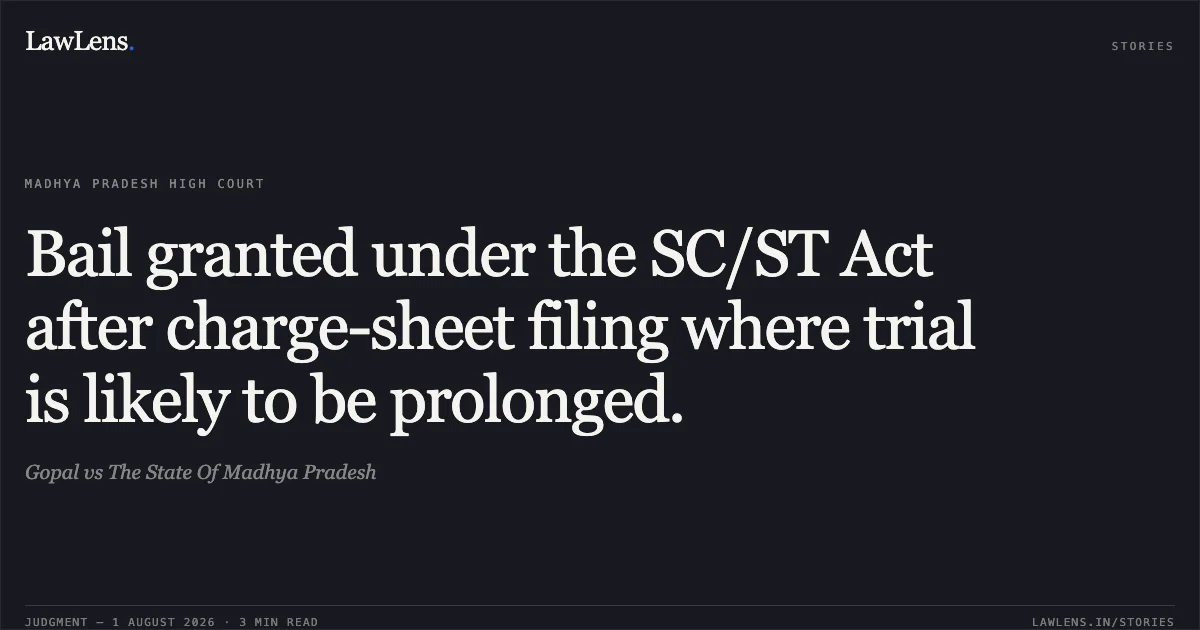
Source reference: para. 1Whether, considering the completion of investigation, filing of the charge-sheet, period of custody, nature of allegations, and likelihood of delay in trial, the appellant was entitled to bail despite the offences alleged under the BNS and the SC/ST Act.
Source reference: paras. 3–7Law Applied
The Court applied Section 14-A(2) of the SC/ST Act, which provides an appellate remedy against an order granting or refusing bail passed by a Special Court or Exclusive Special Court.
Source reference: paras. 1–2Section 15-A of the SC/ST Act, requiring notice and participation-related safeguards for victims.
Source reference: paras. 1–2Section 483 of the BNSS, governing the High Court’s and Court of Session’s power to grant bail.
Source reference: paras. 1–2The general bail principles requiring consideration of the nature of accusations, available material, period of custody, completion of investigation, likelihood of tampering or absconding, and probable duration of the trial.
Source reference: paras. 6–8The Court also exercised its discretion without expressing any final opinion on the merits of the prosecution case.
Source reference: paras. 1–2, 6–8Reasoning
The Court considered that the earlier appeal had expressly been withdrawn with liberty to renew the bail request after filing of the charge-sheet, and that the stated condition had since been fulfilled.
Source reference: para. 1The appellant had remained in custody since 4 May 2026, the investigation was complete, and the charge-sheet had been filed, reducing the need for further custodial interrogation.
Source reference: paras. 3–4The defence raised arguable questions concerning the connection between the alleged obstruction and official duty, the limited nature of the injuries, and the absence of specific caste-based remarks.
Source reference: para. 4Without adjudicating these merits, the Court gave particular weight to the fact that the trial was likely to take considerable time and that the record did not indicate a likelihood of the appellant fleeing from justice.
Source reference: para. 4On this overall assessment, the Court found the case appropriate for grant of bail.
Source reference: paras. 6–7Holding
The appeal was allowed, and the Special Judge’s order dated 16 July 2026 was set aside.
The appellant was directed to be released on bail upon furnishing a personal bond of ₹50,000 with one solvent surety in the like amount to the satisfaction of the trial Court.
Source reference: para. 7Bail was made subject to conditions requiring compliance with the bond, cooperation in the investigation/trial, non-interference with witnesses, abstention from similar offences, avoidance of unnecessary adjournments, and obtaining prior permission before leaving India.
Source reference: para. 8A copy of the order was directed to be sent to the concerned Court for compliance.
Source reference: para. 9Acts & Sections Cited
8 provisions across 3 statutes referred to in this judgment. Each provision opens on LawLens.
Bharatiya Nyaya Sanhita, 20236
Bharatiya Nagarik Suraksha Sanhita, 20231
Scheduled Castes and the Scheduled Tribes (Prevention of Atrocities) Act, 19891
Original Court PDF
GopalvsThe State Of Madhya Pradesh
Click to open original judgment
Original judgment, available to read, download and summarize on LawLens.in