Facts
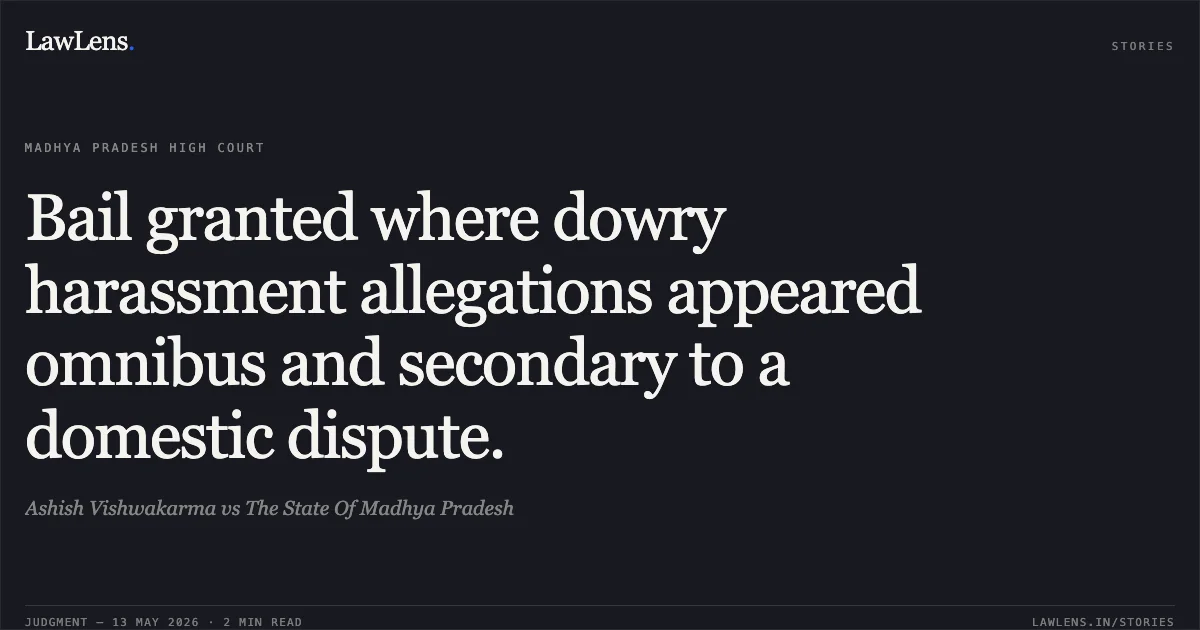
The applicant, Ashish Vishwakarma, filed his first bail application under Section 483 of the Bharatiya Nagarik Suraksha Sanhita (BNSS), 2023. He was arrested on January 29, 2026, in connection with the death of his wife, Roshni Vishwakarma.
Source reference: p. 1-2The prosecution alleged that the applicant subjected the deceased to cruelty over dowry demands (a gold chain).
Source reference: p. 2The applicant contended that on January 18, 2026, he discovered his wife speaking to one Dharmendra Sharma; after he confronted her and threatened to inform her parents, she committed suicide by hanging.
Source reference: p. 1-2The postmortem report confirmed death by asphyxia due to ante-mortem hanging with no other injuries.
Source reference: p. 2Investigation is complete and the final report has been submitted.
Source reference: p. 2Issues
1. Whether the applicant is entitled to regular bail considering the nature of allegations and the progress of the investigation
Source reference: p. 32. Whether there exists a prima facie case of dowry death/harassment or if the incident was triggered by personal marital discord unrelated to dowry
Source reference: p. 2-3Law Applied
The court applied Section 483 of the Bharatiya Nagarik Suraksha Sanhita (BNSS), 2023 [equivalent to Section 439 CrPC] regarding the High Court's power to grant bail.
Source reference: p. 1Substantive charges were considered under Sections 85 (Cruelty by husband or relatives) and 80(2) (Dowry Death terms) of the Bharatiya Nyaya Sanhita (BNS), 2023, along with Sections 3 and 4 of the Dowry Prohibition Act.
Source reference: p. 1-2The court also adhered to the principle of "bail is the rule, jail is the exception," evaluating the risk of recidivism, tampering with evidence, and the socio-economic status of the accused.
Source reference: p. 3Reasoning
The court observed that the applicant has been in custody since January 29, 2026, and the investigation is already complete with the final report filed.
Source reference: p. 2-3It noted the absence of criminal antecedents and the applicant's status as a labourer with family responsibilities.
Source reference: p. 2-3Critically, the court found merit in the applicant’s defense that the suicide followed a specific confrontation regarding a phone call to a third party, rather than immediate dowry harassment.
Source reference: p. 2The medical evidence corroborated death by hanging without signs of physical struggle or other injuries.
Source reference: p. 2The court reasoned that since the trial would take time and there was no evidence suggesting the applicant would flee or influence witnesses, continued incarceration was not compelling.
Source reference: p. 3Holding
The court held that the veracity of the prosecution's claims and the applicant's complicit role are matters to be determined during the trial.
The court allowed the application and directed the release of the applicant on bail upon furnishing a personal bond of Rs. 50,000/- with one solvent surety of the same amount, subject to conditions including regular appearance in court, refraining from committing similar offences, and not tampering with evidence or threatening witnesses.
Source reference: p. 3-4Acts & Sections Cited
7 provisions across 3 statutes referred to in this judgment. Each provision opens on LawLens.
Bharatiya Nagarik Suraksha Sanhita, 20234
Code of Criminal Procedure, 19731
Original Court PDF
Ashish VishwakarmavsThe State Of Madhya Pradesh
Click to open original judgment
Original judgment, available to read, download and summarize on LawLens.in