Facts
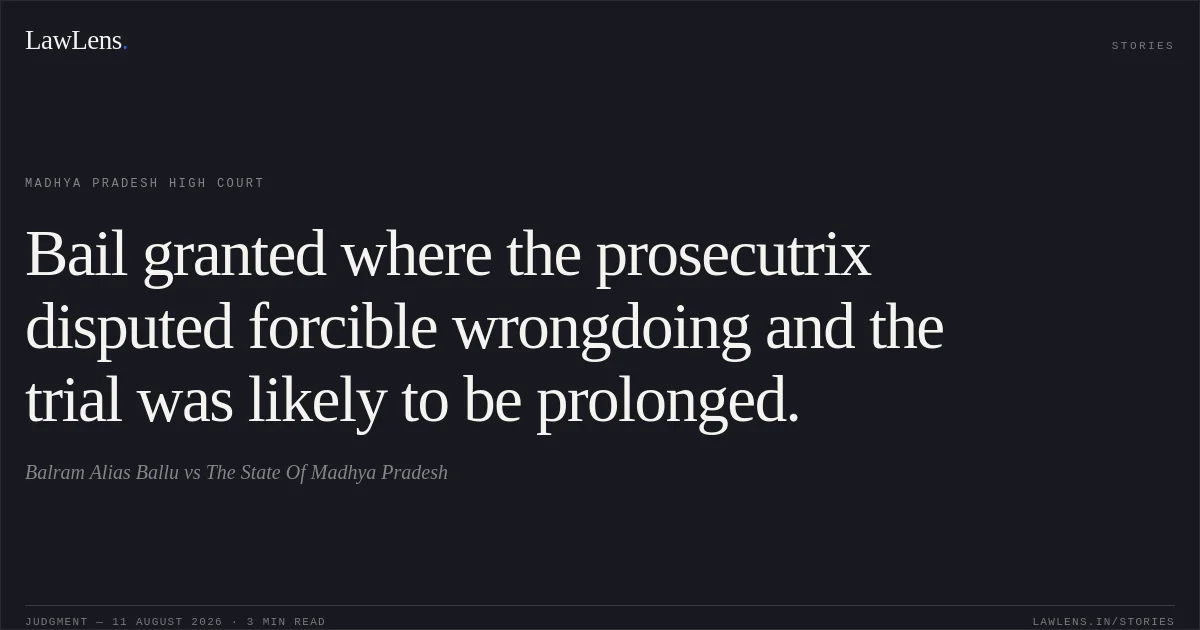
The appellant challenged the order dated 22 July 2026 of the Special Judge (Atrocities), Sheopur, rejecting his bail application under Section 483 of the Bharatiya Nagarik Suraksha Sanhita, 2023 (“BNSS”). The appeal was filed under Section 14-A(2) of the Scheduled Castes and Scheduled Tribes (Prevention of Atrocities) Act, 1989 (“SC/ST Act”).
Source reference: para. 1The appellant was arrested on 3 July 2026 in connection with Crime No. 224/2026 registered at Police Station Vijaypur, District Sheopur, for offences under Sections 70(1), 87, 127(2), 351(3) and 506 of the Bharatiya Nyaya Sanhita, 2023 (“BNS”), and Sections 3(1)(w)(i) and 3(2)(va) of the SC/ST Act.
Source reference: para. 3The prosecution alleged that on 27 June 2026 the appellant deceitfully took the prosecutrix to the house of co-accused Jheeguriya, where she was wrongfully confined and repeatedly raped until 30 June 2026.
Source reference: para. 4The appellant relied on the delay in lodging the FIR, which was registered on 2 July 2026 although the prosecutrix had allegedly returned home on 30 June 2026.
Source reference: para. 4He also relied on the prosecutrix’s sworn affidavit and no-objection application, in which she stated that the appellant had not committed any forcible wrongful act and that the dispute arose from a monetary transaction which had been amicably resolved through a village panchayat.
Source reference: para. 4Issues
Whether the appellant was entitled to bail under Section 483 of the BNSS in an appeal under Section 14-A(2) of the SC/ST Act, despite the allegations under the BNS and the SC/ST Act?
Source reference: paras. 1, 3–7Whether the attending circumstances—including the appellant’s custody, the alleged delay in lodging the FIR, the prosecutrix’s subsequent affidavit and no-objection, and the likelihood of a prolonged trial—justified granting bail without commenting on the merits of the prosecution case?
Source reference: para. 4; para. 7Law Applied
The Court applied Section 14-A(2) of the SC/ST Act, which provides the statutory mechanism for an appeal against an order of a Special Court refusing or granting bail; Section 483 of the BNSS, governing the High Court’s power to grant bail; and Sections 15-A and 18-A of the SC/ST Act framework, including the requirement that the victim be informed of the appeal.
Source reference: paras. 1–2The governing bail principle applied was that bail may be granted after considering the allegations, material in the case diary, period of custody, likelihood of the trial taking time, possibility of absconding or tampering with evidence, and the need to impose safeguards, without undertaking a final adjudication on the merits at the bail stage.
Source reference: paras. 4.1, 6–8The Court also considered the offences alleged under Sections 70(1), 87, 127(2), 351(3) and 506 of the BNS and Sections 3(1)(w)(i) and 3(2)(va) of the SC/ST Act.
Source reference: para. 3Reasoning
The Court considered the appellant’s custody since 3 July 2026, the submissions regarding the delayed FIR, and the prosecutrix’s affidavit and no-objection asserting that the dispute was monetary and had been resolved.
Source reference: paras. 4, 4.1It also noted the appellant’s submission that the prosecutrix’s statement under Section 164 of the Code of Criminal Procedure did not prima facie establish the alleged offences, although the Court did not expressly determine that contention on merits.
Source reference: para. 4.1After perusing the case diary and hearing the State, the Court gave particular weight to the fact that the trial would take time to conclude.
Source reference: paras. 5–7It therefore exercised its bail jurisdiction while expressly declining to comment on the merits of the case.
Source reference: paras. 5–7The risks of interference, harassment and non-cooperation were addressed through detailed bail conditions, including cooperation with the investigation and trial, prohibition against threats or inducements, a restriction on leaving India, and a direction not to approach or harass the complainant or prosecutrix.
Source reference: para. 8Holding
The High Court allowed the criminal appeal and set aside the order dated 22 July 2026 rejecting bail.
It directed that the appellant be released on bail upon furnishing a personal bond of Rs. 50,000, together with one solvent surety for the like amount, to the satisfaction of the trial Court.
Source reference: para. 7The bail was made subject to conditions requiring compliance with the bond, cooperation in the investigation and trial, non-interference with witnesses, abstention from similar offences, avoidance of unnecessary adjournments, prior permission before leaving India, and non-harassment of or movement in the vicinity of the complainant party/prosecutrix.
Source reference: para. 8A copy of the order was directed to be sent to the concerned Court for compliance.
Source reference: para. 9Acts & Sections Cited
8 provisions across 4 statutes referred to in this judgment. Each provision opens on LawLens.
Scheduled Castes and the Scheduled Tribes (Prevention of Atrocities) Act, 19891
Bharatiya Nyaya Sanhita, 20235
Bharatiya Nagarik Suraksha Sanhita, 20231
Code of Criminal Procedure, 19731
Original Court PDF
Balram Alias BalluvsThe State Of Madhya Pradesh
Click to open original judgment
Original judgment, available to read, download and summarize on LawLens.in