01Facts
The State challenged the order dated 1 January 2025 by which the learned Special Judge-I, Shimla granted bail to several accused in FIR No. 50 of 2024, registered at Police Station Kotkhai under Sections 21 and 29 of the Narcotic Drugs and Psychotropic Substances Act, 1985 (“NDPS Act”).
¶ 1–2The High Court also initiated suo motu proceedings concerning bail granted in the same FIR by orders dated 29 March 2025.
¶ 1–2The prosecution case was that, on 18–19 September 2024, the police intercepted a taxi carrying Muddasir Ahmad Mochi and Deepan Lal.
¶ 2.1–2.10Although no contraband was found in the vehicle or in Muddasir’s bag, a subsequent search conducted in the presence of a gazetted officer allegedly resulted in the recovery of 468.380 grams of heroin/chitta from Muddasir’s underwear.
¶ 2.1–2.10The recovered quantity was treated as commercial quantity.
¶ 3During investigation, statements of the accused and bank-account records allegedly indicated an interstate drug-distribution network involving Shahi Mahatma, Muddasir Ahmad Mochi, Harinder Manta, Pradeep Kumar @ Pankaj Ranta and other persons.
¶ 2.13–2.38The prosecution also relied upon alleged financial transactions between certain accused persons and the principal accused.
¶ 2.13–2.38The trial Court granted bail without recording findings under Section 37(1)(b)(ii) of the NDPS Act and, in part, proceeded on the assumption that some accused were drug-dependent and had acquired contraband for personal consumption.
¶ 8–1002Issues
i.1. Whether the trial Court could grant bail in an offence involving commercial quantity under the NDPS Act without recording the mandatory findings required under Section 37(1)(b)(ii), namely, that there were reasonable grounds to believe that the accused were not guilty and that they were unlikely to commit any offence while on bail?
¶ 3–9ii.2. Whether the bail orders dated 1 January 2025 and 29 March 2025 were legally sustainable when the trial Court treated the prosecution case as requiring further scrutiny and assumed possible personal consumption without recording the statutory satisfaction under Section 37?
¶ 9–13iii.3. Whether the matter should be remanded to the trial Court for fresh consideration of the bail applications in accordance with Section 37 of the NDPS Act?
¶ 14–1503Law Applied
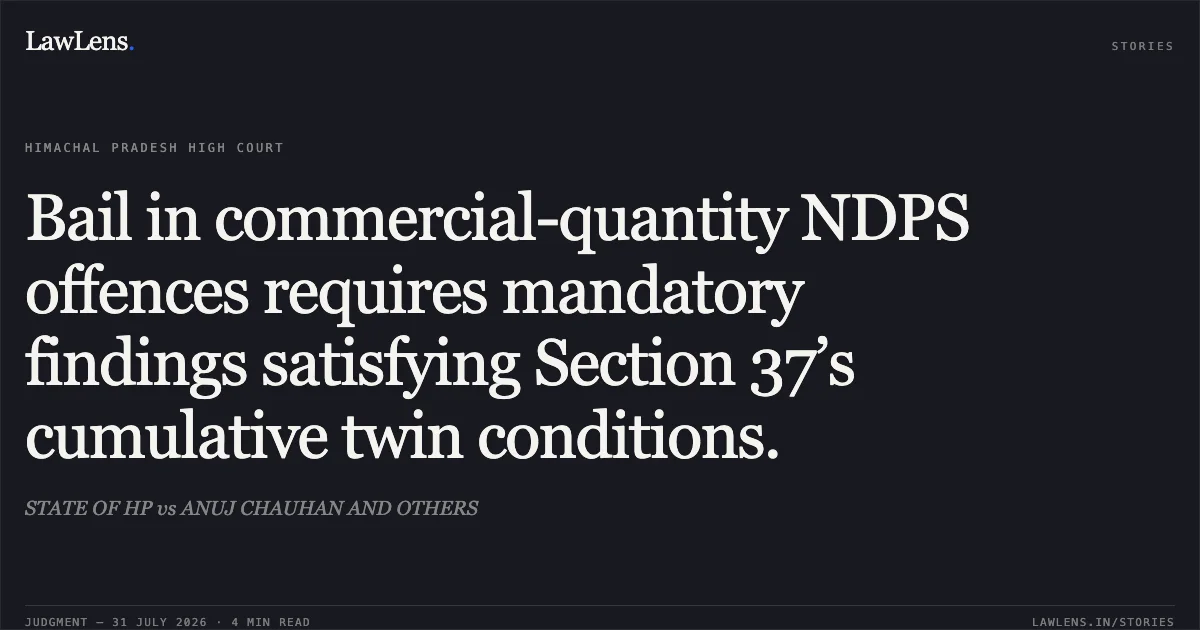
Section 37(1)(b) of the NDPS Act imposes stringent and mandatory conditions for bail where the offence involves commercial quantity: the Public Prosecutor must be given an opportunity to oppose bail, and, if bail is opposed, the Court must be satisfied that there are reasonable grounds for believing that the accused is not guilty and is unlikely to commit any offence while on bail.
¶ 8The twin conditions are cumulative, and “reasonable grounds” require something more than prima facie grounds—namely, credible and substantial grounds supporting a belief that the accused is not guilty.
¶ 5–6The Court relied on Narcotics Control Bureau v. Mohit Aggarwal, AIR 2022 SC 3444, and Narcotics Control Bureau v. Kashif, 2024 INSC 1045, which hold that Section 37 is mandatory and that recording the requisite findings is a sine qua non for granting bail in commercial-quantity cases.
¶ 5–6The Court also applied the principle that procedural or evidentiary issues cannot be used to bypass the statutory requirements of Section 37 at the bail stage.
¶ 6, 9–12Provisions in the judgment · 11 · Linked ones open on LawLens
Narcotic Drugs and Psychotropic Substances Act, 1985 9 provisions
Section 19Section 21Section 24Section 27Section 29Section 37Section 42Section 50Section 54Code of Criminal Procedure, 1973 Section 439
Bharatiya Nagarik Suraksha Sanhita, 2023 Section 180
04Reasoning
The alleged recovery of 468.380 grams of heroin/chitta constituted commercial quantity, thereby attracting Section 37 of the NDPS Act.
¶ 2.9, 3–4The trial Court nevertheless granted bail without determining whether there were reasonable grounds to believe that the accused were not guilty or that they would not commit an offence while on bail.
¶ 8–9Its reasoning that the case involved financial transactions requiring detailed legal scrutiny, and that the accused might have been purchasing contraband for personal consumption, did not amount to the mandatory statutory satisfaction under Section 37.
¶ 9–10The High Court held that the trial Court could not bypass the legislative mandate on the basis of assumptions, particularly when personal consumption had neither been pleaded by the accused nor accepted by the prosecution.
¶ 10The trial Court also failed to explain its conclusion that the alleged offences were punishable under Section 27 of the NDPS Act and therefore inherently bailable.
¶ 11Since the twin conditions under Section 37 had not been considered or recorded, the bail orders were unsustainable.
05Holding
The High Court held that the bail orders dated 1 January 2025 and 29 March 2025 were legally unsustainable because they were passed without compliance with the mandatory requirements of Section 37(1)(b)(ii) of the NDPS Act.
¶ 13–14The orders were set aside and the matter was remanded to the trial Court for fresh decision on the bail applications, in accordance with law, within one month of receipt of the record.
¶ 15Bail was not cancelled immediately; the existing bail orders were directed to remain operative on the same terms and conditions until the trial Court decided the applications afresh.
¶ 15–18The sureties were to be informed, and both proceedings were disposed of.
¶ 15–18Original Court PDF
STATE OF HPvsANUJ CHAUHAN AND OTHERS
Click to open original judgment
Original judgment, available to read, download and summarize on LawLens.in