01Facts
The petitioner, a 35-year-old labourer, is the sole accused in Spl. C. (POCSO) No. 49/2026 before the Additional District and Sessions Judge, Bidar, arising from Crime No. 25/2026 registered by Bidar Women Police Station for offences under Sections 137(2), 64(2)(m) and 351(2) of the BNS and Sections 4 and 6 of the POCSO Act.
pp. 1–2The prosecution alleges that the petitioner is the husband of the victim's maternal aunt, that he had sexual intercourse with the victim over about two years, and that on 16.03.2026 he took her to Hyderabad and committed forcible intercourse at a lodge.
¶ 3 · pp. 3–4On 13.04.2026 police apprehended the two at the petitioner's brother-in-law's house in Doulatabad, Bidar, and the FIR was registered on the victim's statement.
¶ 3 · p. 4The charge sheet has been filed and the trial has commenced; the victim has been examined as PW-1.
¶ 11 · p. 8The petitioner relies on a school admission extract giving the victim's date of birth as 07.04.2008, and on her Aadhaar-based date of birth of 04.04.2008 disclosed at the time of marriage on 08.04.2026, which he contends places her below 18 at the time of the alleged incidents.
¶ 5 · pp. 4–5 · ¶ 6 · pp. 5–6In cross-examination, PW-1 admitted the marriage, and the defence marked the marriage photographs, affidavit and marriage register as Exs. D1–D4.
¶ 6 · pp. 5–6 · ¶ 7 · p. 6The prosecution and respondent No. 2 contend that the marriage was procured by threat, but the victim's statement to police does not say so.
¶ 8 · pp. 6–7The petitioner has no antecedents forthcoming from the police report.
¶ 12 · pp. 8–902Issues
i.1. Whether the petitioner, charged under the POCSO Act and the BNS, is entitled to bail during the pendency of trial, where the investigation is complete, the charge sheet is filed and PW-1 has been examined.
¶ 10–11 · p. 8ii.2. Whether the admitted marriage between the petitioner and the victim, and the discrepancy in the victim's dates of birth, can be considered at the bail stage, without entering the merits of the case.
¶ 5–9 · pp. 4–8 · ¶ 10 · p. 8iii.3. Whether the prosecution's contention that the marriage was procured by threat, and the victim's alleged suppression of her age and marriage before police and the Magistrate, constitute grounds to deny bail.
¶ 8–9 · pp. 6–8iv.4. Whether the seriousness of the offences, or the petitioner being the husband of the victim's maternal aunt, justifies continued custody, and whether the HCGP's apprehensions can be met by conditions.
¶ 12–14 · pp. 8–1003Law Applied
Section 483 of the BNSS (the successor to Section 439 CrPC) governs the High Court's power to grant bail; the inquiry was confined to whether continued judicial custody is necessary, since the merits must not be examined at the bail stage so as not to prejudice the trial.
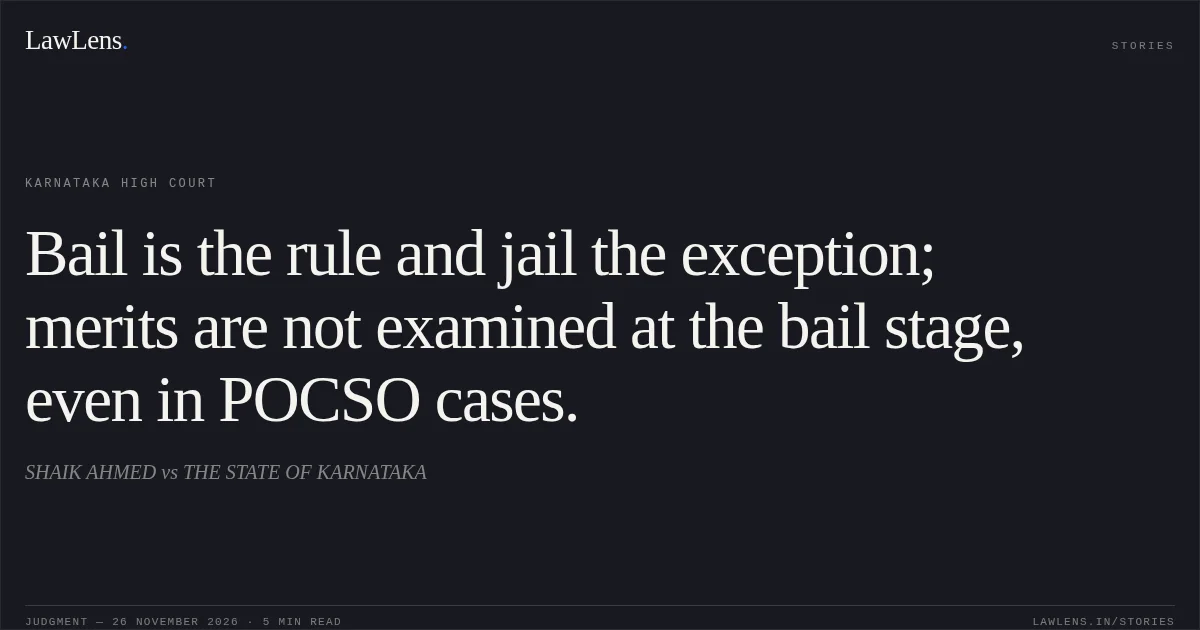
¶ 10 · p. 8Bail is the rule and jail the exception; an accused may not be kept in custody during the pre-trial stage as punishment, and the accused is presumed innocent until proved guilty, even where the offences are heinous, such as those under Section 6 of the POCSO Act and Section 64(2)(m) of the BNS.
¶ 13 · p. 9The risks of witness tampering and hampering investigation are assessed on the stage reached in the case, and apprehensions can be addressed through conditions.
¶ 11 · p. 8 · ¶ 14 · pp. 9–10Section 94 of the Juvenile Justice (Care and Protection of Children) Act, 2015, governing age determination, was referred to as the procedure the investigating officer should have invoked for resolving conflicting dates of birth.
¶ 6 · pp. 5–6Section 183 of the BNSS (recording of statements before a Magistrate) was noted in assessing the victim's earlier statements.
¶ 9 · p. 8No precedent was cited.
Provisions in the judgment · 8 · Linked ones open on LawLens
Bharatiya Nagarik Suraksha Sanhita, 2023 Section 483Section 183
Bharatiya Nyaya Sanhita, 2023 Section 137Section 64Section 351
Protection of Children from Sexual Offences Act, 2012 Section 4Section 6
Juvenile Justice (Care and Protection of Children) Act, 2015. Section 94
04Reasoning
The defence of innocence raised by the petitioner could not be accepted at this stage, since the investigation is over and the charge sheet filed, and the merits could not be decided at the bail stage.
¶ 4 · p. 5 · ¶ 10 · p. 8The conflicting dates of birth (07.04.2008 in the school record and 04.04.2008 on the Aadhaar card) were noted, with the observation that the investigating officer had not initiated age determination under Section 94 of the JJ Act, and that the victim herself had deposed in cross-examination that she had not disclosed the marriage to police or the Magistrate. These matters were treated as relevant to the strength of the prosecution's case and to the victim's credibility, but no finding was reached on them, and the merits were expressly left to trial.
¶ 6 · pp. 5–6 · ¶ 9 · pp. 7–8 · ¶ 10 · p. 8On custody, the court found that the investigation was complete, that the victim had already been examined, and that there was no real risk of tampering with witnesses or hampering investigation.
¶ 11 · p. 8The relationship with the victim's maternal aunt was held insufficient, by itself, to deny bail, and the absence of any antecedents or special grounds advanced by the police weighed in favour of release.
¶ 12 · pp. 8–9Although the offences are serious, the presumption of innocence and the rule that bail is the norm led the court to conclude that there was no reason to deny bail, and that the apprehensions of the HCGP could be met through bail conditions.
¶ 13–14 · pp. 9–1005Holding
The petitioner had made out sufficient grounds for bail, and the Criminal Petition was allowed.
¶ 14 · pp. 9–10 · ¶ 15 · p. 10The petitioner is to be enlarged on bail in Spl. C. (POCSO) No. 49/2026 on executing a personal bond for ₹2,00,000 with two sureties for the like sum, to the satisfaction of the Special Court, subject to the conditions that he (i) appear before the Special Judge as and when directed and assist the trial; (ii) not tamper with prosecution witnesses or hamper further investigation; and (iii) not commit any similar offence or any offence during the pendency of the case.
pp. 10–11The order does not reflect the reference to Section 351(2) BNS in the operative part as framed in the body of the petition.
pp. 1–2 · pp. 10–11The court expressly made no finding on the petitioner's innocence, the victim's age, or the alleged threat to marry, which remain for trial.
¶ 4 · p. 5 · ¶ 10 · p. 8Original Court PDF
SHAIK AHMEDvsTHE STATE OF KARNATAKA
Click to open original judgment
Original judgment, available to read, download and summarize on LawLens.in