Facts
The appellants were charged in Crime No. 381 of 2025 with offences under Sections 61(2), 296(b) and 103(1) of the Bharatiya Nyaya Sanhita, 2023, and Sections 3(1)(r) and 3(2)(v) of the SC/ST (Prevention of Atrocities) Act.
Source reference: p. 2The prosecution alleged that they and a juvenile had attacked the deceased with a knife because of prior enmity.
Source reference: p. 2Arrested on 21 August 2025, the appellants were subsequently detained under Act 14 of 1982; after that detention order was quashed, the Sessions Court dismissed their bail application on 30 April 2026.
Source reference: p. 2By the time the appeal was considered, the trial had commenced.
Source reference: p. 3–4A2 had cross-examined PW1 and PW2, while PW3 had turned hostile; A1’s counsel undertook to cross-examine PW1 and PW2 at the next available hearing.
Source reference: p. 3–4Issues
Whether the appellants should be released on bail after the Sessions Court dismissed their bail application, having regard to their period in custody and the progress of the trial.
Source reference: p. 2, 4Whether conditions should be imposed to protect the de facto complainant and ensure the appellants’ attendance and timely conduct of the trial.
Source reference: p. 4–6Law Applied
The appeal was brought under Section 14(a) of the SC/ST (Prevention of Atrocities) Act.
Source reference: p. 1The charged provisions were Sections 61(2), 296(b) and 103(1) of the BNS, 2023, and Sections 3(1)(r) and 3(2)(v) of the SC/ST Act.
Source reference: p. 2The Court relied on its assessment that continued custody was not required for the trial, and imposed conditions governing attendance, non-interference with witnesses and the de facto complainant’s safety.
Source reference: p. 4–6It cited P.K. Shaji v. State of Kerala, [(2005) AIR SCW 5560], for the trial court’s authority to take appropriate action if bail conditions are breached.
Source reference: p. 5Reasoning
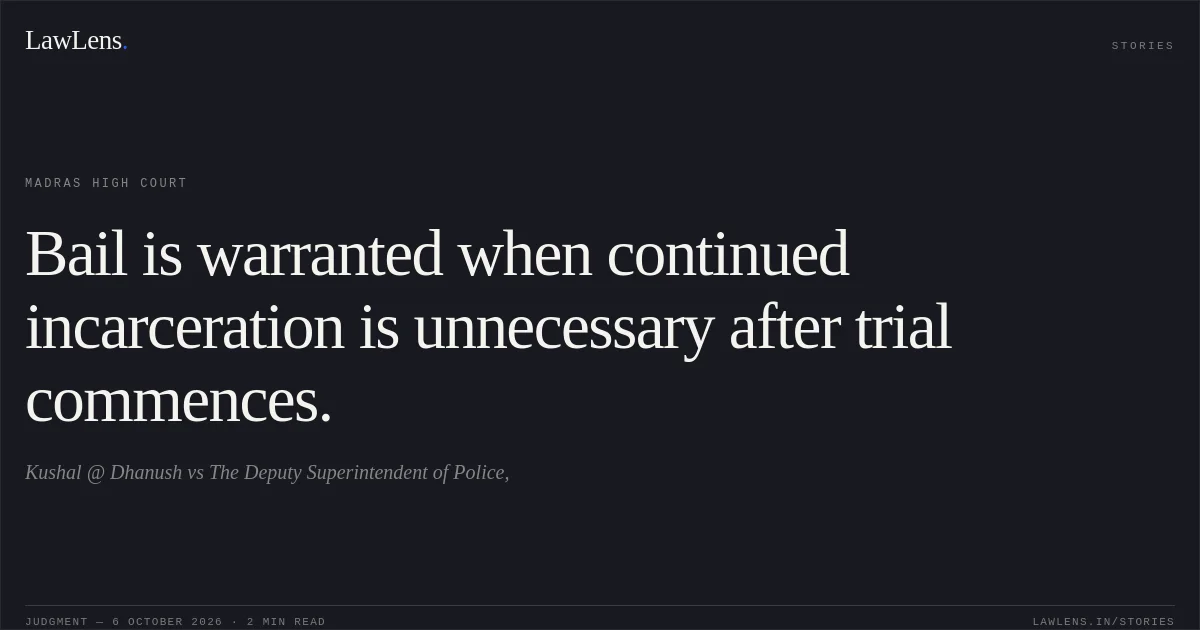
The Court considered that the appellants had been in custody since 21 August 2025, the trial had commenced, and further incarceration was not necessary for trial purposes.
Source reference: p. 4It also took account of the trial’s progress and the appellants’ need to defend themselves before the trial court.
Source reference: p. 4To address the risk of delay and protect the complainant, it required A1 not to seek an adjournment for cross-examining PW1 and PW2 when they were next produced, and permitted the State to seek cancellation of bail if A1 adopted dilatory tactics.
Source reference: p. 4, 6The Court also imposed conditions concerning attendance, non-absconding, non-tampering with evidence or witnesses, and the complainant’s safety.
Source reference: p. 4–6Holding
The Court allowed the appeal and set aside the Sessions Court’s order dated 30 April 2026 dismissing the bail application.
It directed the appellants’ release on bonds of ₹25,000 each, with two sureties each for a like sum, subject to the stated conditions, including regular attendance, protection of the complainant, and A1’s timely cross-examination of PW1 and PW2.
Source reference: p. 4–6Acts & Sections Cited
4 provisions across 2 statutes referred to in this judgment. Each provision opens on LawLens.
Scheduled Castes and the Scheduled Tribes (Prevention of Atrocities) Act, 19891
Bharatiya Nyaya Sanhita, 20233
Original Court PDF
Kushal @ DhanushvsThe Deputy Superintendent of Police,
Click to open original judgment
Original judgment, available to read, download and summarize on LawLens.in