Facts
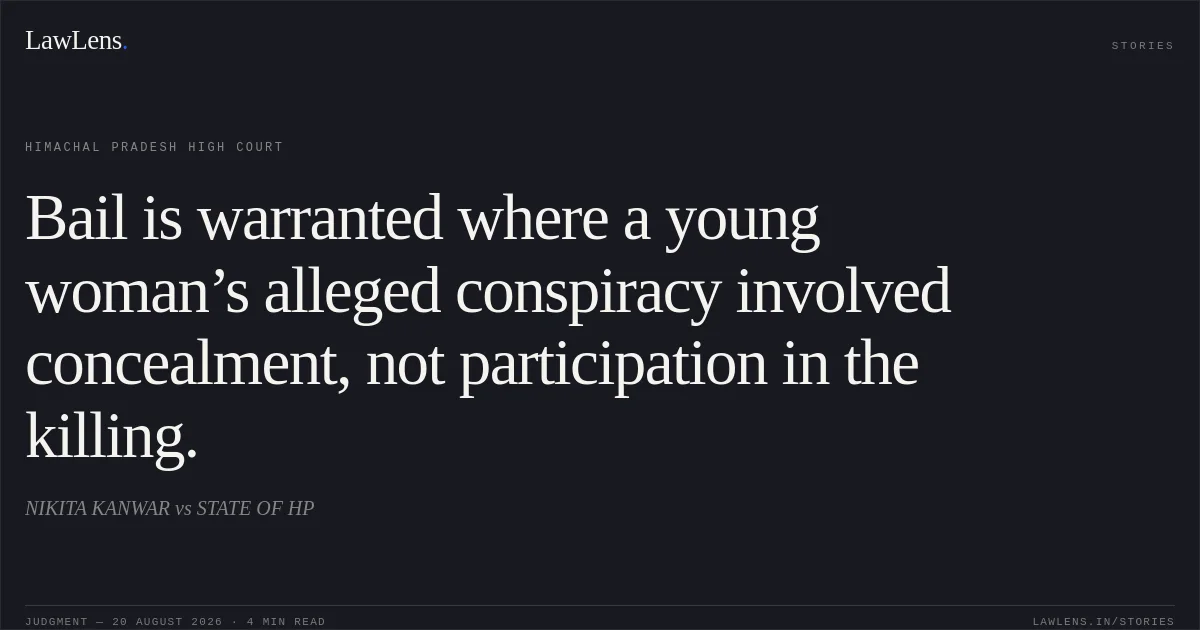
The petitioner, Nikita Kanwar, aged 19 years and a college student, had been in custody since 5 February 2026 in FIR No. 12 of 2026, registered at Police Station Kasauli, District Solan, under Sections 103 and 61(2) of the Bharatiya Nyaya Sanhita, 2023 (“BNS”).
Source reference: p.1, para. 1The deceased, Suman, was found dead at her matrimonial home on 31 January 2026. Her husband, co-accused Chattar Singh, initially attempted to portray the death as suicide but subsequently disclosed to the police that he had strangulated Suman after an altercation and had thereafter inflicted injuries on her neck to create a false suicide narrative.
Source reference: pp.2–4, para. 3The prosecution alleged that Chattar Singh, his brother Narender, and the petitioner conspired to conceal the killing.
Source reference: pp.4–5, paras. 5, 7–8The petitioner contended that there was no evidence that she had inflicted any injury on the deceased or participated in the killing, and that the alleged conspiracy was formed only after the deceased had died.
Source reference: pp.4–5, paras. 5, 7–8The challan had been filed and nothing remained to be recovered from the petitioner.
Source reference: p.4, para. 4Issues
1. Whether the petitioner was entitled to regular bail under Section 483 of the Bharatiya Nagarik Suraksha Sanhita, 2023, notwithstanding the gravity of the offences alleged under Sections 103 and 61(2) BNS?
Source reference: p.1, para. 1; pp.5–7, paras. 6–92. Whether the material on record disclosed a prima facie case of the petitioner’s participation in the murder or criminal conspiracy to conceal the deceased’s death sufficient to justify her continued incarceration during trial?
Source reference: pp.6–7, paras. 7–93. Whether the petitioner’s age, gender, status as a first offender, completion of investigation, and the constitutional protection of personal liberty supported the grant of bail?
Source reference: pp.7–9, paras. 9–14Law Applied
The Court exercised its jurisdiction under Section 483 BNSS, which empowers the High Court to grant regular bail.
Source reference: p.1, para. 1It considered the first proviso to Section 480 BNSS, under which a woman, child, sick or infirm person may be released on bail in the circumstances specified by the provision, subject to its statutory limitations.
Source reference: p.7, para. 9The alleged offences were under Sections 103 and 61(2) BNS, concerning culpable homicide/murder and criminal conspiracy, respectively.
Source reference: p.1, para. 1The Court applied the presumption of innocence and the principle that incarceration should not continue indefinitely where the trial may take considerable time, as recognised under Article 21 of the Constitution.
Source reference: p.8, para. 10Relying on Dataram Singh v. State of Uttar Pradesh, Criminal Appeal No. 227 of 2018, it reiterated that an accused is presumed innocent until proven guilty and that liberty cannot be curtailed indefinitely.
Source reference: p.8, para. 11It also relied on Sanjay Chandra v. Central Bureau of Investigation, (2012) 1 SCC 49, for the principle that gravity alone is not decisive in bail matters and that bail is intended to secure attendance at trial, not to punish or preventively detain the accused; Manoranjana Sinh alias Gupta v. CBI, (2017) 5 SCC 218, for the principle that the primary object of bail is securing the accused’s presence at trial and that bail is ordinarily the rule; and Prasanta Kumar Sarkar v. Ashis Chatterjee, (2010) 14 SCC 496, for the relevant bail factors, including the prima facie case, nature and gravity of the accusation, severity of punishment, likelihood of repetition, and possibility of witness influencing.
Source reference: pp.8–9, paras. 12–14Reasoning
The Court found that co-accused Chattar Singh’s statement attributed the actual strangulation and subsequent infliction of injuries on the deceased to him, and did not state that the petitioner had inflicted any injury upon Suman.
Source reference: p.6, para. 7The injuries allegedly caused to the petitioner were treated as part of the fabricated attempt to suggest that Suman had attacked her husband, the petitioner, and Narender.
Source reference: p.6, para. 7The Court further noted that, even on the prosecution’s case, Suman had died before the injuries were allegedly inflicted on her throat or neck; therefore, the strongest allegation against the petitioner was participation in an attempt to conceal the death, a fact still requiring proof at trial.
Source reference: p.6, para. 8Since there was no direct evidence showing that the petitioner caused injury to the deceased, the investigation was complete, the challan had been filed, and no recovery remained, continued detention was not justified merely because the alleged offence was serious.
Source reference: pp.4, 6–8, paras. 4, 7–10The petitioner’s age, gender, first-offender status, and the absence of any applicable disqualification under the proviso to Section 480 BNSS further supported a lenient view.
Source reference: p.7, para. 9The Court considered that any apprehension of flight or interference with the administration of justice could be addressed through stringent bail conditions.
Source reference: p.8, para. 10Holding
The Court held that the petitioner had established a case for regular bail.
It therefore allowed the petition and directed her release in FIR No. 12 of 2026 upon furnishing a personal bond of Rs. 2,00,000/- with two local sureties in the like amount to the satisfaction of the concerned Chief Judicial Magistrate or trial Court.
Source reference: p.9, para. 15The bail was subject to conditions requiring her to cooperate with interrogation, attend the trial regularly, refrain from tampering with evidence or influencing witnesses, and not leave India without prior permission of the Court.
Source reference: pp.9–10, para. 15The Court clarified that misuse or violation of the conditions would entitle the investigating agency to seek cancellation of bail, and that its observations were confined to the bail application and would not affect the merits of the trial.
Source reference: p.10, paras. 16–17Acts & Sections Cited
5 provisions across 2 statutes referred to in this judgment. Each provision opens on LawLens.
Bharatiya Nagarik Suraksha Sanhita, 20233
Bharatiya Nyaya Sanhita, 20232
Original Court PDF
NIKITA KANWARvsSTATE OF HP
Click to open original judgment
Original judgment, available to read, download and summarize on LawLens.in