Facts
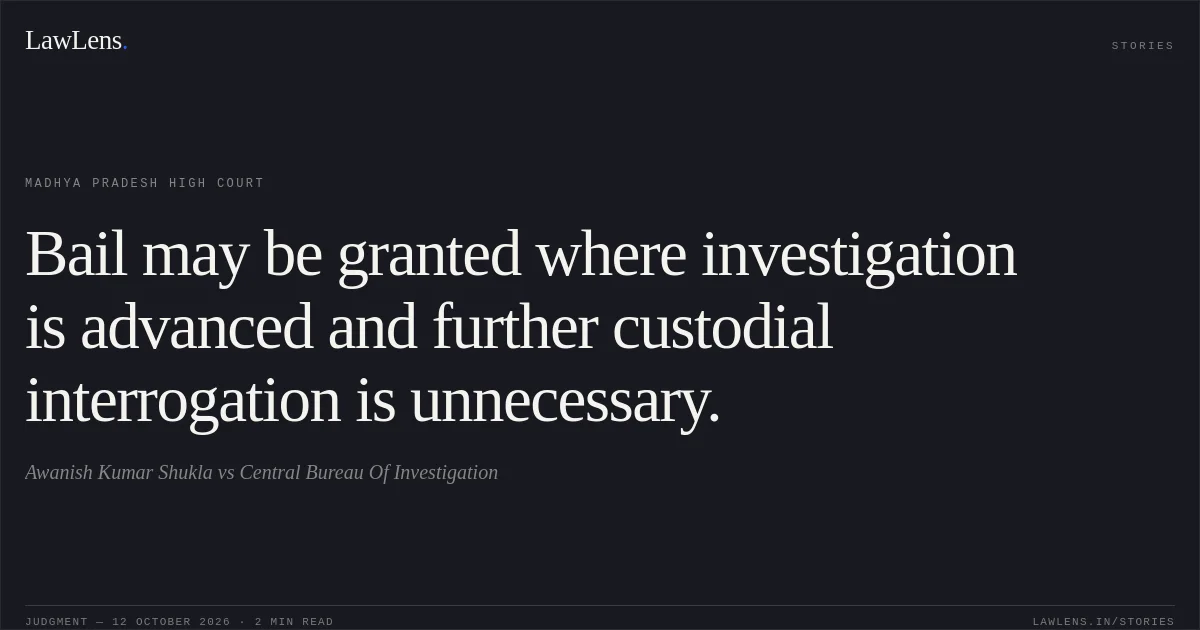
The applicant, a Chief Engineer in BSNL’s Electrical Department, sought regular bail under Section 483 of the Bharatiya Nagarik Suraksha Sanhita, 2023, in a CBI case alleging offences under Section 61(2) of the Bharatiya Nyaya Sanhita, 2023, and Section 7 of the Prevention of Corruption Act, 1988.
Source reference: para. 1He had been in custody since 27 August 2026.
Source reference: para. 1The allegation was that he demanded illegal gratification equivalent to 2% of pending bills amounting to ₹93 lakh; ₹75,000 in tainted currency was recovered from his table during trap proceedings.
Source reference: para. 6The applicant disputed the allegations, while the CBI relied on a recorded conversation and the recovery.
Source reference: para. 6The Court noted that the investigation was advanced, that the applicant had no reported criminal antecedents, and that he was about 58 years old.
Source reference: paras. 4–6Issues
Whether the applicant should be released on regular bail, having regard to the allegations, the stage of investigation, and the circumstances relevant to the risk of absconding, reoffending, or interference with evidence or witnesses.
Source reference: paras. 6–8Whether bail should be subject to conditions to secure the applicant’s attendance and prevent interference with the proceedings.
Source reference: paras. 8–11Law Applied
The application was considered under Section 483 of the Bharatiya Nagarik Suraksha Sanhita, 2023, identified in the order as corresponding to Section 439 of the Code of Criminal Procedure, 1973.
Source reference: para. 1The Court applied the discretionary bail principles reflected in its consideration of the accusation, the stage of investigation, the need for further custody, the applicant’s antecedents and personal circumstances, the risk of flight or interference with the proceedings, and the likely duration of trial.
Source reference: paras. 6–8No precedent was cited.
Source reference: no citationThe order also imposed conditions concerning attendance, similar offences, inducements or threats, evidence and witnesses, and compliance during trial.
Source reference: para. 9Reasoning
The Court acknowledged the CBI’s allegation that the recorded conversation established a demand and that the tainted notes were recovered from the applicant’s table on his directions.
Source reference: para. 6However, it considered that the applicant’s contentions had prima facie substance and left the truth of the prosecution case and the applicant’s complicity for determination at trial.
Source reference: para. 6Because the investigation was advanced, relevant seizures and the voice sample had been obtained, and further custodial interrogation might not be required, continued detention was not justified on the material before the Court.
Source reference: para. 6The applicant’s age, lack of reported criminal antecedents, family responsibilities, and the anticipated duration of trial further weighed in favour of bail; the Court found no apparent likelihood of flight, reoffending, or interference with evidence or witnesses.
Source reference: para. 7Holding
The Court allowed the bail application without expressing a view on the merits.
It directed the applicant’s release on a personal bond of ₹2,00,000 with one surety for the same amount, subject to conditions including attendance at hearings and non-interference with evidence or witnesses.
Source reference: para. 9Bail was to remain effective through trial, with the trial court at liberty to consider cancellation on the merits if a condition was breached.
Source reference: para. 10Acts & Sections Cited
6 provisions across 4 statutes referred to in this judgment. Each provision opens on LawLens.
Bharatiya Nagarik Suraksha Sanhita, 20232
Code of Criminal Procedure, 19732
Bharatiya Nyaya Sanhita, 20231
Prevention of Corruption Act, 19881
Original Court PDF
Awanish Kumar ShuklavsCentral Bureau Of Investigation
Click to open original judgment
Original judgment, available to read, download and summarize on LawLens.in
![Competent authority must reconsider transfer-waiting-list priority through a reasoned order.. Prabhat Kumar Srivastwa vs NORTH CENTRAL RAILWAY. CAT - ['Allahabad']. LawLens](/stories/thumbnails/competent-authority-must-reconsider-transfer-waiting-list-priority-through-a-reasoned-orde-e23ccd4eaf154e82b09ea183b25e32fb.webp)
![Excess-pay recovery from retired Group C employees is impermissible absent fraud or misrepresentation.. SATYA NAND YADAV vs NORTH EASTERN RAILWAY. CAT - ['Allahabad']. LawLens](/stories/thumbnails/excess-pay-recovery-from-retired-group-c-employees-is-impermissible-absent-fraud-or-misrep-c357cbdd195c44d68331385eea2a3c9a.webp)