Facts
FIR No. 420/2024 was registered following an allegation that two armed persons fired approximately 35 rounds at Hotel Highway King and demanded Rs. 5 crore as extortion money, threatening to kill if payment was not made.
Source reference: para. 1–10During the investigation, the appellant was implicated in alleged organised criminal activity and conspiracy; he was arrested on 12 November 2024.
Source reference: para. 1–10The NIA Special Court rejected his bail application, and he appealed under Section 21 of the National Investigation Agency Act, 2008.
Source reference: para. 1–10He relied, among other things, on the alleged lack of independent material, his custody of more than 22 months, filing of the charge-sheet and supplementary charge-sheets, and the absence of UAPA charges.
Source reference: para. 1–10The NIA opposed bail, relying on the seriousness of the allegations, criminal antecedents, flight-risk concerns, and statements of two witnesses placed before the Court in sealed cover.
Source reference: para. 1–10Issues
Whether the appellant had established grounds for bail, having regard to the nature of the allegations, the material relied on by the prosecution, his antecedents, and the risks of absconding or interference with the proceedings.
Source reference: para. 12–16, 19–21Whether prolonged custody, the filing of the charge-sheet and supplementary charge-sheets, and the asserted lack of trial progress warranted bail notwithstanding the other circumstances.
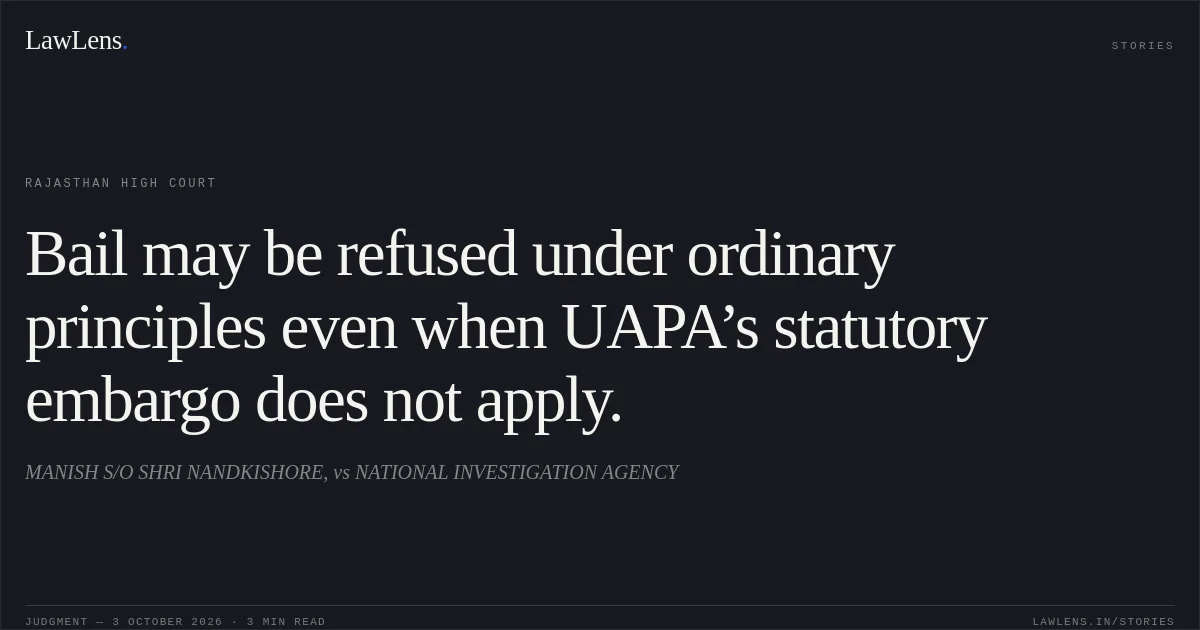
Source reference: para. 17–18, 21Whether the absence of a UAPA charge, and therefore of the bar under Section 43-D(5) of the UAPA, precluded refusal of bail on ordinary bail considerations.
Source reference: para. 16Law Applied
Section 21 of the NIA Act provides the appellate jurisdiction invoked in challenging the Special Court’s bail order.
Source reference: para. 1, 20Bail is determined through a prima facie assessment, not a trial-like evaluation, taking account of the nature and gravity of the accusation, the accused’s role and antecedents, the risk of absconding, and the possibility of witness tampering or obstruction of justice; the Court relied on State of U.P. through CBI v. Amarmani Tripathi, (2005) 8 SCC 21, and Anil Kumar Yadav v. State (NCT of Delhi), (2018) 12 SCC 129.
Source reference: para. 12–13Criminal antecedents are relevant but are not, by themselves, proof of guilt; the Court relied on Neeru Yadav v. State of Uttar Pradesh, (2016) 15 SCC 422.
Source reference: para. 14–15Prolonged incarceration and trial delay are relevant to liberty under Article 21, but do not automatically entitle an accused to bail; the Court referred to Union of India v. K.A. Najeeb, (2021) 3 SCC 713, and Satender Kumar Antil v. Central Bureau of Investigation, (2022) 10 SCC 51.
Source reference: para. 17–18Since the UAPA had not been invoked against the appellant, Section 43-D(5)’s statutory restriction could not be mechanically applied, though ordinary bail factors remained available.
Source reference: para. 16Reasoning
The Court considered the alleged firing, extortion demand and conspiracy serious, and took account of the appellant’s alleged criminal antecedents, the prosecution’s prima facie material—including the statements of PW-80 and PW-96—and its apprehension that he might abscond.
Source reference: para. 14–15, 18–21It declined to assess the ultimate admissibility or reliability of the statements at the bail stage, holding that doing so would involve a mini-trial.
Source reference: para. 15The Court accepted that Section 43-D(5) did not apply, and considered custody and trial delay, but found those factors insufficient when weighed against the other circumstances.
Source reference: para. 16–18, 21It made no finding of guilt based on the appellant’s family relationship or the alleged network connections, leaving those matters open.
Source reference: para. 19, 22Holding
The Court held that the appellant had not established grounds for release on bail at that stage and dismissed the appeal under Section 21 of the NIA Act.
The sealed documents were directed to be returned to the NIA’s counsel.
Source reference: para. 22–23The Court clarified that its observations were confined to the bail determination and that the trial court must proceed uninfluenced by them.
Source reference: para. 22–23Acts & Sections Cited
5 provisions across 3 statutes referred to in this judgment. Each provision opens on LawLens.
National Investigation Agency Act, 20081
Bharatiya Nyaya Sanhita, 20232
Arms Act, 19592
Original Court PDF
MANISH S/O SHRI NANDKISHORE,vsNATIONAL INVESTIGATION AGENCY
Click to open original judgment
Original judgment, available to read, download and summarize on LawLens.in