Facts
The Petitioner, Sabina Khan, filed a writ petition under Article 226 of the Constitution of India challenging the "illegal, arbitrary and unlawful" freeze and lien imposed on her Savings Bank Account (No. 20180928259) maintained with the State Bank of India.
Source reference: para. 1The Petitioner sought a writ of mandamus directing the Respondents to unfreeze the account and permit her to operate it freely.
Source reference: para. 1The Petitioner argued that her case was identical to the precedent established in Malcolm Murayis & Ors. v. State Bank of India and Others (W.P. No. 1100 of 2024), where bank accounts were frozen by cyber cells of various police stations on allegations of cyber fraud without issuing notice to the account holders or complying with statutory seizure procedures.
Source reference: para. 2-3Issues
1. Whether the indefinite freezing of a bank account by a bank, acting solely on the instructions of investigative agencies without the agencies following statutory procedural safeguards, is legally sustainable.
Source reference: para. 3 (sub-para 4, 9), para. 52. Whether the Petitioner is entitled to operate her bank account subject to the security of the specific disputed amount allegedly linked to the crime.
Source reference: para. 5Law Applied
The Court exercised its jurisdiction under Article 226 of the Constitution of India.
Source reference: para. 1Section 102 of the Code of Criminal Procedure (Cr.P.C.)—and the corresponding provisions of the Bharatiya Nagarik Suraksha Sanhita (BNSS)—which mandate that investigating agencies must inform the concerned Magistrate regarding the seizure of property.
Source reference: para. 3 (sub-para 4, 9), para. 5The Court further applied the principle of mutatis mutandis regarding its previous ruling in Malcolm Murayis & Ors. v. State Bank of India.
Source reference: para. 4Reasoning
The Court noted that the bank had frozen the Petitioner’s account not of its own volition but based on instructions from cyber crime agencies.
Source reference: para. 3 (sub-para 5)By incorporating the reasoning from Malcolm Murayis, the Court observed an "irresponsible approach" by various cyber crime cells that freeze accounts via email but fail to respond to bank inquiries or fulfill the legal obligation to report such seizures to a Magistrate under Section 102 Cr.P.C.
Source reference: para. 3 (sub-para 8)The Court reasoned that the Petitioner’s right to operate her account should be restored, provided the specific "disputed amount" is secured to protect the interests of the investigation.
Source reference: para. 5The Court emphasized that investigative agencies must proceed in accordance with the law (BNSS) within a reasonable timeframe (three months) rather than keeping accounts frozen indefinitely without judicial oversight.
Source reference: para. 5Holding
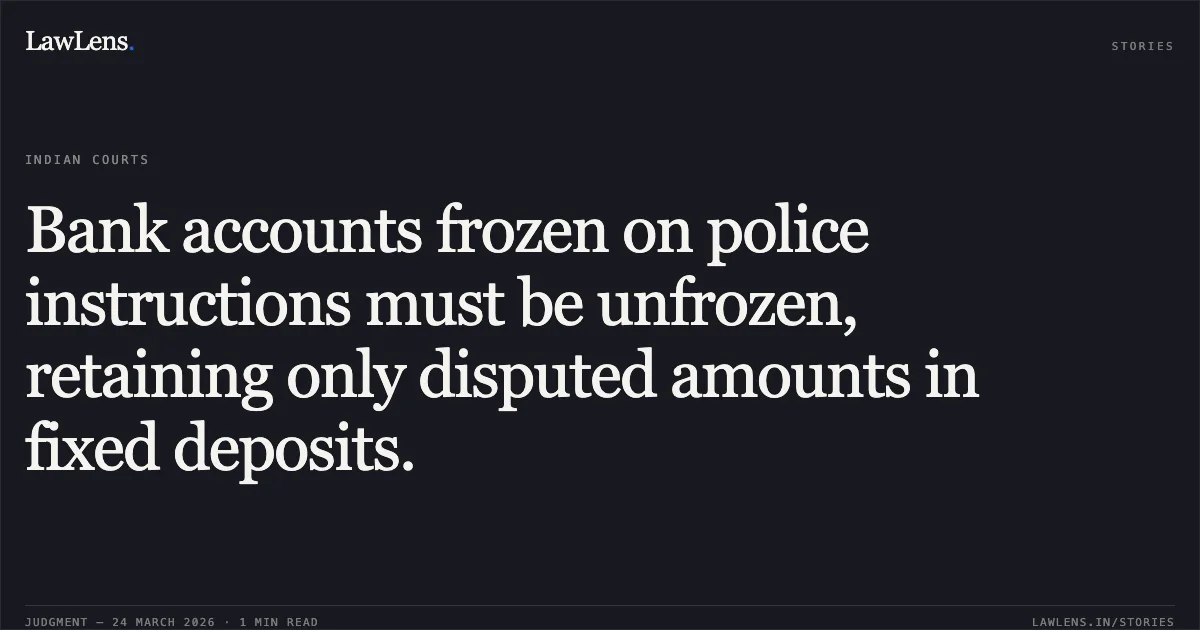
The High Court disposed of the writ petition by directing the Respondent Bank to unfreeze the Petitioner’s account.
The Bank was ordered to keep the specific disputed amount, as identified by the crime agencies, in a fixed deposit (FD).
Source reference: para. 5This FD is only to be liquidated upon orders from a competent Judicial Magistrate.
Source reference: para. 5If the police agency fails to proceed according to the relevant provisions of the BNSS within three months, the Petitioner shall be allowed to withdraw the FD amount under intimation to the agency.
Source reference: para. 5The petition was disposed of with no order as to costs.
Source reference: para. 6Acts & Sections Cited
1 provisions across 1 statute referred to in this judgment. Linked provisions open on LawLens.
Code of Criminal Procedure1
Original Court PDF
Sabina KhanvsState Bank Of India
Click to open original judgment
Original judgment, available to read, download and summarize on LawLens.in


