Facts
The petitioner, a director and guarantor associated with M/s Kali Mata Krishipanya Bipanan Pvt. Ltd. and M/s Umananda Rice Mills Pvt. Ltd., was implicated in CBI FIR No. RC 01/E/2018-KOL concerning alleged conspiracy and cheating in obtaining and diverting credit facilities from the State Bank of India.
Source reference: pp. 8–11The company had availed cash-credit facilities initially amounting to approximately ₹3 crores, subsequently enhanced to ₹4 crores, along with a standby letter of credit of ₹45 lakhs, against collateral securities and guarantees.
Source reference: pp. 8–11The prosecution alleged that the petitioner submitted or relied upon defective title documents, secured credit against property that had previously been mortgaged, and diverted ₹50 lakhs from the enhanced credit facility to an associated company in which he was also a director.
Source reference: pp. 9–11The loan account became a non-performing asset, following which the bank initiated recovery proceedings before the Debt Recovery Tribunal.
Source reference: pp. 8–10During the pendency of those proceedings, the borrower companies entered into one-time settlement arrangements with the bank. The settlement amounts were paid, the proceedings before the DRT were withdrawn or disposed of, and the bank issued “No Dues Certificates”.
Source reference: pp. 8–10, 23–25Although the original complaint alleged offences under the Prevention of Corruption Act, the CBI ultimately exonerated the bank officials and submitted a charge sheet against the petitioner and other private accused only under Sections 120B and 420 of the IPC.
Source reference: pp. 2–3, 18, 23–24Issues
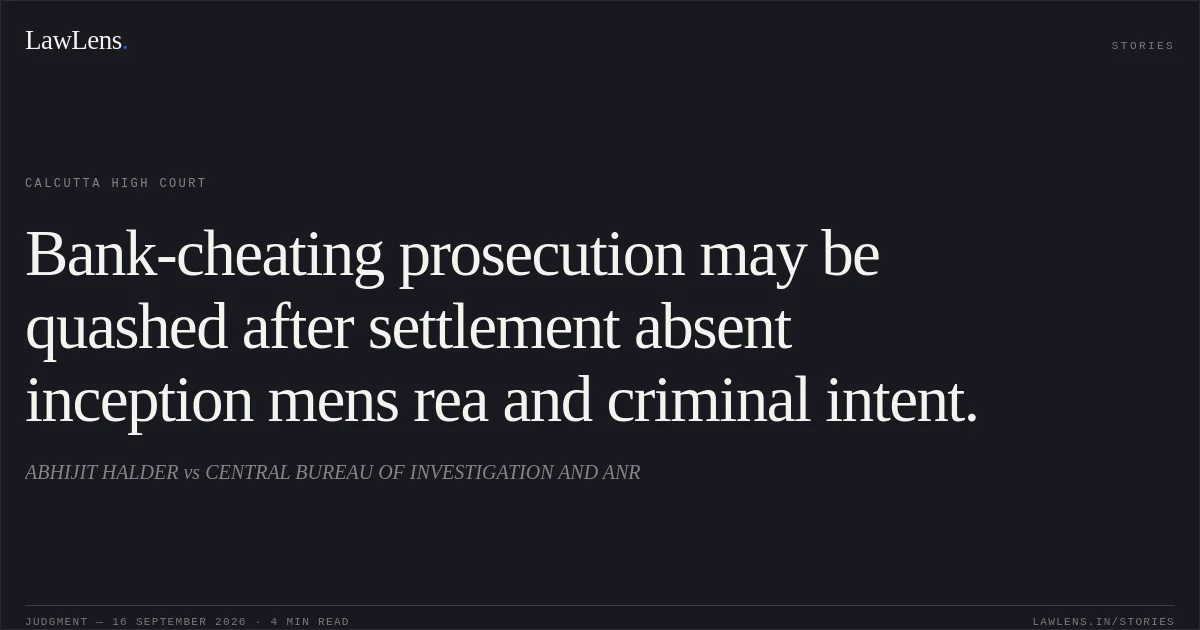
Whether criminal proceedings for conspiracy and cheating under Sections 120B and 420 of the IPC could be quashed after the bank and borrower had entered into and fully performed a one-time settlement, resulting in DRT closure and issuance of a “No Dues Certificate”?
Source reference: paras. 12–15, 22–25; pp. 10–16, 23–25Whether the materials in the charge sheet disclosed the essential ingredient of dishonest or fraudulent intention from the inception necessary to constitute an offence under Section 420 IPC against the petitioner?
Source reference: paras. 15, 22–24; pp. 15–16, 23–25Whether continuation of the prosecution, in circumstances where the bank officials were exonerated and no offence under the Prevention of Corruption Act was established, would amount to abuse of the process of court?
Source reference: paras. 17, 22–25; pp. 18, 23–26Law Applied
The Court considered the inherent jurisdiction to prevent abuse of process and quash criminal proceedings in appropriate cases, particularly where a commercial or banking dispute has been completely settled and the possibility of conviction is remote.
Source reference: paras. 12–15; pp. 11–15It relied on Gian Singh v. State of Punjab, which distinguishes private and commercial disputes from offences having serious societal impact.
Source reference: paras. 12–15; pp. 11–15Rumi Dhar v. State of West Bengal, CBI v. Maninder Singh, State of Maharashtra v. Vikram Anantrai Doshi, and Sushil Suri v. CBI, which caution that settlement or repayment ordinarily does not extinguish serious bank fraud involving forgery, conspiracy or public loss.
Source reference: paras. 12–15; pp. 11–15The Court also applied the more settlement-oriented principles stated in Tarina Sen v. Union of India, K. Bharathi Devi v. State of Telangana, and Vijay Kumar Kela v. CBI, under which proceedings arising predominantly from commercial or financial transactions may be quashed where the parties have fully settled the dispute, the loan account has been closed, and continuation would be oppressive or futile.
Source reference: paras. 16, 18–21; pp. 16–22The Court further treated proof of dishonest intention from the inception as essential to a prosecution under Section 420 IPC and held that mere default or subsequent non-payment of a loan does not, without more, establish cheating.
Source reference: paras. 15, 22–24; pp. 15–16, 23–25Reasoning
The Court distinguished cases involving proved or specifically established forgery, fabricated documents, public-servant complicity, or unrecovered public loss from the present case.
Source reference: paras. 12–18; pp. 11–19Although the charge sheet referred to defective legal scrutiny and alleged diversion of funds, the CBI had exonerated the bank officials, found no sustainable case under the Prevention of Corruption Act, and did not establish that the petitioner possessed a dishonest intention at the inception of the loan transaction.
Source reference: paras. 17, 22–24; pp. 18, 23–25The banking relationship had continued from 2009, the facilities had been renewed and enhanced over time, and the petitioner’s liability was ultimately resolved through a bank-approved one-time settlement recorded in DRT proceedings, followed by full payment under the settlement and issuance of “No Dues Certificates”.
Source reference: paras. 9–11, 23–24; pp. 8–11, 23–25In those circumstances, the Court held that the dispute had an overwhelmingly civil and commercial character, that the essential ingredients of Section 420 IPC were not sufficiently made out, and that continuation of the prosecution would serve no legitimate criminal-law purpose and would amount to abuse of process.
Source reference: paras. 22–25; pp. 23–26Holding
The Court answered the issues in favour of the petitioner.
It held that, on the facts of the case, the completed settlement with the bank, the DRT proceedings, the “No Dues Certificates,” the exoneration of the bank officials, and the absence of material establishing fraudulent intention from inception justified quashing the prosecution.
Source reference: paras. 23–25; pp. 23–26The revision application was allowed, and the entire proceedings arising from FIR No. RC 01/E/2018-KOL, Special Case No. 02/2019 and Case No. 01/18 E, including the charge sheet under Sections 120B and 420 IPC, were quashed qua the petitioner.
Source reference: paras. 26–30; p. 26The petitioner was discharged and directed to be released from the bail bond forthwith.
Source reference: paras. 26–30; p. 26Acts & Sections Cited
6 provisions across 3 statutes referred to in this judgment. Each provision opens on LawLens.
Indian Penal Code, 18604
Prevention of Corruption Act, 19881
Code of Criminal Procedure, 19731
Original Court PDF
ABHIJIT HALDERvsCENTRAL BUREAU OF INVESTIGATION AND ANR
Click to open original judgment
Original judgment, available to read, download and summarize on LawLens.in
![Promotions granted under a subsequently abeyed circular cannot be retrospectively cancelled.. M P Choudhary vs M/o Railways. CAT - ['Jabalpur']. LawLens](/stories/thumbnails/promotions-granted-under-a-subsequently-abeyed-circular-cannot-be-retrospectively-cancelle-519018b2b47f4830a4348abfb67c9b27.webp)
![Promotion-based entry into the Assistant Station Master cadre counts for MACP purposes, unlike direct recruitment.. K R JAYAKUMAR vs M/o Railways. CAT - ['Ernakulam']. LawLens](/stories/thumbnails/promotion-based-entry-into-the-assistant-station-master-cadre-counts-for-macp-purposes-unl-282dda8e34834d65b8f11f2c55a5c0e4.webp)
![Continuity of service preserves service benefits but does not automatically confer retrospective promotion.. Arun Kumar Shukla vs M/o Environment And Forests. CAT - ['Jabalpur']. LawLens](/stories/thumbnails/continuity-of-service-preserves-service-benefits-but-does-not-automatically-confer-retrosp-d2f37722da1042f194c7970092895b8f.webp)