Facts
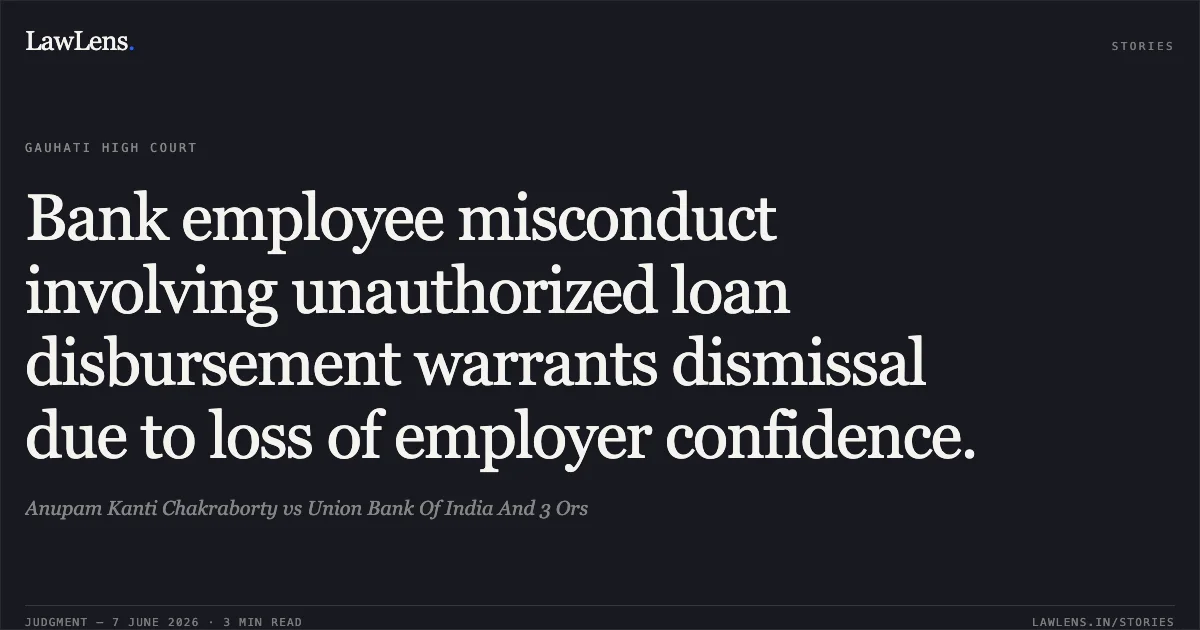
The petitioner, while serving as Branch Manager at Latakandi Branch of Union Bank of India, was issued a Memorandum of Charge on 28.02.2014.
Source reference: p.3The primary allegations included unauthorized disbursement of 61 loans totaling ₹69.53 lakhs after his delegated lending powers were suspended on 07.03.2013.
Source reference: p.5Further charges involved procedural lapses, such as failing to execute security documents, sanctioning loans to overdue accounts, and unexplained cash deposits in his personal account.
Source reference: p.9-10Following a departmental inquiry, the Enquiry Officer found the charges established.
Source reference: p.4On 27.02.2015, the Disciplinary Authority imposed the penalty of dismissal from service.
Source reference: p.2The petitioner's subsequent appeal and review petition were rejected.
Source reference: p.4He challenged these orders via a writ petition, claiming the disbursements were made to meet bank-mandated targets and that the penalty was disproportionate.
Source reference: p.5-6Issues
1. Whether the findings of the Enquiry Officer and the subsequent order of dismissal by the Disciplinary Authority were based on admissible evidence or suffered from perversity.
Source reference: p.112. Whether the penalty of dismissal from service was shockingly disproportionate to the proved misconduct of the Bank Manager.
Source reference: p.15-18Law Applied
The Court primarily applied the standard of judicial review over departmental proceedings under Article 226, emphasizing that Courts should not act as appellate authorities or re-appreciate evidence unless perversity is shown.
Source reference: p.11It relied on United Commercial Bank v. P.C. Kakkar, establishing that Bank officers must maintain higher standards of honesty and integrity as they deal with public trust.
Source reference: p.12It further applied the "Loss of Confidence" doctrine from Divisional Controller, KSRTC v. M. G. Vittal Rao, holding that once an employer loses bona-fide confidence in an employee holding a position of trust, dismissal is appropriate.
Source reference: p.13-14Regarding proportionality, it invoked the "Doctrine of Proportionality" as interpreted in Ranjit Thakur v. Union of India, asserting that interference with punishment is only warranted if it is "outrageously disproportionate" or "shocks the conscience".
Source reference: p.18-19Reasoning
The Court examined the inquiry records and found that the petitioner admitted to the suspension of his delegated authority but failed to produce written instructions restoring those powers.
Source reference: p.9The Court rejected the petitioner's defense that he acted to meet targets, noting that acting beyond one’s authority constitutes a breach of discipline regardless of profit or loss to the bank.
Source reference: p.9, 12Regarding the unexplained deposits, the Court noted the petitioner failed to provide cogent evidence to prove the funds were from family members.
Source reference: p.10The Court found no procedural impropriety or violation of natural justice in the inquiry process.
Source reference: p.11It reasoned that since the findings were based on admissible legal evidence, it would not re-evaluate the adequacy of such evidence.
Source reference: p.8, 11The Court emphasized that in the banking sector, absolute devotion and honesty are paramount; compromising these justifies a loss of confidence, rendering the relationship between the employer and employee untenable.
Source reference: p.12-14Holding
The Court held that the charges were established through a fair inquiry and that the findings did not suffer from perversity.
It concluded that the penalty of dismissal was proportionate to the gravity of the misconduct, especially given the petitioner's role as a Bank Manager in a position of trust.
Source reference: p.19The Court ruled that it could not substitute its own opinion on the quantum of punishment when the Disciplinary Authority had exercised its discretion objectively.
Source reference: p.17Consequently, the writ petition was dismissed, and the orders of dismissal, appeal, and review were upheld.
Source reference: p.20Original Court PDF
Anupam Kanti ChakrabortyvsUnion Bank Of India And 3 Ors
Click to open original judgment
Original judgment, available to read, download and summarize on LawLens.in