Facts
Ten petitioners, primarily government employees from Scheduled Tribes, challenged the unauthorized sanctioning of high-value personal loans by various banks (Respondent Nos. 5–13)
Source reference: p. 1-6They alleged that Private Respondents (Nos. 17–18), acting as bank agents, fraudulently obtained their documents and OTPs to facilitate multiple loans withoutinformed consent or physical documentation
Source reference: p. 6, para. 2The loan amounts were reportedly siphoned to the agents, leaving the petitioners with EMIs exceeding their monthly salaries
Source reference: p. 7, para. 3Despite an FIR registered on 24.02.2026 (Crime No. 38/2026), the petitioners faced coercive recovery actions, including frozen accounts and salary deductions
Source reference: p. 6-7The petitioners approached the High Court seeking a stay on recovery and a direction for the Banking Ombudsman to investigate
Source reference: p. 5, para. 10.1–10.4Issues
1. Whether the Respondent Banks violated RBI guidelines and the Fair Practices Code by sanctioning multiple loans without assessing creditworthiness or obtaining informed consent?
Source reference: p. 7, para. 32. Whether the petitioners are entitled to interim protection from coercive recovery actions pending a decision by the Banking Ombudsman?
Source reference: p. 8, para. 4–5Law Applied
The Court relied on Article 226 of the Constitution of India regarding the High Court's discretionary power to issue writs for the enforcement of rights
Source reference: p. 6, para. 2Substantively, the court referred to the regulatory framework established by the Reserve Bank of India (RBI), specifically the Fair Practices Code and Master Circulars governing lending practices and creditworthiness assessment
Source reference: p. 7, para. 3It further recognized the statutory role of the Banking Ombudsman as an efficacious alternative remedy for grievances against banking services and violations of RBI notifications
Source reference: p. 8, para. 4Reasoning
The Court observed that the gravity of the allegations—involving collusion between bank officials and agents, siphoning of funds, and reckless lending—necessitated formal investigation
Source reference: p. 7, para. 3However, the Court determined that because the petitioners had already initiated complaints with the Banking Ombudsman on 16.04.2025, the proper course of action was to exhaust that specialized alternative remedy rather than the Court adjudicating the merits of the fraud allegations directly
Source reference: p. 8, para. 4The Court reasoned that since the petitioners were being pushed into financial destitution, the Ombudsman must be mandated to hear interim relief applications within a strict timeline to prevent irreparable harm while the main dispute is being resolved
Source reference: p. 8, para. 5Holding
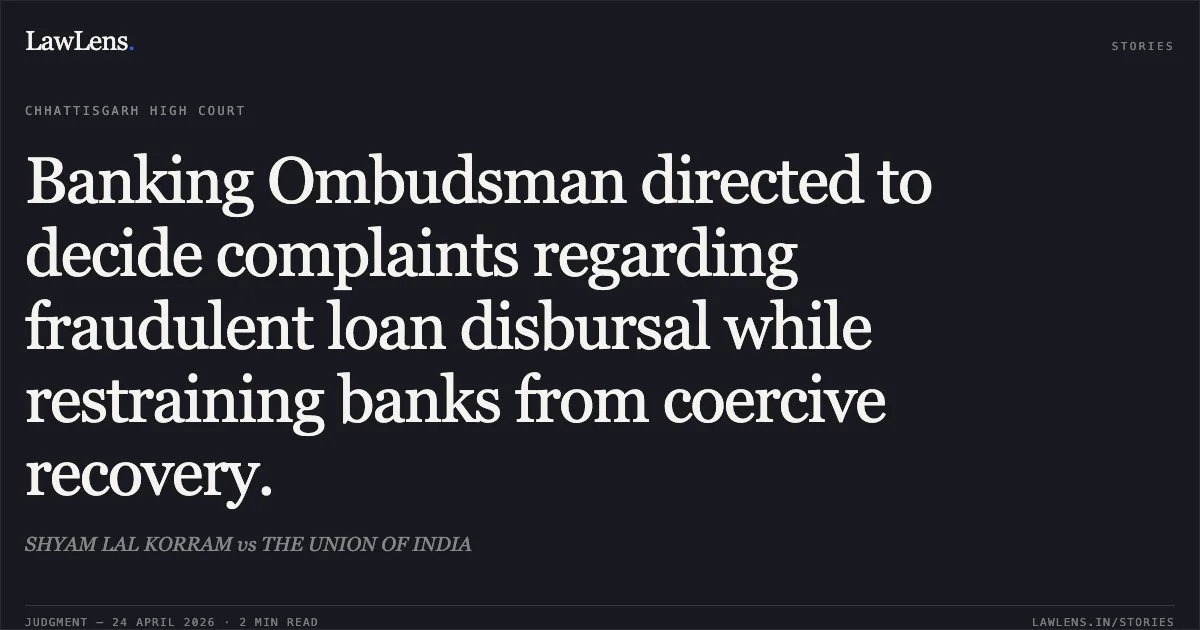
The Court disposed of the petition by directing the petitioners to file interim relief applications before the Banking Ombudsman, Raipur, within 15 days
The Banking Ombudsman is directed to pass appropriate orders on these applications within 30 days of filing
Source reference: p. 9, para. 5Crucially, the Court ordered that until the complaints are decided by the Ombudsman, the Banking authorities are restrained from taking any coercive steps against the petitioners
Source reference: p. 9, para. 6Original Court PDF
SHYAM LAL KORRAMvsTHE UNION OF INDIA
Click to open original judgment
Original judgment, available to read, download and summarize on LawLens.in