Facts
The Department appealed under Section 260A of the Income-tax Act, 1961, against the Income Tax Appellate Tribunal’s order for assessment year 2006–07.
Source reference: p. 1The admitted questions concerned the treatment of Government securities held by the bank as stock-in-trade, the deductibility of a revaluation loss of ₹27,76,08,025, and the allowance of bad debts relating to non-rural advances in light of Sections 36(1)(vii) and 36(1)(viia).
Source reference: pp. 2–3The parties accepted that the issues were covered by Supreme Court and High Court precedents.
Source reference: p. 3Issues
1. Whether Government securities held to maturity by the bank could be treated as stock-in-trade.
Source reference: p. 22. Whether the loss arising from revaluation of the securities, amounting to ₹27,76,08,025, was deductible.
Source reference: p. 23. Whether the bank was entitled to deduct bad debts relating to non-rural advances.
Source reference: p. 24. Whether the write-off under Section 36(1)(vii) had to be set off against the provision balance under Section 36(1)(viia), without distinguishing between urban and rural advances.
Source reference: p. 25. Whether the Tribunal’s decision was contrary to the scope of the bad-debt provisions as clarified by Explanation (2) to Section 36(1)(vii).
Source reference: p. 2Law Applied
Section 36(1)(vii) permits deduction of bad debts actually written off, while Section 36(1)(viia) provides a separate deduction for eligible provisions for bad and doubtful debts.
Source reference: no citationIn Catholic Syrian Bank Ltd. v. Commissioner of Income-tax, 343 ITR 270, the Supreme Court held that the proviso to Section 36(1)(vii) limits the deduction for actual write-offs only in relation to rural advances covered by Section 36(1)(viia); write-offs of urban advances are not limited by that proviso.
Source reference: pp. 4–6The Court also relied on Commissioner of Income Tax v. Karur Vysya Bank, 273 ITR 510, for the rule that Government securities held by a bank constitute stock-in-trade, and that such securities are valued at cost or market value, whichever is lower.
Source reference: p. 3It further applied Commissioner of Income Tax I v. Karur Vysya Bank Ltd., T.C.(A) Nos. 290 to 295 and 663 of 2010, dated 20 February 2026, which applied Catholic Syrian Bank to the bad-debt issues.
Source reference: pp. 3, 6Reasoning
Applying Karur Vysya Bank, the Court held that the securities were properly treated as stock-in-trade; consequently, the loss determined on revaluation using the lower of cost or market value was allowable.
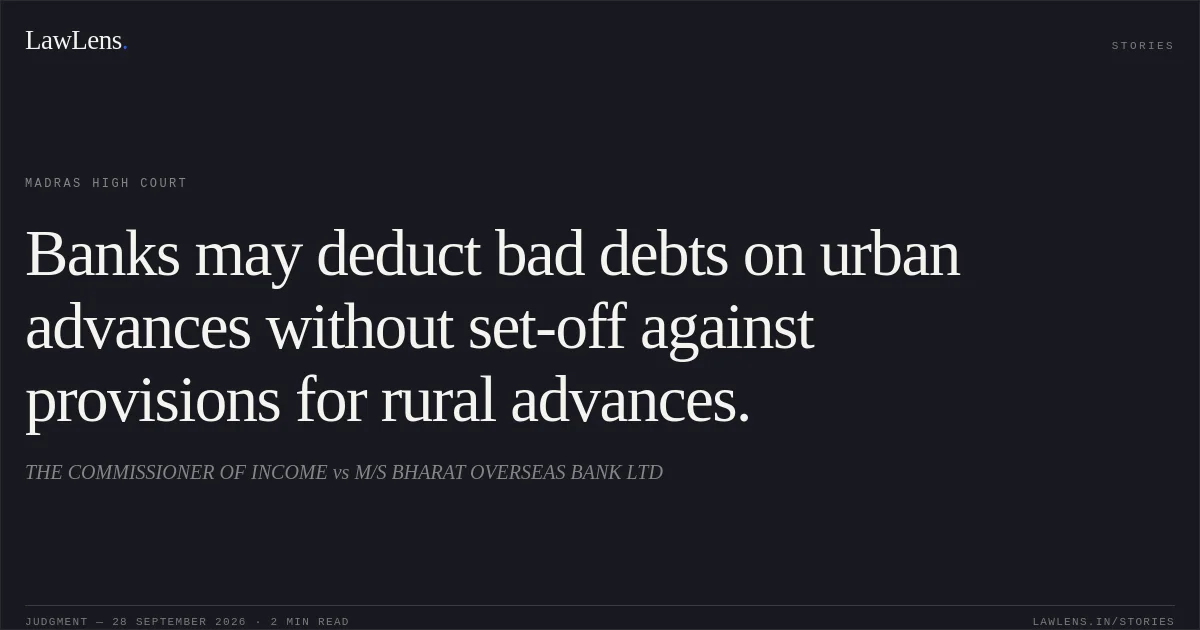
Source reference: p. 3On the bad-debt questions, the Court followed Catholic Syrian Bank and the later Karur Vysya Bank decision, which established that the restriction in the proviso to Section 36(1)(vii) does not curtail deductions for actual write-offs of non-rural advances.
Source reference: pp. 3–6As the parties agreed that the admitted questions were governed by those authorities, the Court applied them to the appeal.
Source reference: p. 3Holding
The Court answered all five substantial questions of law in favour of the assessee and dismissed the Department’s appeal.
The Tribunal’s order, including the allowance of the revaluation loss and bad debts relating to non-rural advances, was therefore left undisturbed.
Source reference: pp. 3, 7Acts & Sections Cited
2 provisions across 1 statute referred to in this judgment. Linked provisions open on LawLens.
Income Tax Act, 19612
Original Court PDF
THE COMMISSIONER OF INCOMEvsM/S BHARAT OVERSEAS BANK LTD
Click to open original judgment
Original judgment, available to read, download and summarize on LawLens.in