Facts
The petitioner, Ankita Nimback, filed a writ petition under Article 226 of the Constitution of India challenging the freezing of her bank account by the Bank of Maharashtra.
Source reference: p. 1The account was allegedly frozen following intimations from cyber crime cells regarding suspected involvement in cyber fraud.
Source reference: para. 3The petitioner contended that the freezing was arbitrary, violated fundamental rights, and was conducted without prior notice or compliance with statutory procedures regarding seizure.
Source reference: p. 2The petitioner sought the unfreezing of the account and compensation for financial hardship.
Source reference: p. 1-2Issues
1. Whether the freezing of the petitioner's bank account by the respondent bank at the behest of investigative agencies without following the prescribed statutory procedure was legal and valid.
Source reference: para. 3-42. Whether the petitioner is entitled to operate the bank account while ensuring the disputed amount remains secured during the investigation.
Source reference: para. 5Law Applied
The court primarily relied on the precedent established in Malcolm Murayis & Ors. Vs. State Bank of India and Others (W.P. No. 1100 of 2024), which mandates that bank accounts cannot be kept frozen indefinitely without active legal proceedings.
Source reference: para. 2-3The court referenced Section 102 of the Code of Criminal Procedure (Cr.P.C.)—now corresponding to relevant provisions of the Bharatiya Nagarik Suraksha Sanhita (BNSS)—which requires investigating officers to report seizures to the Magistrate.
Source reference: para. 4/9, para. 5The court also applied the principle of proportionality to balance the interest of the State in investigating cybercrime with the account holder's right to property and livelihood.
Source reference: para. 9Reasoning
The court found that the petitioner’s situation was squarely covered by the Malcolm Murayis decision.
Source reference: para. 4It observed that while banks freeze accounts based on police instructions, investigating agencies often fail to respond to inquiries or comply with the mandatory reporting requirements under Section 102 Cr.P.C. or the BNSS.
Source reference: para. 8-9The court reasoned that freezing an entire account for a specific disputed amount causes undue hardship. Therefore, the court determined that the disputed portion of the funds should be sequestered in a fixed deposit to satisfy potential legal claims, thereby allowing the petitioner to regain access to the remainder of the account and operate it normally.
Source reference: para. 5, 9Holding
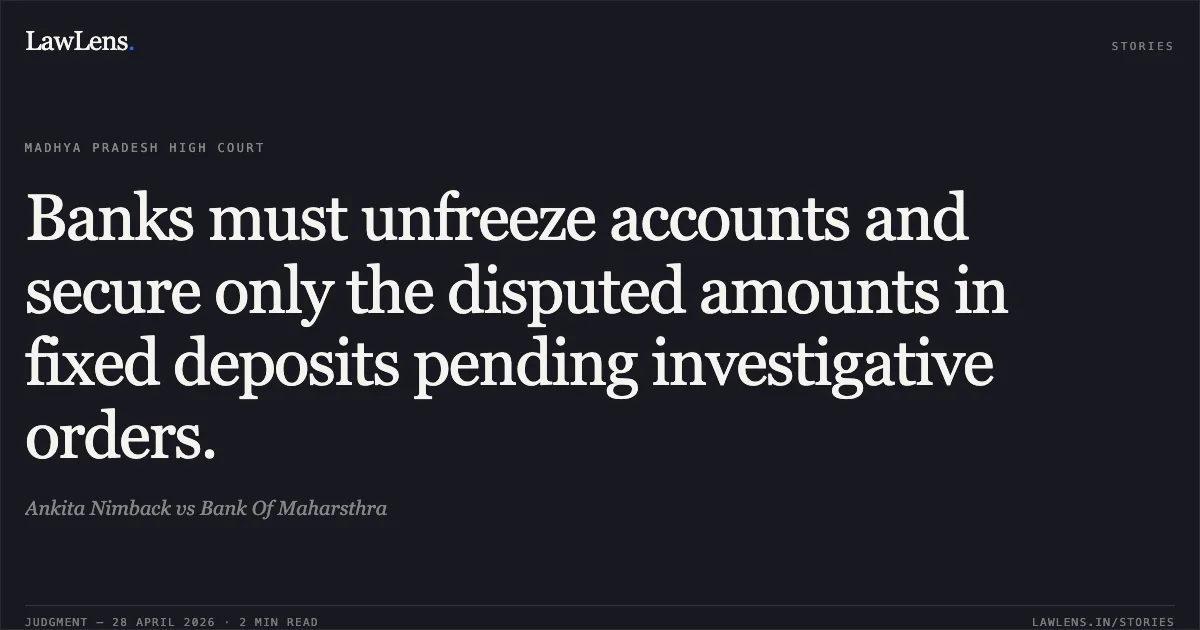
The court allowed the petition in part, directing the respondent bank to unfreeze the petitioner's bank account.
The bank was ordered to keep only the specific "disputed amount" (as identified by the crime agencies) in a fixed deposit. This deposit is to be liquidated only upon orders from a competent Judicial Magistrate. If the investigating agencies fail to obtain such orders within three months, the petitioner is permitted to withdraw the fixed deposit amount under intimation to the police.
Source reference: para. 5The petition was disposed of with no order as to compensation.
Source reference: para. 6Acts & Sections Cited
1 provisions across 1 statute referred to in this judgment. Each provision opens on LawLens.
Code of Criminal Procedure, 19731
Original Court PDF
Ankita NimbackvsBank Of Maharsthra
Click to open original judgment
Original judgment, available to read, download and summarize on LawLens.in


![Subsequent exoneration does not retrospectively invalidate a finalized promotion select list.. UNNIKRISHNAN M vs M/o Environment And Forests. CAT - ['Ernakulam']. LawLens](/stories/thumbnails/subsequent-exoneration-does-not-retrospectively-invalidate-a-finalized-promotion-select-li-ce80a0e84f2f4887857271e8b4341c42.webp)