Facts
The plaintiff filed a suit for possession of land, claiming his father had permitted the defendant to cultivate it in 1980 on the condition of returning it upon demand
Source reference: para 2The defendant contested, asserting that the plaintiff’s father had sold the land to him for ₹250/- and that the plaintiff later executed a written agreement to sell on 08.01.1992 for ₹3,600/-, which was fully paid
Source reference: para 3The Trial Court decreed the suit in favor of the plaintiff, holding that the defendant failed to prove adverse possession and could not benefit from Section 53A of the Transfer of Property Act because a suit for specific performance was barred by limitation
Source reference: para 7The Appellate Court reversed this, finding the agreement to sell (Ext. DW3/A) duly proved
Source reference: para 8The plaintiff appealed to the High Court
Source reference: para 9Issues
1. Whether the protection of Section 53A of the Transfer of Property Act was properly pleaded and proved by the defendant
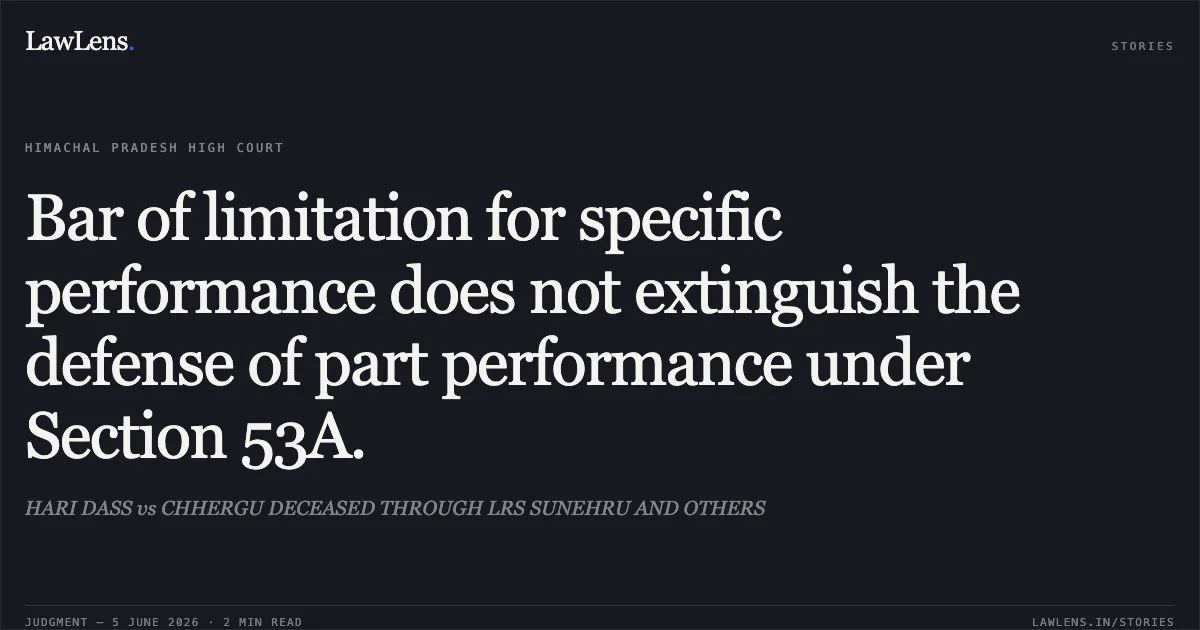
Source reference: para 92. Whether the bar of limitation for filing a suit for specific performance prevents a defendant from taking the plea of part performance under Section 53A
Source reference: para 163. Whether the plaintiff, as the recorded owner, is entitled to a decree of possession despite the existence of an agreement to sell
Source reference: para 9Law Applied
Section 53A of the Transfer of Property Act, 1882, which provides the equitable doctrine of part performance as a statutory defense for a transferee in possession under a written contract
Source reference: para 15, 23The Supreme Court precedent in Vasanthi v. Venugopal (2017) regarding the prerequisites for part performance
Source reference: para 23Shrimant Shamrao Suryavanshi v. Pralhad Bhairoba Suryavanshi (2002), which established that the law of limitation bars a remedy (suit) but does not extinguish a defense used to protect possession
Source reference: para 28The principle from Chander Kanta v. Durga Dutt (2006) that once full consideration is paid, the requirement of "readiness and willingness" is deemed satisfied
Source reference: para 25Reasoning
The High Court found that the agreement to sell dated 08.01.1992 (Ext. DW3/A) was validly executed and signed by the plaintiff, as supported by the testimonies of the document writer (DW3) and marginal witnesses (DW4, PW3)
Source reference: paras 17-21The court determined that all prerequisites for Section 53A were met: there was a written contract for consideration, the defendant was in possession in furtherance of that contract, and the defendant had performed his part by paying the full consideration of ₹3,600/-
Source reference: paras 25-27The court corrected the Trial Court’s legal error, clarifying that even if a suit for specific performance is time-barred, the transferee can still use Section 53A as a "shield" to defend their possession against the transferor
Source reference: para 28-29The court rejected the plaintiff’s reliance on adverse possession precedents, noting the defense was based on part performance
Source reference: para 30Holding
The High Court answered the substantial questions of law against the appellant and in favor of the respondents, holding that the defendant successfully pleaded and proved the defense of part performance under Section 53A of the Transfer of Property Act
The plaintiff is precluded from seeking possession of the suit land despite holding the legal title. The appeal was dismissed, and the judgment of the First Appellate Court was upheld
Source reference: para 33, 34Acts & Sections Cited
1 provisions across 1 statute referred to in this judgment. Linked provisions open on LawLens.
Transfer Of Property Act, 18821
Original Court PDF
HARI DASSvsCHHERGU DECEASED THROUGH LRS SUNEHRU AND OTHERS
Click to open original judgment
Original judgment, available to read, download and summarize on LawLens.in


