01Facts
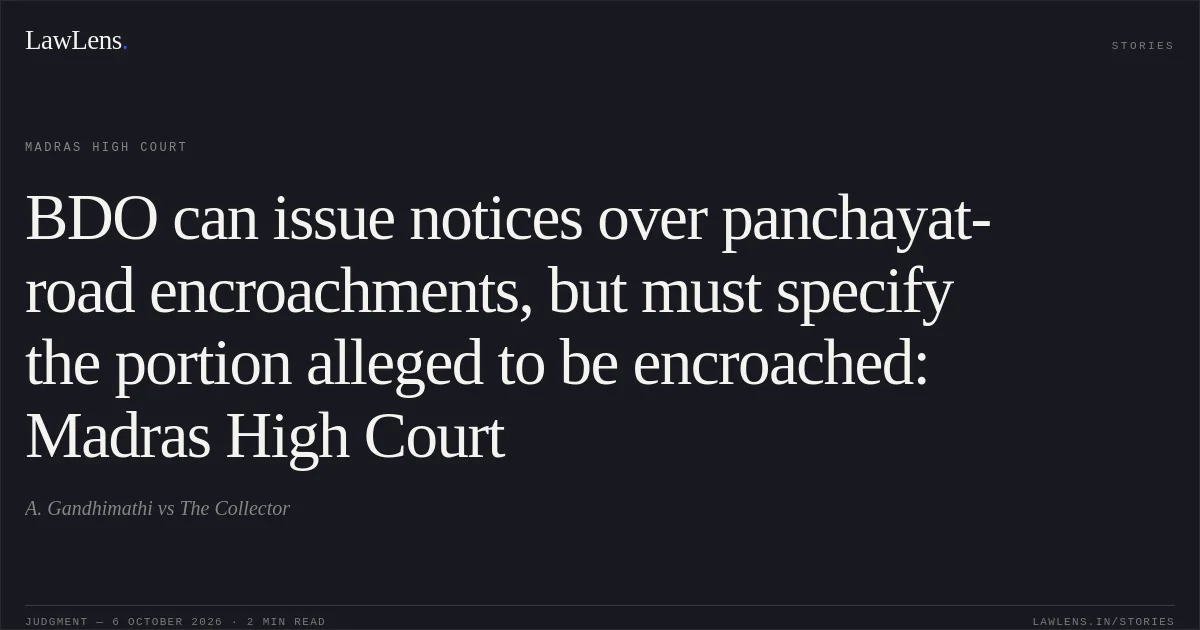
The petitioner claimed ownership of a 1,280 sq. ft. property at Plot No. 11, Sri Perumal Nagar, Periyakurichi, and challenged a notice issued by the Block Development Officer (BDO) alleging encroachment on a public pathway.
p. 2 · ¶ 1–2She contended that no survey established an encroachment and that the BDO lacked authority to issue the notice.
p. 2 · ¶ 1–2The respondents relied on precedents recognising the Panchayat authorities’ powers concerning encroachments on public roads.
pp. 3–7 · ¶ 3–7The Court found that the impugned notice did not specify the extent of the alleged encroachment.
p. 10 · ¶ 1102Issues
i.1. Whether the BDO, acting as the Executive Authority of the Village Panchayat, was competent to issue a notice concerning an alleged encroachment on a public road
pp. 3–9 · ¶ 3–10ii.2. Whether the impugned notice was adequate when it did not identify the precise extent of the alleged encroachment
p. 10 · ¶ 11–1203Law Applied
Section 131 of the Tamil Nadu Panchayats Act, 1994 prohibits obstruction in or over public roads; under Section 131(2), the Panchayat’s Executive Authority is empowered to address encroachments on property vested in the Panchayat, and may seek Revenue Department assistance where required.
p. 8 · ¶ 8 · p. 9 · ¶ 9The Court relied on V. Balamurugan v. The District Collector, Virudhunagar District [(2008) 1 MLJ 1134], Sundari v. District Collector, Virudhunagar District [(2007) 6 MLJ 399], and the Division Bench decisions discussed in its reasoning, as supporting the authority to issue notice.
pp. 4–5, 9 · ¶ 4, 9–10It treated the contrary observations in Raji and Jebaraj as per incuriam for not referring to earlier decisions of co-equal Benches.
pp. 6–9 · ¶ 5–9The Court also referred to Section 219 of the Act as providing a revision remedy.
pp. 3–5 · ¶ 3–4Provisions in the judgment · 8 · Linked ones open on LawLens
Tamil Nadu Panchayats Act,1994 Section 219Section 218Section 201Section 202Section 131
Tamil Nadu Land Encroachment Act, 1905 Section 7Section 6Section 10
04Reasoning
The Court rejected the challenge to the BDO’s competence, holding that the land was within the Panchayat and that Section 131(2), read with the cited Division Bench decisions, authorised the Executive Authority to issue notice concerning an encroachment on a public road.
pp. 8–9 · ¶ 8–10However, the notice did not state the exact extent of the alleged encroachment.
p. 10 · ¶ 11Although the respondents submitted that a Form-1 notice identified a septic tank, that description was not reflected in the notice under challenge.
p. 10 · ¶ 11The Court therefore considered a fresh inspection and a notice specifying the affected area necessary.
p. 10 · ¶ 1205Holding
The Court held that the BDO was competent to issue notice but directed the third respondent to inspect the property, identify and earmark the encroached portion, and issue a fresh notice specifying the precise area to be removed.
p. 10 · ¶ 12–13If the petitioner failed to comply, the authority could proceed in accordance with law.
p. 10 · ¶ 12–13The writ petition was disposed of and the connected miscellaneous petitions were closed; no costs were awarded.
p. 10 · ¶ 12–13Original Court PDF
A. GandhimathivsThe Collector
Click to open original judgment
Original judgment, available to read, download and summarize on LawLens.in