01Facts
The petitioners/defendants, tenants in the suit property, challenged the order dated 18 June 2024 passed by the Civil Judge (Junior Division), 2nd Court at Sealdah, in Ejectment Suit No. 118 of 2015.
¶ 5The suit had been instituted by the opposite parties/plaintiffs principally on the ground of reasonable requirement.
¶ 5After the plaintiffs’ evidence had concluded and the matter had been fixed for the defendants’ evidence, the defendants applied under Order VI Rule 17 read with Section 151 of the Code of Civil Procedure, 1908, seeking to amend their written statement.
¶ 8The proposed amendment alleged that, during the pendency of the suit, the plaintiffs had obtained possession of a roadside shop room in the suit premises and had suppressed that fact, although the plaintiffs allegedly occupied six rooms in the premises.
¶ 8The plaintiffs disputed actual possession of the shop room, contending that it remained tenanted, and argued that the amendment application was vague, belated, and unsupported by any stated date of possession or date of knowledge.
¶ 12–13A Court-appointed Local Inspection Commissioner had inspected the property in the defendants’ presence but did not record that the plaintiffs were in possession of the roadside shop room.
¶ 14, 16The Trial Court rejected the amendment application, leading to the present revision.
During the revision, the Court also allowed CAN 1 of 2026 and expunged the name of opposite party no. 2, who had died on 23 February 2025.
¶ 2–402Issues
i.1. Whether the defendants should be permitted under Order VI Rule 17 read with Section 151 CPC to amend their written statement, at an advanced stage of the ejectment suit, to plead the plaintiffs’ alleged subsequent possession of an additional shop room and alleged suppression of that fact?
¶ 5, 8–11ii.2. Whether the Trial Court committed any illegality or material irregularity in rejecting the amendment application on the grounds of vagueness, delay, and lack of evidentiary support?
¶ 15–2003Law Applied
The Court applied Order VI Rule 17 CPC, which governs amendment of pleadings, read with the inherent powers under Section 151 CPC.
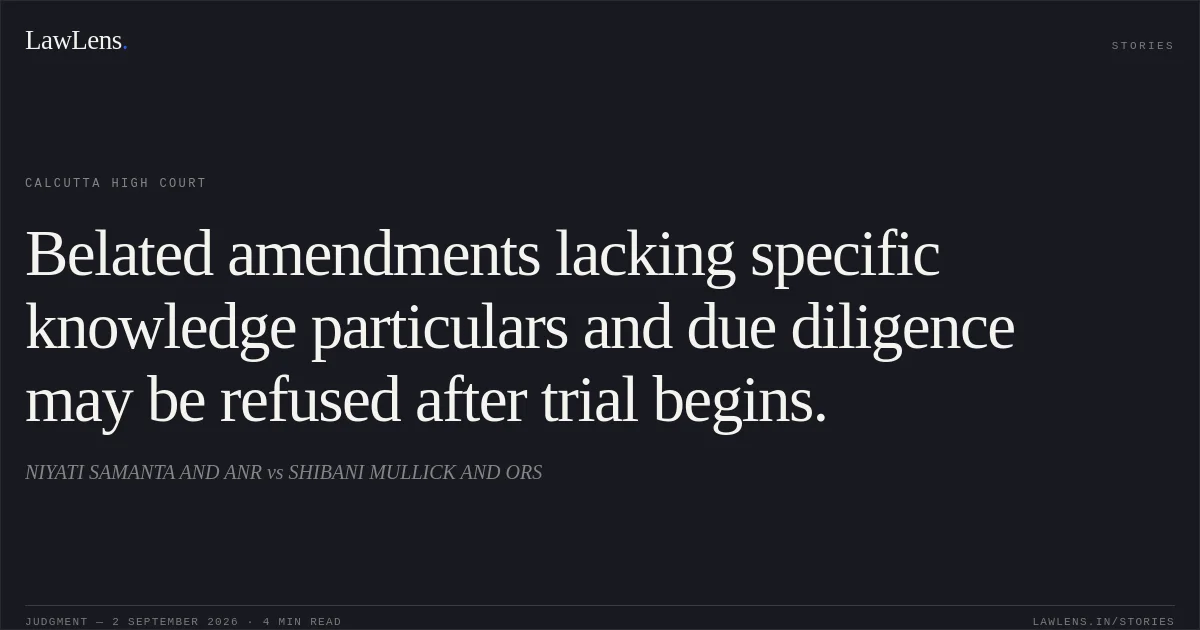
The governing principle is that an amendment may be allowed where it is necessary for determining the real questions in controversy; however, a belated amendment must be supported by specific and credible facts, including an explanation for the delay and compliance with the due-diligence requirement.
¶ 15The Court also recognised that deliberate concealment of material facts may justify allowing an amendment even at an advanced stage of proceedings, but held that the applicant must establish the factual basis and materiality of the proposed amendment.
¶ 15The Court further relied on the evidentiary significance of the Local Inspection Commissioner’s report, which did not corroborate the defendants’ allegation of the plaintiffs’ possession.
¶ 16, 18Provisions in the judgment · 1 · Linked ones open on LawLens
Code of Civil Procedure, 1908 Section 151
04Reasoning
The Court found that the defendants’ proposed amendment was made after the plaintiffs’ evidence had closed and at a stage when the defendants’ evidence was nearing completion.
¶ 16, 19Although the alleged possession of an additional shop room could theoretically be relevant to a claim based on reasonable requirement, the defendants failed to state the date on which the plaintiffs allegedly obtained possession or the date on which the defendants acquired knowledge of that fact.
¶ 16–17This omission rendered the plea vague and weakened the assertion that the fact had genuinely been discovered at a later stage.
¶ 16–17The Court also considered the Local Inspection Commissioner’s report, prepared following an inspection conducted in the defendants’ presence.
¶ 16, 18Since the report contained no reference to the plaintiffs’ possession of the roadside shop room, it materially undermined the factual foundation of the proposed amendment.
¶ 16, 18The municipal Certificate of Enlistment relied upon by the defendants established, at most, the issuance of the certificate in the plaintiffs’ name; it did not necessarily establish their actual possession.
¶ 16In these circumstances, the proposed amendment was neither sufficiently precise nor adequately supported, and the Trial Court’s refusal to permit it disclosed no jurisdictional or legal error.
¶ 19–2005Holding
The High Court held that the defendants failed to satisfy the requirements for permitting the belated amendment of their written statement under Order VI Rule 17 read with Section 151 CPC.
¶ 20The Trial Court’s order dated 18 June 2024 was found to suffer from no illegality or material irregularity and was therefore not interfered with.
¶ 20Accordingly, C.O. 394 of 2025 was dismissed.
¶ 21CAN 1 of 2026 was allowed, and the name of deceased opposite party no. 2 was expunged from the revision.
¶ 2–4Original Court PDF
NIYATI SAMANTA AND ANRvsSHIBANI MULLICK AND ORS
Click to open original judgment
Original judgment, available to read, download and summarize on LawLens.in