Facts
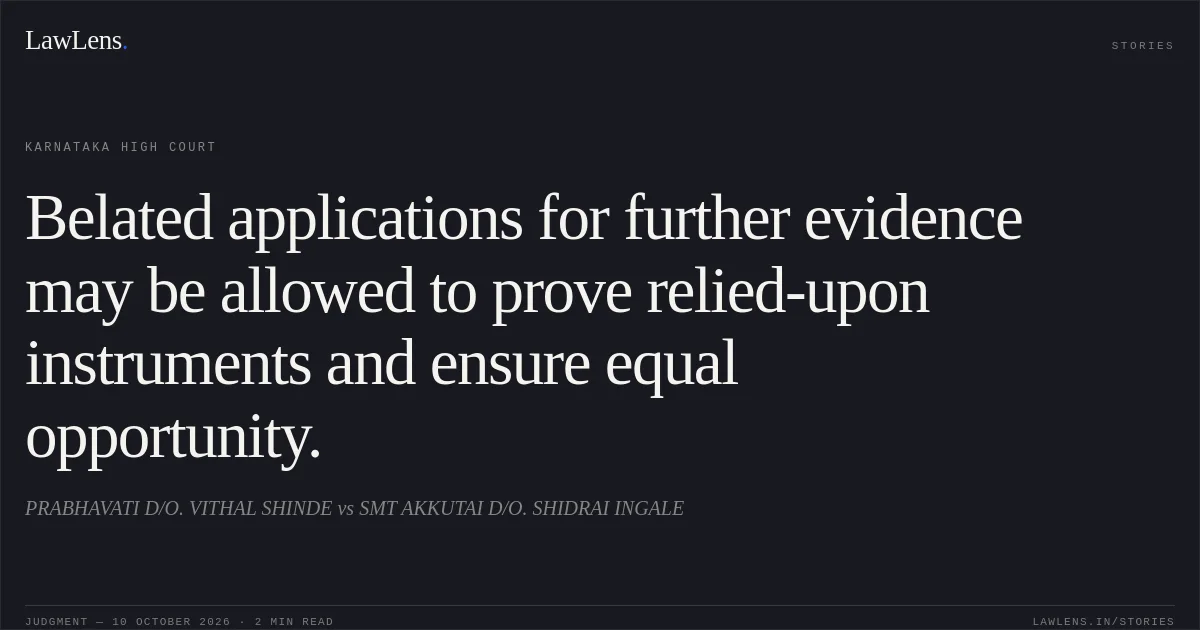
The dispute arose in a partition suit, O.S. No. 84 of 1997. Defendants 2(a) to 2(e), after closure of their evidence, filed applications seeking permission to submit a witness list, summons to witnesses, and reopening of the case to lead further evidence.
Source reference: para. 3–5, 9–10The Trial Court allowed the applications subject to costs of ₹2,000, noting that the defendants relied on a Will and Gift Deed requiring proof through attesting witnesses.
Source reference: para. 3–5, 9–10The petitioners challenged that order, contending that their objections had not been heard. The High Court considered the hearing dates and the Trial Court’s order.
Source reference: para. 6–8Issues
1. Whether the petitioners were denied an opportunity to be heard on I.A. Nos. 39 to 41 before the Trial Court allowed them.
Source reference: para. 6–7, 11–122. Whether the Trial Court’s order allowing the defendants to lead further evidence and summon witnesses warranted interference in writ jurisdiction.
Source reference: para. 9–14Law Applied
Order XVI Rules 1 and 2 of the Code of Civil Procedure govern the filing of witness lists and the summoning of witnesses; Section 151 CPC recognises the court’s inherent power to make orders necessary for the ends of justice.
Source reference: para. 4, 10Section 68 of the Indian Evidence Act requires a Will to be proved by examining at least one attesting witness, where such a witness is available and capable of giving evidence. The judgment identifies no separate precedent or broader test for writ interference; it examines whether the Trial Court considered the parties’ contentions and whether its order disclosed an infirmity warranting interference.
Source reference: para. 4, 10, 13Reasoning
The High Court rejected the claim that the petitioners had not been heard. The matter had been listed on 28 November, 6 December and 9 December 2024, and the petitioners did not avail the opportunity to advance arguments or file written submissions; the Trial Court nevertheless considered their objection that the applications were belated.
Source reference: para. 6–7, 9–12It also accepted the Trial Court’s reasoning that delay alone did not justify rejecting the applications, particularly because the defendants relied on documents for which attesting-witness evidence was required and an opportunity to establish their defence was appropriate.
Source reference: para. 10As the Trial Court had considered the petitioners’ contentions and no infirmity was shown, the High Court found no basis to interfere.
Source reference: para. 11–13Holding
The High Court answered both issues against the petitioners. It held that the petitioners’ non-hearing contention could not be accepted and that the Trial Court’s order disclosed no infirmity warranting interference.
The writ petition was dismissed, leaving in force the order allowing I.A. Nos. 39 to 41 subject to costs of ₹2,000.
Source reference: para. 12–14Acts & Sections Cited
1 provisions across 1 statute referred to in this judgment. Each provision opens on LawLens.
Code of Civil Procedure, 19081
Original Court PDF
PRABHAVATI D/O. VITHAL SHINDEvsSMT AKKUTAI D/O. SHIDRAI INGALE
Click to open original judgment
Original judgment, available to read, download and summarize on LawLens.in