Facts
The respondent instituted a complaint under Section 138 of the Negotiable Instruments Act, 1881, alleging dishonour of a cheque issued by the petitioner.
Source reference: para. 3The petitioner denied knowing the respondent or issuing the cheque, asserting that it was a blank signed cheque previously handed over to Uttam Tiwari in connection with another transaction and was later misused. He also disputed the writings, date, alterations, ink, and signature appearing on the cheque.
Source reference: para. 3The complaint was filed on 28.02.2017. The complainant’s evidence was completed on 13.12.2018, the petitioner’s statement under Section 313 Cr.P.C. was recorded on 13.09.2019, and the petitioner’s evidence and cross-examination concluded on 03.12.2022. When the matter had reached the stage of final arguments, the petitioner filed an application dated 19.01.2023 seeking examination of the cheque by a handwriting/forensic expert.
Source reference: para. 5The JMFC, Budhar rejected the application on 20.03.2023, holding that it was belated and appeared intended to delay the proceedings. The Additional Sessions Judge dismissed the petitioner’s revision on 16.05.2025. The petitioner consequently invoked the High Court’s inherent jurisdiction under Section 528 of the Bharatiya Nagarik Suraksha Sanhita, 2023.
Source reference: paras. 1, 6Issues
Whether the petitioner was entitled to have the disputed cheque examined by a handwriting or forensic expert after the completion of evidence and at the stage of final arguments?
Source reference: paras. 3, 5–7Whether the Trial Court and Revisional Court committed any patent illegality, perversity, jurisdictional error, or material irregularity warranting interference under Section 528 BNSS?
Source reference: paras. 8–10Law Applied
The Court applied Section 138 of the Negotiable Instruments Act, 1881, governing liability for dishonour of a cheque.
Source reference: para. 3The Court applied Section 528 of the Bharatiya Nagarik Suraksha Sanhita, 2023, corresponding to the former Section 482 Cr.P.C., which preserves the High Court’s inherent jurisdiction.
Source reference: para. 1The Court held that although an accused is entitled to a fair opportunity to establish a defence, that right is not unbridled and must be exercised with due diligence.
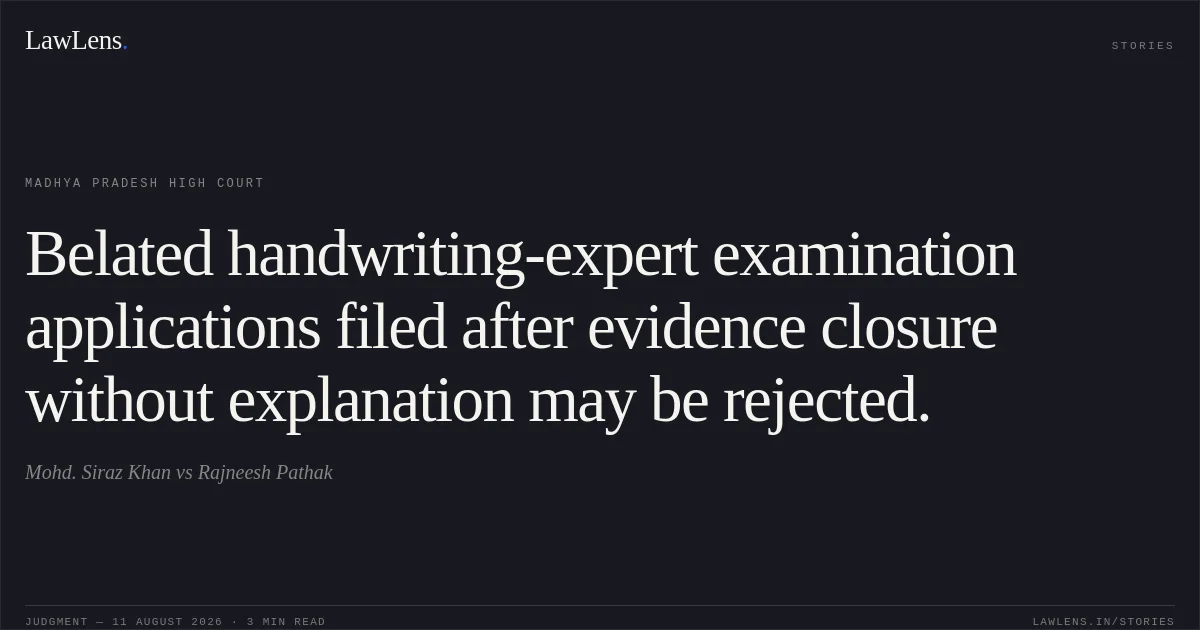
Source reference: para. 7An application for expert examination filed after closure of evidence, without a satisfactory explanation for the delay, may be rejected where it appears designed to delay the proceedings.
Source reference: paras. 6–8Inherent jurisdiction is limited and cannot be used to substitute the discretionary orders of subordinate courts unless they disclose patent illegality, perversity, jurisdictional error, or manifest miscarriage of justice.
Source reference: paras. 8–9Reasoning
The Court noted that the petitioner had been aware from the outset of his defence that the cheque had been misused and that he disputed the writings and signature upon it.
Source reference: paras. 5–7Despite having several opportunities—during the complainant’s evidence, at the stage of his Section 313 statement, and during his own evidence—he did not seek expert examination until after the evidence had concluded and the matter had reached final arguments.
Source reference: paras. 5–7The petitioner offered no satisfactory explanation for this delay. Accordingly, the Trial Court was justified in treating the application as belated and potentially intended to prolong the trial, and the Revisional Court properly affirmed that conclusion.
Source reference: paras. 6–8The mere assertion that the signature near the corrected date was forged did not create an automatic right to expert examination at any stage of the proceedings.
Source reference: para. 9Since the subordinate courts had given cogent reasons and no perversity, illegality, or material irregularity was shown, interference under Section 528 BNSS was unwarranted.
Source reference: paras. 8–10Holding
The High Court answered the issues against the petitioner.
It held that the application for handwriting/forensic examination was filed after an unexplained and substantial delay, following closure of evidence, and was therefore rightly rejected.
Source reference: para. 10The orders dated 20.03.2023 of the JMFC, Budhar, and 16.05.2025 of the Additional Sessions Judge, Budhar, were upheld as free from jurisdictional error or perversity.
Source reference: para. 10The petition under Section 528 BNSS was consequently dismissed.
Source reference: para. 11Acts & Sections Cited
4 provisions across 3 statutes referred to in this judgment. Each provision opens on LawLens.
Bharatiya Nagarik Suraksha Sanhita, 20231
Code of Criminal Procedure, 19732
Negotiable Instruments Act, 18811
Original Court PDF
Mohd. Siraz KhanvsRajneesh Pathak
Click to open original judgment
Original judgment, available to read, download and summarize on LawLens.in