Facts
The petitioner was promoted as Zonal Officer on 29 April 1998 in the pay scale of Rs. 1,640–2,900, although the applicable pay scale for the post was stated to be Rs. 8,000–13,500.
Source reference: para. 2In 2010, the post of Zonal Officer was redesignated as Assistant Commissioner, a post carrying the same pay scale of Rs. 8,000–13,500 under the applicable set-up.
Source reference: paras. 3, 8The petitioner retired in 2016 and filed the present writ petition in 2017 seeking arrears, pay fixation, consequential benefits, and revised pension.
Source reference: para. 5The respondents opposed the petition principally on the ground of delay and laches, contending that the original cause of action arose in 1998.
Source reference: para. 6Issues
Whether the petitioner was entitled to the pay scale of Rs. 8,000–13,500 upon redesignation of his post as Assistant Commissioner in 2010 and until his promotion as Deputy Commissioner in 2012?
Source reference: paras. 8–12Whether the petitioner’s belated claim for arrears and consequential monetary benefits was barred by delay, laches, and the limitation principles applicable to salary claims?
Source reference: paras. 13–25Whether, notwithstanding the bar against arrears, the petitioner could be granted notional pay fixation for recalculation of pensionary benefits?
Source reference: paras. 16–17, 25–27Law Applied
The Court applied the discretionary and equitable principles governing delay and laches under Article 226 of the Constitution, holding that although the Limitation Act does not directly prescribe a limitation period for writ petitions, its public-policy principles may be applied by constitutional courts.
Source reference: para. 13Article 7 of the Schedule to the Limitation Act, 1963, prescribing three years for recovery of wages from the date they become due, was treated as the relevant benchmark for salary arrears.
Source reference: para. 15Relying on State of Orissa v. Mamata Mohanty, (2011) 3 SCC 436, the Court recognised that incorrect pay fixation may constitute a recurring cause of action, but held that arrears for an earlier period may nevertheless be denied for unexplained delay.
Source reference: para. 13Under M.R. Gupta v. Union of India, (1995) 5 SCC 628, an employee may seek correction of an ongoing wrongful pay fixation, but arrears remain subject to limitation and laches.
Source reference: para. 16The Court further relied on Karnataka Power Corporation Ltd. v. K. Thangappan, (2006) 4 SCC 322, Shiv Dass v. Union of India, (2007) 9 SCC 274, U.P. Jal Nigam v. Jaswant Singh, (2006) 11 SCC 464, and NDMC v. Pan Singh, (2007) 9 SCC 278, for the principles that unexplained delay, acquiescence, and prejudice to the opposite party may disentitle a claimant to relief, and that representations do not ordinarily explain prolonged delay.
Source reference: paras. 18, 20, 22, 24Reasoning
The Court found that the petitioner’s post had been redesignated as Assistant Commissioner in 2010 and that the applicable set-up prescribed the pay scale of Rs. 8,000–13,500 for that post.
Source reference: paras. 8–11Since the petitioner worked as Assistant Commissioner from 2010 until his promotion as Deputy Commissioner in 2012, the Court accepted that his claim for proper pay fixation during that period had substance, particularly because the respondents had not filed a substantive reply to the petitioner’s entitlement and the Corporation had earlier recommended the higher scale.
Source reference: paras. 10–12However, the petitioner approached the Court only after retirement and after a prolonged delay dating back to the original appointment as Zonal Officer in 1998 and redesignation in 2010.
Source reference: paras. 5–6Applying the principles governing recurring salary claims, the Court distinguished between correction of pay fixation and recovery of stale arrears.
Source reference: paras. 16–17, 24–25Since the petitioner had already retired, there was no future salary liability to be corrected, and the claim for arrears extending beyond the permissible period was held to be barred by limitation principles and laches.
Source reference: paras. 16–17, 24–25Nevertheless, the Court considered notional fixation appropriate for determining pensionary benefits, as that relief did not involve direct recovery of time-barred salary arrears.
Source reference: para. 25Holding
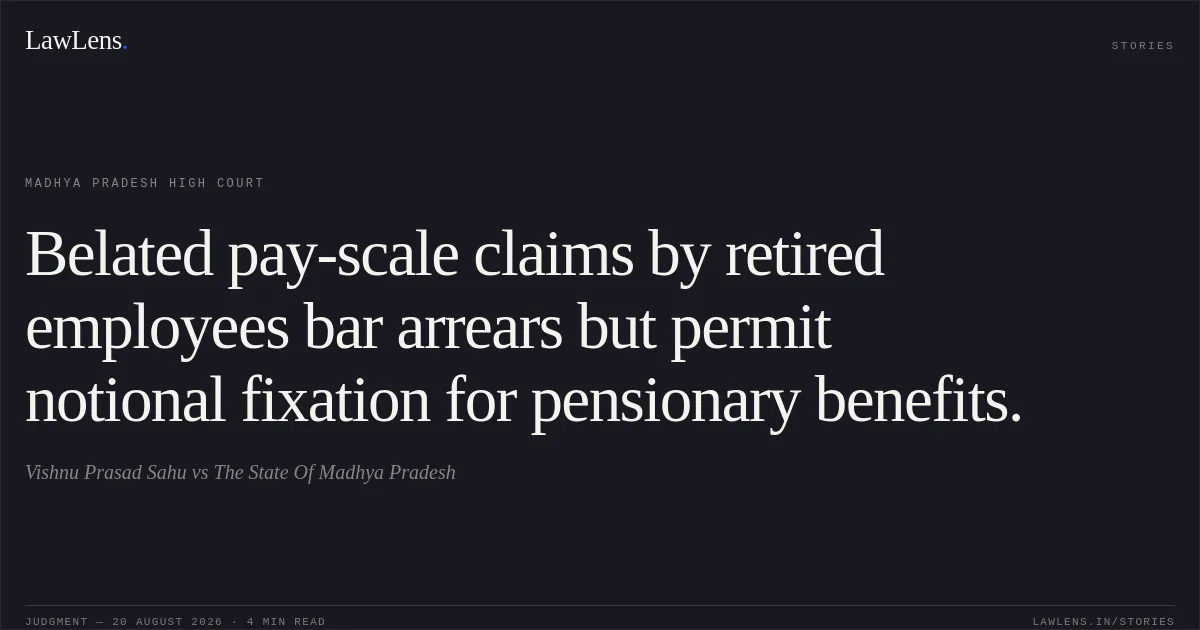
The Court held that the petitioner’s claim for arrears of the difference in pay scale was barred by delay, laches, and the applicable three-year limitation principle.
However, the Court permitted consideration of notional pay fixation for pensionary purposes.
Source reference: para. 26The petition was disposed of with a direction to the petitioner to submit a detailed representation to the competent State authority within 15 days, in light of the earlier recommendations and the Court’s observations.
Source reference: para. 26The competent authority was directed to decide the representation within two months of receiving the certified copy of the order.
Source reference: para. 27The Court clarified that only notional fixation for pension benefits was to be considered; the claim for arrears of the difference in pay scale was rejected as time-barred and affected by delay and laches.
Source reference: paras. 27–28Original Court PDF
Vishnu Prasad SahuvsThe State Of Madhya Pradesh
Click to open original judgment
Original judgment, available to read, download and summarize on LawLens.in